Review
. 2020 Jun;43(6):363-372.
doi: 10.1016/j.tins.2020.03.009. Epub 2020 Apr 21.

Noisy Synaptic Conductance: Bug or a Feature?

Affiliations
Review

Noisy Synaptic Conductance: Bug or a Feature?

Dmitri A Rusakov et al. Trends Neurosci. 2020 Jun.

Abstract

More often than not, action potentials fail to trigger neurotransmitter release. And even when neurotransmitter is released, the resulting change in synaptic conductance is highly variable. Given the energetic cost of generating and propagating action potentials, and the importance of information transmission across synapses, this seems both wasteful and inefficient. However, synaptic noise arising from variable transmission can improve, in certain restricted conditions, information transmission. Under broader conditions, it can improve information transmission per release, a quantity that is relevant given the energetic constraints on computing in the brain. Here we discuss the role, both positive and negative, synaptic noise plays in information transmission and computation in the brain.

Keywords: information transfer; optimal synapse; synaptic noise.


Figures

Figure 1
Figure 1
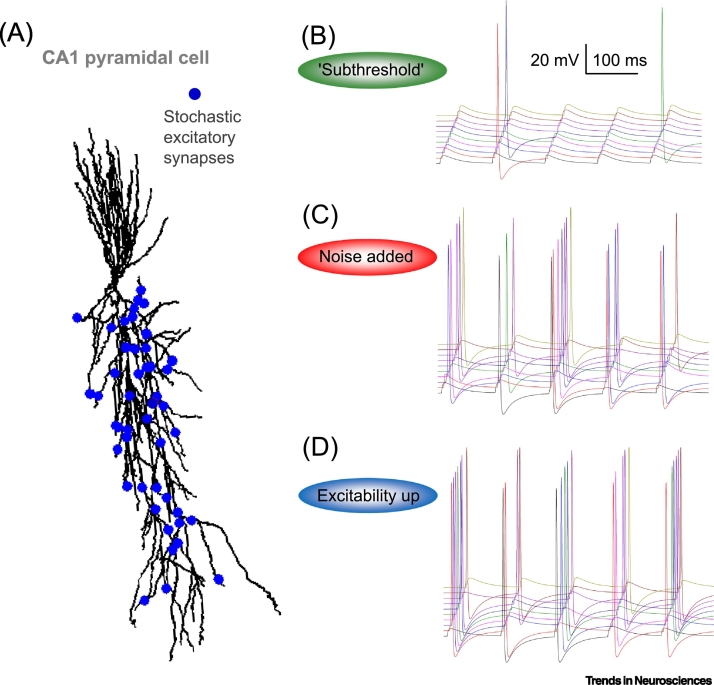
Increasing Synaptic Input Noise or Postsynaptic Cell Excitability Can Improve Signal Transfer: An Illustrative Example. (A) A basic multisynaptic neuron model: reconstructed CA1 pyramidal cell model equipped with known membrane mechanisms [57] (ModelDB accession number 2796, NEURON database). Fifty excitatory inputs (random scatter, blue dots) generate biexponential conductance change (rise and decay time, 0.1 ms and 1.2 ms, respectively), with the same onset but stochastically, in accord with their release probability, Pr; simulations with NEURON 7.2 [58], variable time step dt, t = 34°C. (B) Somatic voltage traces in response to synchronous activation of 50 unreliable synapses (Pr = 0.5), five stimuli at 10 Hz, no noise (conductance coefficient of variation, CV = 0), 'near-subthreshold' activation (peak synaptic conductance Gs = 7.6 pS; somatic sodium channel conductance GNa = 0.032 mS/cm2). (C) As in (B) but with synaptic conductance noise (CV = 0.05) leading to increased spiking. (D) As in (B) but with cell excitability increased (somatic sodium channel conductance doubled to GNa = 0.064 mS/cm2). A fully functional model example and illustrative movie files can be downloaded from http://www.sciencebox.org/Neuroalgebra/TINSWeb/
Figure I
Figure I
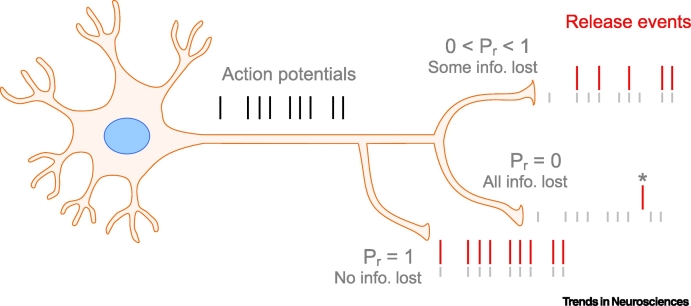
Schematic Illustrating the Mutual Information between a Series of Axonal Spikes and the Corresponding Series of Neurotransmitter Release. This schematic illustrates the mutual information, I, between a series of axonal spikes (black bars; indicated with grey on the postsynaptic side) and the corresponding series of neurotransmitter release (red bars). Note: this is different from the mutual information between the input and output because release does not guarantee an output spike. Information depends on the release probability, Pr, at each presynaptic site. The asterisk indicates spontaneous (action potential-independent) release.
Figure 2
Figure 2
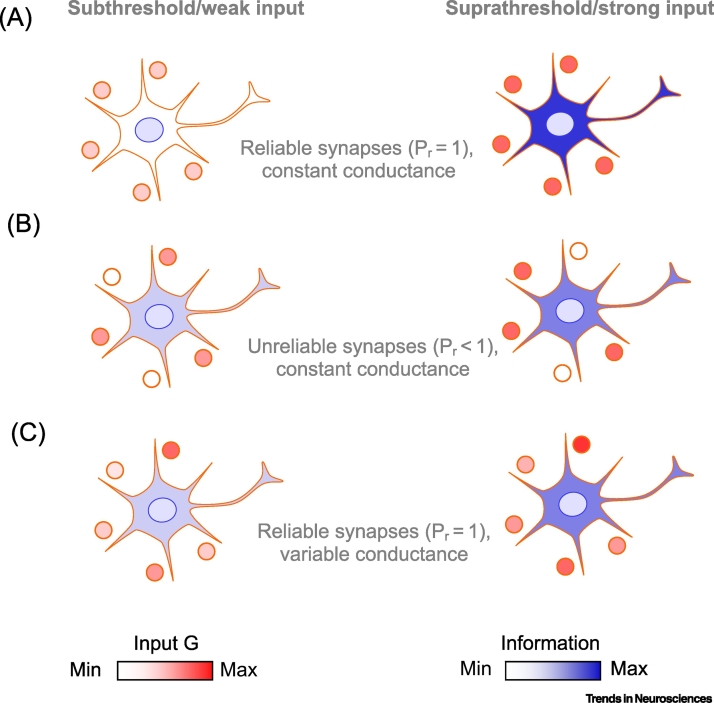
Noisy Synapses Can Be Informationally Advantageous towards the Lower End of the Transmission Dynamic Range. Synaptic inputs are shown by circles, with the intensity of red reflecting their activity. The amount of spiking activity is indicated by the shade of blue, with higher probability of spiking (darker blue) corresponding to higher information rates. (A) Reliable synapses (Pr = 1) and no variability in postsynaptic conductance. If the threshold is too high there are no spikes (left), but if the threshold is lowered slightly, spike transmission is 100% reliable (right). (B) Unreliable synapses (Pr < 1) and no variability in postsynaptic conductance, but conductance is proportional to 1/Pr (to conserve the transmitter expenditure). In this case, postsynaptic spiking is possible under weak input, thus transmitting some information (left). However, under strong input, unreliable synapses lose information [right; compare with (A)]. (C) Reliable synapses (Pr = 1), but with variability in postsynaptic conductance. Information transmission is about the same as with unreliable synapses with variability in postsynaptic conductance [compare with (B)].
Figure I
Figure I
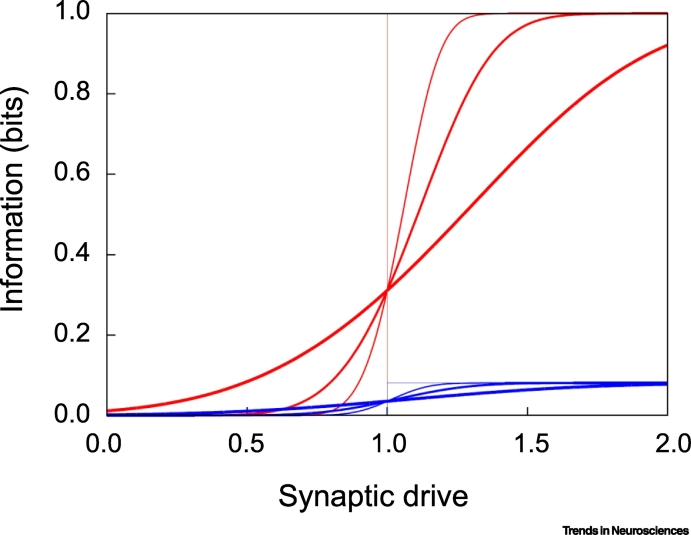
Information (in Bits) Versus Synaptic Drive, μ. Red: the probability of a presynaptic spike, p, is 0.5, corresponding to an effective presynaptic firing rate of 50 Hz, assuming a time bin of 10 ms. Blue: the probability of a presynaptic spike is 0.01, corresponding to an effective presynaptic firing rate of 1 Hz. Noise levels, σ, are 0.0, 0.1, 0.2, and 0.5 (thin to thick lines). The threshold, θ, was set to 1.0.

References

    1. Tarr T.B. Are unreliable release mechanisms conserved from NMJ to CNS? Trends Neurosci. 2013;36:14–22. - PMC - PubMed
    1. Stein R.B. Neuronal variability: noise or part of the signal? Nat. Rev. Neurosci. 2005;6:389–397. - PubMed
    1. McDonnell M.D., Ward L.M. The benefits of noise in neural systems: bridging theory and experiment. Nat. Rev. Neurosci. 2011;12:415–426. - PubMed
    1. Faisal A.A. Noise in the nervous system. Nat. Rev. Neurosci. 2008;9:292–303. - PMC - PubMed
    1. Edwards P.J., Murray A.F. Analog synaptic noise – implications and learning improvements. Int. J. Neural Syst. 1993;4:427–433. - PubMed

Publication types

Substances