. 2020 May 27;12(1):65.
doi: 10.1186/s13195-020-00628-z.

APOE ε4 genotype-dependent cerebrospinal fluid proteomic signatures in Alzheimer's disease

Affiliations

APOE ε4 genotype-dependent cerebrospinal fluid proteomic signatures in Alzheimer's disease

Elles Konijnenberg et al. Alzheimers Res Ther. .

Abstract

Background: Aggregation of amyloid β into plaques in the brain is one of the earliest pathological events in Alzheimer's disease (AD). The exact pathophysiology leading to dementia is still uncertain, but the apolipoprotein E (APOE) ε4 genotype plays a major role. We aimed to identify the molecular pathways associated with amyloid β aggregation using cerebrospinal fluid (CSF) proteomics and to study the potential modifying effects of APOE ε4 genotype.

Methods: We tested 243 proteins and protein fragments in CSF comparing 193 subjects with AD across the cognitive spectrum (65% APOE ε4 carriers, average age 75 ± 7 years) against 60 controls with normal CSF amyloid β, normal cognition, and no APOE ε4 allele (average age 75 ± 6 years).

Results: One hundred twenty-nine proteins (53%) were associated with aggregated amyloid β. APOE ε4 carriers with AD showed altered concentrations of proteins involved in the complement pathway and glycolysis when cognition was normal and lower concentrations of proteins involved in synapse structure and function when cognitive impairment was moderately severe. APOE ε4 non-carriers with AD showed lower expression of proteins involved in synapse structure and function when cognition was normal and lower concentrations of proteins that were associated with complement and other inflammatory processes when cognitive impairment was mild. Repeating analyses for 114 proteins that were available in an independent EMIF-AD MBD dataset (n = 275) showed that 80% of the proteins showed group differences in a similar direction, but overall, 28% effects reached statistical significance (ranging between 6 and 87% depending on the disease stage and genotype), suggesting variable reproducibility.

Conclusions: These results imply that AD pathophysiology depends on APOE genotype and that treatment for AD may need to be tailored according to APOE genotype and severity of the cognitive impairment.

Keywords: APOE genotype; Amyloid aggregation; CSF proteomics.


Conflict of interest statement

All authors report no potential conflict of interest with the content of this paper.

Figures
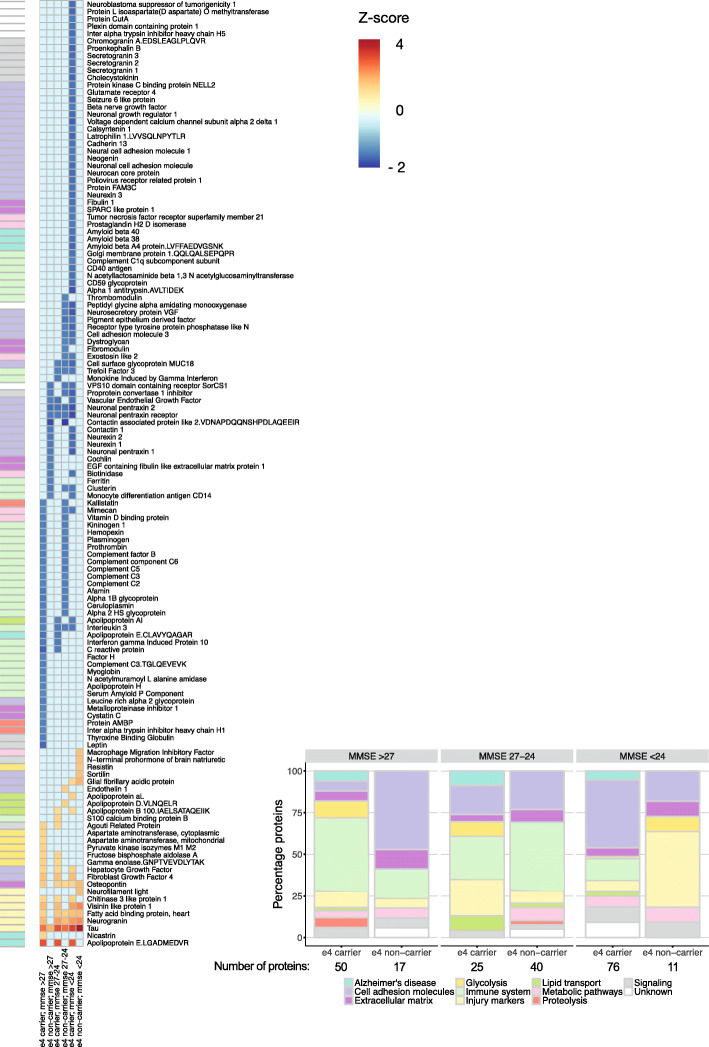
Fig. 1
Fig. 1
Left, heatmap of proteins associated with amyloid pathology. Columns indicate APOE ε4 carriers and non-carriers with AD according to the severity of their cognitive impairment (MMSE > 27, 27–24, or < 24). Color scale indicates the Z value of proteins showing a significant difference (p < .05) compared with the control group (APOE ε4 non-carriers with normal amyloid and MMSE > 27). Proteins are expressed as Z-scores using the control group as a reference and plotted when showing a significant difference (p < .05). Light blue indicates non-significance (p > .05). Right, the percentage of proteins associated with one of the 11 biological process categories. Percentages were calculated with disease stage-specific total numbers of proteins associated with abnormal amyloid, and the number of proteins is given below each disease stage. Please see supplementary table 3 for a detailed description of biological processes enriched
Fig. 2
Fig. 2
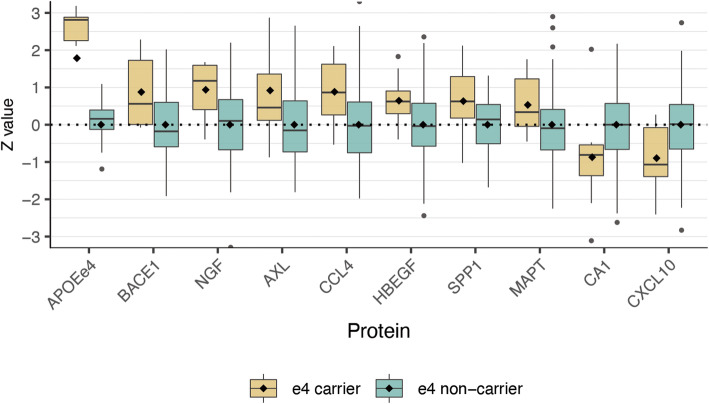
Proteins associated with APOE ε4 carrier status in subjects with normal amyloid. Z-scores are plotted for proteins that were different between subjects with APOE ε4 (in brown) and normal amyloid and normal cognition (MMSE > 27) compared to the control group (i.e., in blue). All values are standardized according to the control group (i.e., APOE ε4 non-carriers with normal amyloid and MMSE > 27)
Fig. 3
Fig. 3
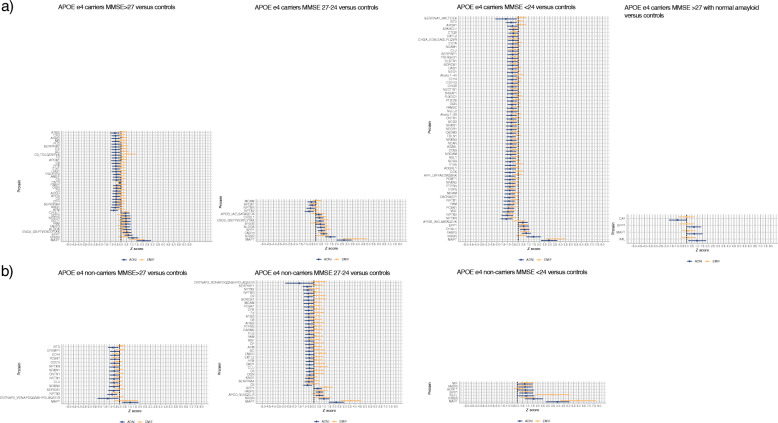
Effect size plots for 114 proteins measured in both ADNI and EMIF-AD MBD studies. a Effects for protein differences of individuals with abnormal amyloid carrying and ≥ 1 APOE ε4 allele against controls (i.e., APOE ε4 non-carriers with normal amyloid and MMSE > 27) according to the severity of their cognitive impairment (MMSE > 27, 27–24, or < 24), and at the far left for APOE ε4 carriers with normal amyloid and MMSE > 27. In blue, effect sizes and 95%CI for ADNI; in orange, for EMIF-AD MBD. b Effects for protein differences of individuals with abnormal amyloid carrying without an APOE ε4 allele against controls (i.e., APOE ε4 non-carriers with normal amyloid and MMSE > 27) according to the severity of their cognitive impairment (MMSE > 27, 27–24, or < 24). In blue, effect sizes and 95%CI for ADNI; in orange, for EMIF-AD MBD

References

    1. Jack CR, Jr, Wiste HJ, Weigand SD, Rocca WA. Age-specific population frequencies of cerebral β-amyloidosis and neurodegeneration among people with normal cognitive function aged 50–89 years: a cross-sectional study. Lancet Neurol. 2014;14:997–1005. - PMC - PubMed
    1. Bateman RJ, et al. Clinical and biomarker changes in dominantly inherited Alzheimer’s disease. N Engl Med. 2012;367:795–804. - PMC - PubMed
    1. Jansen WJ, et al. Prevalence of cerebral amyloid pathology in persons without dementia. JAMA. 2015;313:1924. - PMC - PubMed
    1. Corder EH, et al. Gene dose of apolipoprotein E type 4 allele and the risk of Alzheimer’s disease in late onset families. Science. 1993;261:921–923. - PubMed
    1. Rohn T. Proteolytic cleavage of apolipoprotein E4 as the keystone for the heightened risk associated with Alzheimer’s disease. IJMS. 2013;14:14908–14922. - PMC - PubMed

Publication types