


Efficacy of whole body vibration therapy on pain and functional ability in people with non-specific low back pain: a systematic review
- PMID: 32460819
- PMCID: PMC7251707
- DOI: 10.1186/s12906-020-02948-x
Efficacy of whole body vibration therapy on pain and functional ability in people with non-specific low back pain: a systematic review
Abstract
Background: Whole body vibration (WBV) is currently increasing in popularity as a treatment modality for musculoskeletal disorders and improving health-related quality of life. Recent research has shown that WBV can reduce low back pain and improve the functional abilities for patients, however, optimal frequency and duration of vibration for therapeutic use is unclear. This review was conducted to summarize and determine the efficacy of whole body vibration therapy on individuals with non-specific low back pain (NLBP) and evaluated methodological quality of the included studies.
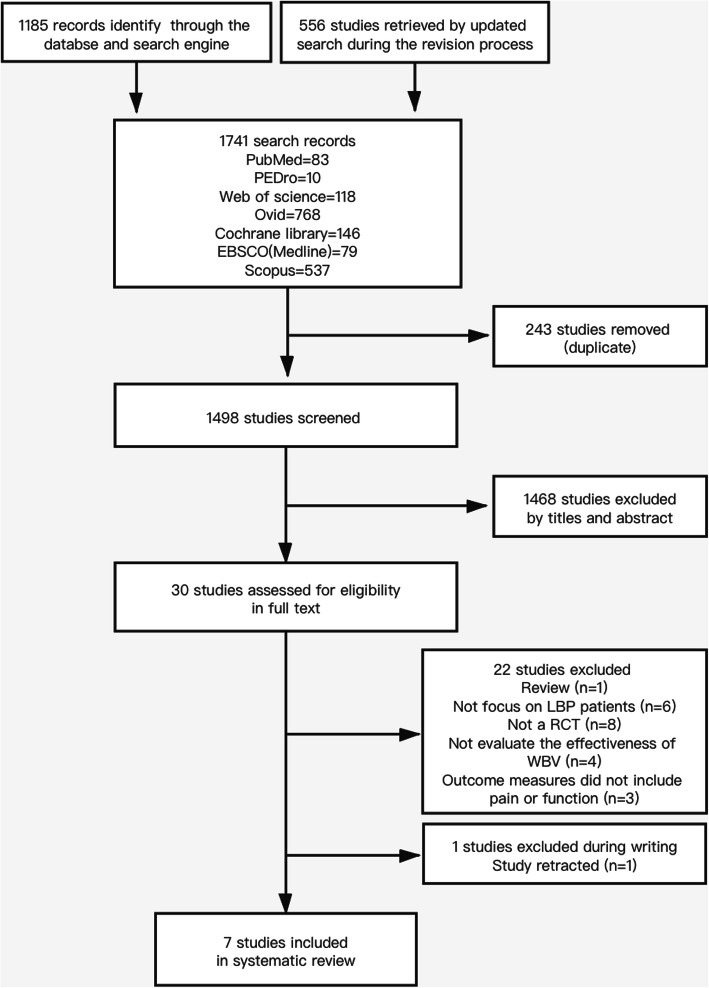
Methods: Online literature searches through the Web of Science, PubMed, Cochrane Library databases, PEDro, Ovid, EBSCO (Medline) and Scopus were conducted up to December 2019. Randomized controlled trials investigating the effect of WBV on pain intensity and/or functional ability in individuals with non-specific low back pain (NLBP) were included. Details of the sample characteristics, treatment of the comparison group, WBV parameters and outcome measures were recorded, and methodological quality appraised using the PEDro scale.
Results: 7 published RCTs (418 patients) were included in the systematic review. Due to heterogeneity in vibration parameters and prescriptions, and small number of studies, no meta-analysis was performed. Four out of the six included studies using pain as an outcome measure showed that WBV had a beneficial effect on pain compared with the control group, whereas only two trials were considered to be of high methodological quality. Among the six studies which measured functional ability, three studies with good quality reported significant between-group differences in favor of WBV.
Conclusions: There is limited evidence suggests that WBV is beneficial for NLBP when compared with other forms of interventions (stability training, classic physiotherapy, routine daily activity). Due to the small sample sizes and statistical heterogeneity, we still cannot draw conclusions that WBV is an effective intervention. Further high-quality studies are needed before clinical recommendations can be provided to support its use in a general population with NLBP and to explore the optimal treatment protocol.
Trial registration: PROSPERO registration number: CRD42017074775.
Keywords: Low back pain; Physical therapy modalities; Vibration.
Conflict of interest statement
The authors declare that they have no competing interests.
References
-
- Update on 2004 Background Paper, BP 6.24 Low back pain. Geneva: World Health Organization 2013. [https://www.who.int/medicines/areas/priority_medicines/BP6_24LBP.pdf]. Accessed 14 May 2020.
-
- Global Burden of Disease Study 2013 Collaborators Global, regional, and national incidence, prevalence, and years lived with disability for 301 acute and chronic diseases and injuries in 188 countries, 1990-2013: a systematic analysis for the global burden of disease study 2013. Lancet. 2015;386(9995):743–800. doi: 10.1016/S0140-6736(15)60692-4. - DOI - PMC - PubMed
-
- Airaksinen O, Brox JI, Cedraschi C, Hildebrandt J, Klaber-Moffett J, Kovacs F, Mannion AF, Reis S, Staal JB, Ursin H, et al. Chapter 4. European guidelines for the management of chronic nonspecific low back pain. Eur Spine J. 2006;15 Suppl 2:S192–S300. doi: 10.1007/s00586-006-1072-1. - DOI - PMC - PubMed
-
- Cole MH, Grimshaw PN. Low back pain and lifting: a review of epidemiology and aetiology. Work. 2003;21(2):173–184. - PubMed
Publication types
MeSH terms
Grants and funding
LinkOut - more resources
Full Text Sources
Medical
