


The hepatoprotective and antioxidative effect of saffron stigma alcoholic extract against vincristine sulfate induced toxicity in rats
- PMID: 32461722
- PMCID: PMC7247369
- DOI: 10.2478/intox-2019-0023
The hepatoprotective and antioxidative effect of saffron stigma alcoholic extract against vincristine sulfate induced toxicity in rats
Abstract
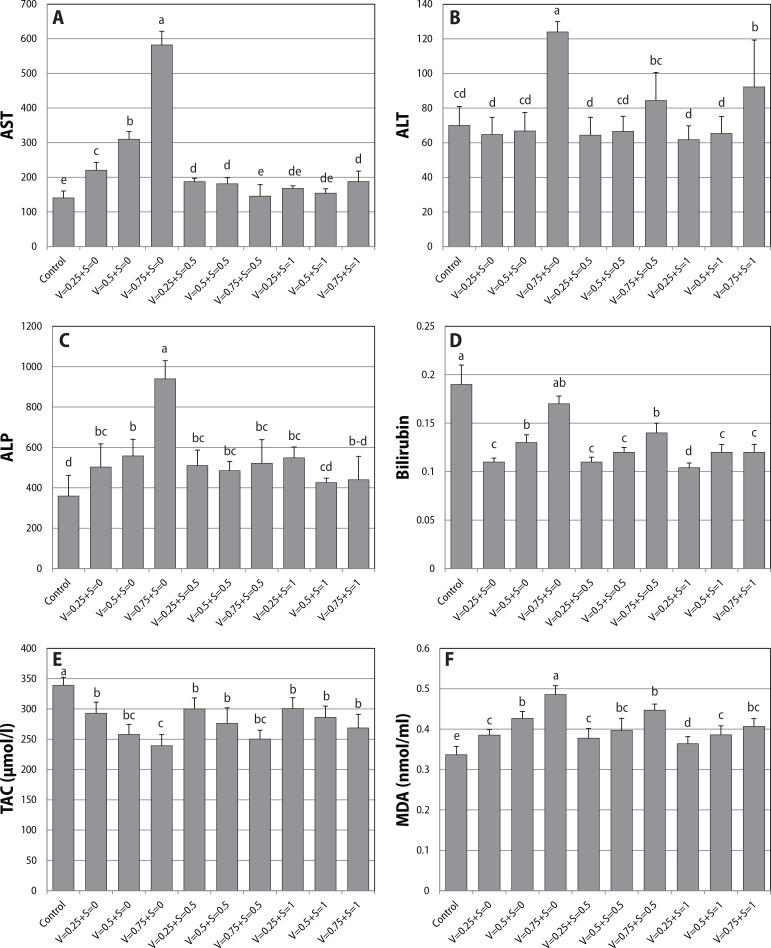
Vincristine (VCR) is an important anti-cancer drug, which is highly toxic for the liver. This study aimed at evaluating the protective effect of alcoholic extract of saffron stigma against vincristine hepatotoxicity in the rat. A total number of 50 rats were randomly divided into 10 groups, including controls, rats receiving 0.25 mg/kg (A group), 0.5 mg/kg (B group), 0.75 mg/kg (C group) VCR, 0.25 mg/kg VCR + 0.5 mg/kg saffron (D group), 0.5 mg/kg VCR + 0.5 mg/kg saffron (E group), 0.75 mg/kg VCR + 0.5 mg/kg saffron (F group), 0.25 mg/kg VCR + 1mg/kg saffron (G group), 0.5 mg/kg VCR + 1 mg/kg saffron (H group), and 0.75 mg/kg VCR + 1 mg/kg saffron (I group) groups. Serum level of liver enzymes, including aspartate transaminase (AST), alanine transaminase (ALT), alkaline phosphatase (ALP), and bilirubin were measured using specific kits at the end of the experimental period. Serum total antioxidant capacity (TAC) and malondialdehyde (MDA) values were measured using ferric reducing antioxidant of power (FRAP) and thiobarbituric acid reaction (TBAR) methods, respectively. Administration of VCR, especially at the concentration of 0.75mg/kg, caused severe hepatic injury with significant increase in the levels of AST (582.0±39.45 UI), ALT (124.0±5.92 UI), ALP (939.8±89.8 UI) enzymes and bilirubin (0.17±0.008). VCR administration also significantly increased the serum MDA level (0.49±0.021 nmol/ml), while TAC value was declined significantly (241.27±18.27 μmol/l). These effects were dose-dependent. Treatment with saffron extract decreased the activity of liver enzymes and MDA values in hepatotoxic rats with a significant enhancement in serum TAC content. These effects were notable for rats that received 1mg/kg plant extract. Administration of saffron, especially at higher concentration, can reduce VCR-induced hepatotoxicity, antioxidant depletion and lipid peroxidation, presumably due to its antioxidative properties.
Keywords: hepatotoxicity; liver enzymes; oxidative stress; saffron; vincristine.
Copyright © 2019 SETOX & Institute of Experimental Pharmacology and Toxicology, SASc.
Figures
References
-
- Amin A, Hamza AA, Daoud S, Khazanehdari K, Hrout AA, Baig B, Chaiboonchoe A, Adrian TE, Zaki N, Salehi-Ashtiani K. Saffron-Based Crocin Prevents Early Lesions of Liver Cancer: In vivo, In vitro and Network Analyses. Recent Pat Anticancer Drug Discov. 2016;11:121–133. - PubMed
-
- Assimopoulou AN, Sinakos Z, Papageorgiou VP. Radical scavenging activity of Crocus sativus L. extract and its bioactive constituents. Phytother Res. 2005;19:997–1000. - PubMed
-
- Ben Salem I, Boussabbeh M, Kantaoui H, Bacha H, Abid-Essefi S. Crocin, the main active saffron constituent, mitigates dichlorvos-induced oxidative stress and apoptosis in HCT-116 cells. Biomed Pharmacother. 2016;82:65–71. - PubMed
-
- Benzie IF, Strain JJ. The ferric reducing ability of plasma (FRAP) as a measure of “antioxidant power”: the FRAP assay. Anal Biochem. 1996;239:70–76. - PubMed
-
- Berger F, Hensel A, Nieber K. Saffron extract and trans-crocetin inhibit glutamatergic synaptic transmission in rat cortical brain slices. Neuroscience. 2011;180:238–247. - PubMed
LinkOut - more resources
Full Text Sources
Miscellaneous