


Mapping non-response in a prevention program for cardiometabolic diseases in primary care: How to improve participation?
- PMID: 32461878
- PMCID: PMC7240717
- DOI: 10.1016/j.pmedr.2020.101092
Mapping non-response in a prevention program for cardiometabolic diseases in primary care: How to improve participation?
Abstract
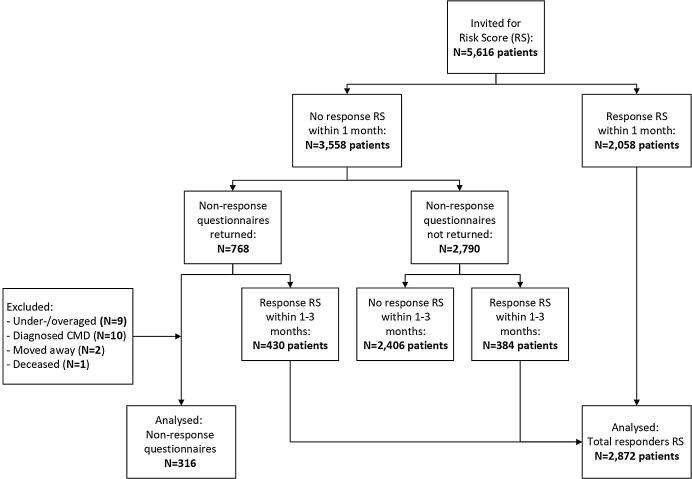
Non-response in prevention programs for cardiometabolic diseases (CMD) in primary care is often overlooked. The aim for this study was to define factors that influence the primary response to a selective CMD prevention program and to determine response-enhancing strategies that influence the willingness to participate. We conducted a non-response analysis within a randomized controlled trial evaluating a selective CMD prevention program, the study was conducted from 2013 to 2018 in Netherlands. A random sample of 5616 patients from 15 general practices were invited to complete a risk score (RS) as initial step of the program. Non-responders received an additional questionnaire. The response on the risk score was 51% (n = 2872). From the 3558 non-response questionnaires sent, 786 (22%) were returned. In a multivariable multilevel regression analysis smoking was independently associated with non-response. Of all reported reasons for non-response 'forgot/no time' accounted for 45%. In total, 73% of the non-responders indicated to reconsider participation when approached differently. A personal approach by the patients' own GP, using advertisements and informative campaigns are potentially the best methods to enhance the response. Although a relatively high proportion did not respond to the invitation for the risk score, the majority of them indicated to be willing to participate if a different invitation strategy would be used. With more time and energy, response rates for CMD prevention programs could possibly increase substantially. A next logical step in this process is to test potential response enhancing strategies in research setting.
Keywords: BMI, Body mass index; CMD, Cardiometabolic diseases; CVD, Cardiovascular disease; Cardiovascular Diseases; Health Risk Behaviors; Primary Prevention; RS, risk score; Refusal to Participate; Risk Assessment; Risk Factors.
© 2020 The Authors.
Conflict of interest statement
The authors declare that they have no known competing financial interests or personal relationships that could have appeared to influence the work reported in this paper.
Figures
References
-
- Badenbroek I.F., Stol D.M., Nielen M.M., Hollander M., Kraaijenhagen R.A., De Wit G.A., Schellevis F.G., De Wit N.J. Design of the INTEGRATE study: Effectiveness and cost-effectiveness of a cardiometabolic risk assessment and treatment program integrated in primary care. BMC Fam. Pract. 2014;15:1–10. doi: 10.1186/1471-2296-15-90. - DOI - PMC - PubMed
-
- Barrett-connor, M.H.C.E., Austin, M., 1978. Differences between respondents and non-respondents in a population-based cardiovascular disease study 108. - PubMed
-
- Brannstrom I., Lindblad I.-B. Mass communication and health promotion: the power of the media and public opinion. Health Commun. 1994;6:21–36. doi: 10.1207/s15327027hc0601_2. - DOI
LinkOut - more resources
Full Text Sources
