


Pharmacological inhibition of sodium-proton-exchanger subtype 3-mediated sodium absorption in the gut reduces atrial fibrillation susceptibility in obese spontaneously hypertensive rats
- PMID: 32462076
- PMCID: PMC7243186
- DOI: 10.1016/j.ijcha.2020.100534
Pharmacological inhibition of sodium-proton-exchanger subtype 3-mediated sodium absorption in the gut reduces atrial fibrillation susceptibility in obese spontaneously hypertensive rats
Abstract
Background: Increased sodium uptake has been shown to contribute to hypertension and cardiac end-organ damage. The sodium-proton-exchanger subtype 3 (NHE3) is an important mediator of intestinal sodium absorption. Whether a reduction in intestinal sodium absorption can prevent the development of an atrial arrhythmogenic substrate in hypertension is unknown.
Methods: Eight-week-old obese spontaneously hypertensive rats (SHR-ob) were treated for six weeks with the gut-specific NHE3-inhibitor SAR (1-(β-D-glucopyranosyl)-3-{3-[(4S)-6,8-dichloro-2-methyl-1,2,3,4-tetrahydroiso-chinolin-4-yl]phenyl}urea, 1 mg/kg/d in chow, SHR-ob SAR, n = 7) and compared to aged-matched placebo-treated SHR-ob (SHR-ob PLAC, n = 8). Cardiac magnetic resonance imaging was performed at the end of the treatment period to assess atrial emptying function. Afterwards, local conduction disturbances and inducible atrial fibrillation (AF) duration were determined and histological analysis to quantify atrial fibrosis amount were performed.
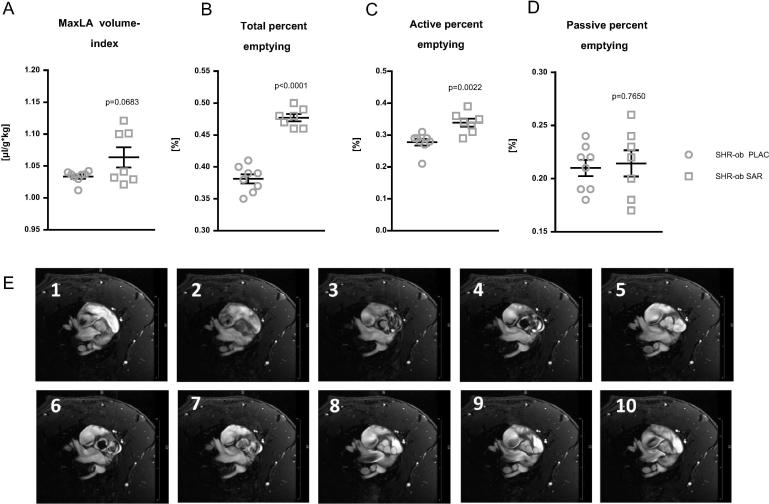
Results: Inhibition of intestinal NHE3 by SAR increased fecal sodium excretion, resulted in marked changes in feces electrolyte concentrations and water content, reduced blood pressure and preserved atrial emptying function (active total percent emptying: SHR-ob SAR: 0.47 ± 0.05% vs. SHR-ob PLAC: 0.38 ± 0.007, p < 0.0001). Atrial fibrosis content was lower (21.4 ± 2.5% vs. 36.7 ± 1.2%, p < 0.0001) and areas of slow conduction were smaller (2.5 ± 0.09% vs. 5.3 ± 0.2%, p < 0.0001) in SHR-ob SAR compared to SHR-ob PLAC. Left atrial burst stimulation resulted in shorter inducible AF-durations in SHR-ob SAR compared to SHR-ob PLAC.
Conclusions: Reduction of intestinal sodium absorption and subsequent changes in feces milieu by pharmacological NHE3 inhibition in the gut preserved atrial emptying function and reduced AF susceptibility. Whether pharmacological NHE3 inhibition in the gut prevents AF in humans warrants further study.
Keywords: Atrial fibrillation; Intestinal sodium absorption; Salt; Sodium-proton-exchanger Subtype 3 (NHE 3).
© 2020 The Authors. Published by Elsevier B.V.
Conflict of interest statement
The authors declare that they have no known competing financial interests or personal relationships that could have appeared to influence the work reported in this paper.
Figures


References
-
- Mente A., O'Donnell M., Rangarajan S., McQueen M., Dagenais G., Wielgosz A., Lear S., Ah S.T.L., Wei L., Diaz R., Avezum A., Lopez-Jaramillo P., Lanas F., Mony P., Szuba A., Iqbal R., Yusuf R., Mohammadifard N., Khatib R., Yusoff K., Ismail N., Gulec S., Rosengren A., Yusufali A., Kruger L., Tsolekile L.P., Chifamba J., Dans A., Alhabib K.F., Yeates K., Teo K., Yusuf S. Urinary sodium excretion, blood pressure, cardiovascular disease, and mortality: a community-level prospective epidemiological cohort study. Lancet. 2018;392(10146):496–506. - PubMed
-
- O'Donnell M., Mente A., Rangarajan S., McQueen M.J., Wang X., Liu L., Yan H., Lee S.F., Mony P., Devanath A., Rosengren A., Lopez-Jaramillo P., Diaz R., Avezum A., Lanas F., Yusoff K., Iqbal R., Ilow R., Mohammadifard N., Gulec S., Yusufali A.H., Kruger L., Yusuf R., Chifamba J., Kabali C., Dagenais G., Lear S.A., Teo K., Yusuf S., Investigators P. Urinary sodium and potassium excretion, mortality, and cardiovascular events. New England J. Med. 2014;371(7):612–623. - PubMed
-
- Nishida C., Uauy R., Kumanyika S., Shetty P. The joint WHO/FAO expert consultation on diet, nutrition and the prevention of chronic diseases: process, product and policy implications. Public Health Nutr. 2004;7(1A):245–250. - PubMed
-
- Ponikowski P., Voors A.A., Anker S.D., Bueno H., Cleland J.G.F., Coats A.J.S., Falk V., Gonzalez-Juanatey J.R., Harjola V.P., Jankowska E.A., Jessup M., Linde C., Nihoyannopoulos P., Parissis J.T., Pieske B., Riley J.P., Rosano G.M.C., Ruilope L.M., Ruschitzka F., Rutten F.H., van der Meer P., E.S.C.S.D. Group 2016 ESC Guidelines for the diagnosis and treatment of acute and chronic heart failure: The Task Force for the diagnosis and treatment of acute and chronic heart failure of the European Society of Cardiology (ESC)Developed with the special contribution of the Heart Failure Association (HFA) of the ESC. Eur. Heart J. 2016;37(27):2129–2200. - PubMed
-
- Williams B., Mancia G., Spiering W., Agabiti Rosei E., Azizi M., Burnier M., Clement D.L., Coca A., de Simone G., Dominiczak A., Kahan T., Mahfoud F., Redon J., Ruilope L., Zanchetti A., Kerins M., Kjeldsen S.E., Kreutz R., Laurent S., Lip G.Y.H., McManus R., Narkiewicz K., Ruschitzka F., Schmieder R.E., Shlyakhto E., Tsioufis C., Aboyans V., Desormais I., E.S.C.S.D. Group 2018 ESC/ESH Guidelines for the management of arterial hypertension. Eur. Heart. J. 2018:71–159. doi: 10.5603/KP.2019.0018. - DOI
LinkOut - more resources
Full Text Sources
Miscellaneous
