


Tissue regulatory T cells
- PMID: 32463116
- PMCID: PMC7450170
- DOI: 10.1111/imm.13208
Tissue regulatory T cells
Abstract
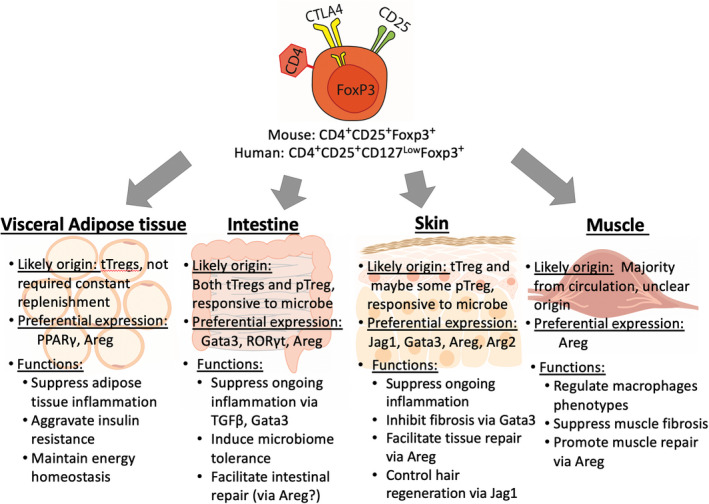
Foxp3+ CD4+ regulatory T cells (Tregs) are an immune cell lineage endowed with immunosuppressive functionality in a wide array of contexts, including both anti-pathogenic and anti-self responses. In the past decades, our understanding of the functional diversity of circulating or lymphoid Tregs has grown exponentially. Only recently, the importance of Tregs residing within non-lymphoid tissues, such as visceral adipose tissue, muscle, skin and intestine, has been recognized. Not only are Tregs critical for influencing the kinetics and strength of immune responses, but the regulation of non-immune or parenchymal cells, also fall within the purview of tissue-resident or infiltrating Tregs. This review focuses on providing a systematic and comprehensive comparison of the molecular maintenance, local adaptation and functional specializations of Treg populations operating within different tissues.
Keywords: inflammation; regulatory T cells; tissue regulatory T cells; tissue repair.
© 2020 The Authors. Immunology published by John Wiley & Sons Ltd.
Conflict of interest statement
The authors have no competing interests to declare.
Figures
References
-
- Gershon RK, Cohen P, Hencin R, Liebhaber SA. Suppressor T cells. J Immunol 1972; 108:586–90. - PubMed
-
- Rammensee HG, Nagy ZA, Klein J. Suppression of cell‐mediated lymphocytotoxicity against minor histocompatibility antigens mediated by Lyt‐1+Lyt–2+ T cells of stimulator‐strain origin. Eur J Immunol 1982; 12:930–4. - PubMed
-
- Baxevanis CN, Ishii N, Nagy ZA, Klein J. Role of the Ek molecule in the generation of suppressor T cells in response to LDHB. Scand J Immunol 1982; 16:25–31. - PubMed
-
- Sakaguchi S, Wing K, Miyara M. Regulatory T cells – a brief history and perspective. Eur J Immunol 2007; 37(Suppl 1):S116–23. - PubMed
Publication types
MeSH terms
Grants and funding
LinkOut - more resources
Full Text Sources
Research Materials
Miscellaneous
