


Epidemiological Trend of Sepsis in Patients with Hospital Admissions Related to Hepatitis C in Spain (2000-2015): A Nationwide Study
- PMID: 32466412
- PMCID: PMC7355745
- DOI: 10.3390/jcm9061607
Epidemiological Trend of Sepsis in Patients with Hospital Admissions Related to Hepatitis C in Spain (2000-2015): A Nationwide Study
Abstract
Background: Hepatitis C virus (HCV) infection predisposes patients to other infectious diseases, such as sepsis. We aimed to analyze epidemiological trends of sepsis-related admissions, deaths, and costs in hospital admissions with chronic hepatitis C who had a hospital admission in Spain.
Methods: We performed a retrospective study of all hospitalizations involving chronic hepatitis C in the Spanish Minimum Basic Data Set (MBDS) between 2000 and 2015. This period was divided into four calendar periods (2000-2004, 2005-2007, 2008-2011, and 2012-2015).
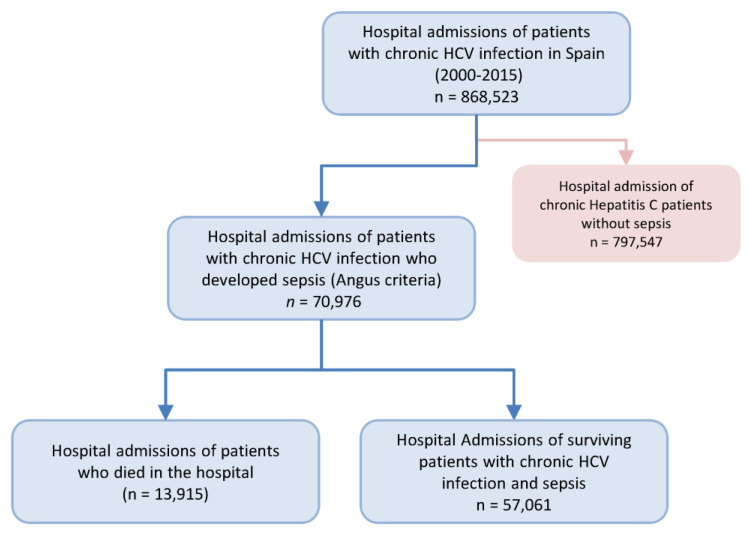
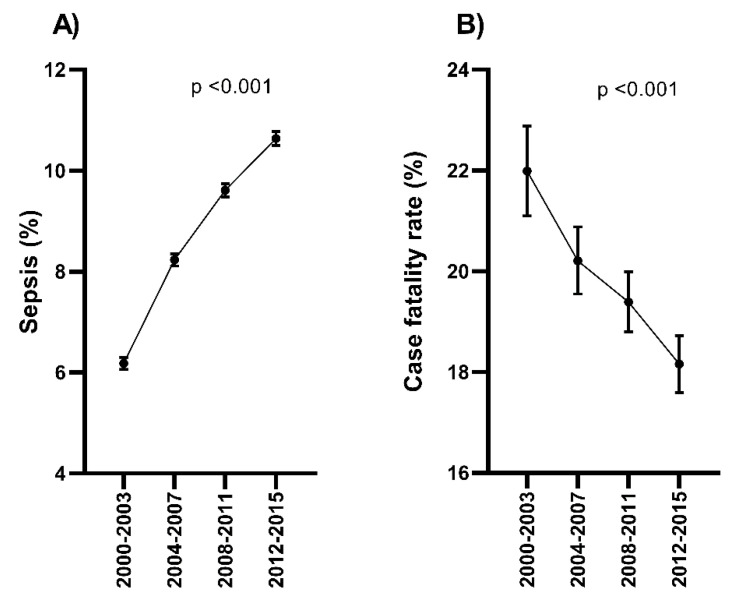
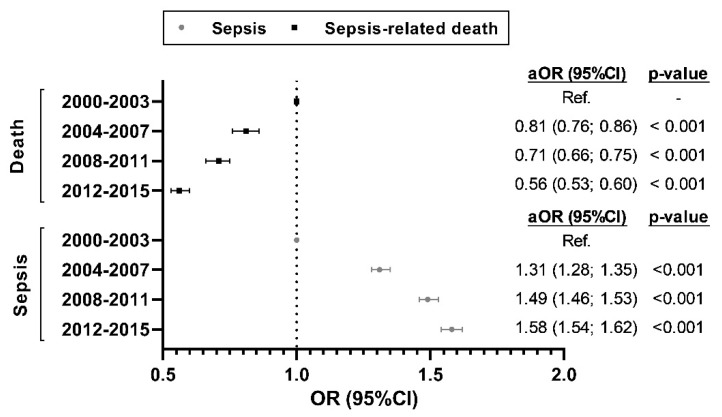
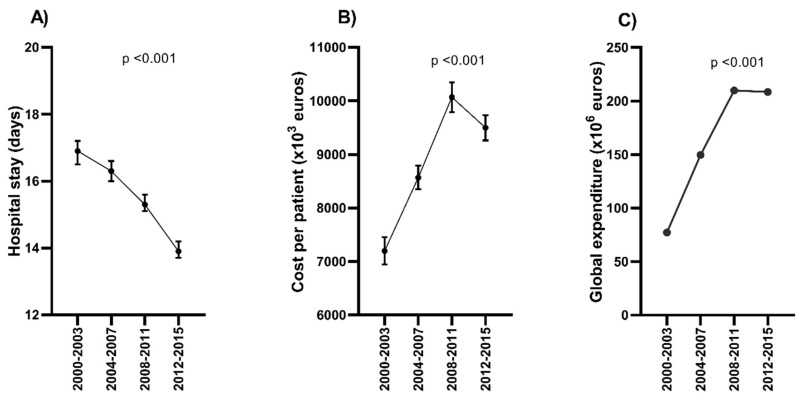
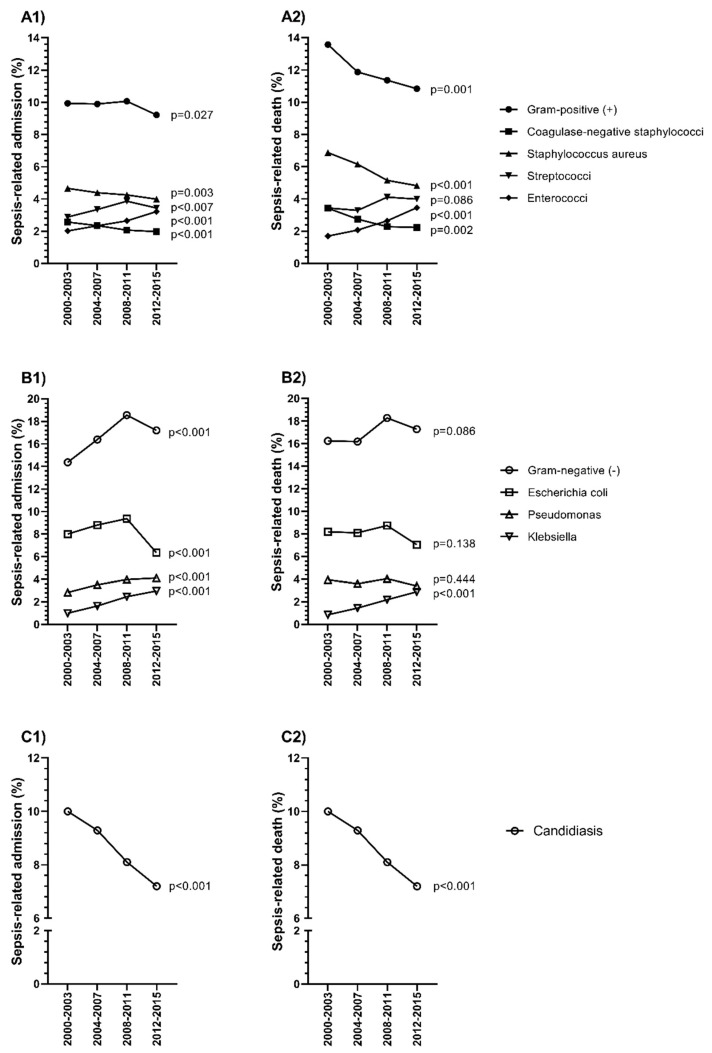
Results: We selected 868,523 hospital admissions of patients with chronic hepatitis C over 16 years in the Spanish MBDS. Among them, we found 70,976 (8.17%) hospital admissions of patients who developed sepsis, of which 13,915 (19.61%) died during admission. We found an upward trend, from 2000-2003 to 2012-2015, in the rate of sepsis-related admission (from 6.18% to 10.64%; p < 0.001), the risk of sepsis-related admission (from 1.31 to 1.55; p < 0.001), and the sepsis-related cost per hospital admission (from 7198€ to above 9497€; p < 0.001). However, we found a downward trend during the same study period in the sepsis case-fatality rate (from 21.99% to 18.16%; p < 0.001), the risk of sepsis-related death (from 0.81 to 0.56; p < 0.001), and the length of hospital stay (LOHS) (from 16.9 to 13.9; p < 0.001). Moreover, the rate of bacterial Gram-positive and candidiasis infections decreased, while Gram-negative microorganisms increased from 2000-2003 to 2012-2015.
Conclusions: Sepsis, in chronic hepatitis C patients admitted to the hospital, has increased the period 2000-2015 and has been an increasing burden for the Spanish public health system. However, there has also been a significant reduction in lethality and LOHS during the study period. In addition, the most prevalent specific microorganisms have also changed in this period.
Keywords: epidemiology; hepatitis C; hospital admission; hospital resources; mortality; sepsis.
Conflict of interest statement
The authors declare no conflict of interest.
Figures
References
-
- World Health Organization Global Hepatitis Report. [(accessed on 10 December 2018)];2017 Available online: http://apps.who.int/iris/bitstream/handle/10665/255016/9789241565455-eng....
-
- Chen Q., Ayer T., Bethea E., Kanwal F., Wang X., Roberts M., Zhuo Y., Fagiuoli S., Petersen J., Chhatwal J. Changes in hepatitis C burden and treatment trends in Europe during the era of direct-acting antivirals: A modelling study. BMJ Open. 2019;9:e026726. doi: 10.1136/bmjopen-2018-026726. - DOI - PMC - PubMed
-
- Grupo de Trabajo Del Estudio De Prevalencia De La Infección Por Hepatitis C En Población General En España 2017–2018 Resultados Del Segundo Estudio De Seroprevalencia En Espanña (2017–2018) [(accessed on 31 March 2020)]; Available online: https://www.mscbs.gob.es/ciudadanos/enfLesiones/enfTransmisibles/sida/do....
Grants and funding
LinkOut - more resources
Full Text Sources
