. 2020 May 26;12(6):1353.
doi: 10.3390/cancers12061353.

Non-Anticoagulant Heparan Sulfate from the Ascidian Phallusia nigra Prevents Colon Carcinoma Metastasis in Mice by Disrupting Platelet-Tumor Cell Interaction

Affiliations

Non-Anticoagulant Heparan Sulfate from the Ascidian Phallusia nigra Prevents Colon Carcinoma Metastasis in Mice by Disrupting Platelet-Tumor Cell Interaction

Christiane F S Silva et al. Cancers (Basel). .

Abstract

Although metastasis is the primary cause of death in patients with malignant solid tumors, efficient anti-metastatic therapies are not clinically available currently. Sulfated glycosaminoglycans from marine sources have shown promising pharmacological effects, acting on different steps of the metastatic process. Oversulfated dermatan sulfates from ascidians are effective in preventing metastasis by inhibition of P-selectin, a platelet surface protein involved in the platelet-tumor cell emboli formation. We report in this work that the heparan sulfate isolated from the viscera of the ascidian Phallusia nigra drastically attenuates metastases of colon carcinoma cells in mice. Our in vitro and in vivo assessments demonstrate that the P. nigra glycan has very low anticoagulant and antithrombotic activities and a reduced hypotension potential, although it efficiently prevented metastasis. Therefore, it may be a promising candidate for the development of a novel anti-metastatic drug.

Keywords: circulating tumor cells; circulating tumor microemboli; glycosaminoglycans; hematogenous metastasis; marine invertebrates; platelets.


Conflict of interest statement

The authors state that they have no conflict of interests.

Figures
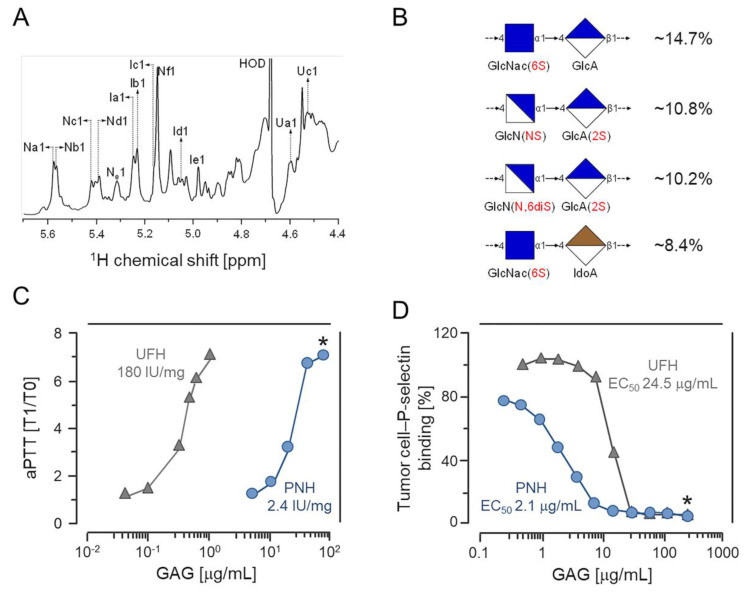
Figure 1
Figure 1
Chemical composition, anticoagulant activity and P-selectin binding blockage by the heparan sulfate from Phallusia nigra (PNH). (A) 1H NMR spectrum of PNH. For details on the signals annotated in the spectra, check reference [21]. (B) Proportions of PNH major disaccharides components. (C) Anticoagulant activities (expressed as heparin International Units (IU/mg) of PNH (blue circles) and heparin (gray triangles) determined by aPTT clotting assays. (D) Doses (EC50) of PNH and heparin necessary to inhibit adhesion of LS180 colon carcinoma cells to P-selectin immobilized onto microplate wells. This experiment was repeated and is similar to the one shown in reference [21]. * (p < 0.05). Modified (A,C) or similar (D) to reference [21].
Figure 2
Figure 2
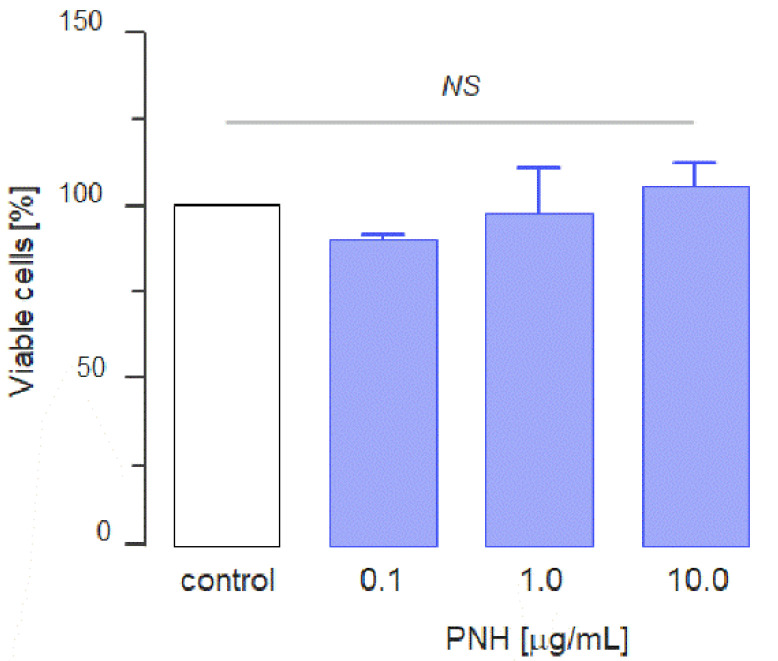
Cytotoxic effect of P. nigra heparan sulfate (PNH). 2 × 10⁴ MC-38 cells were cultured in the presence of different concentrations of PNH for 24 h. MTT was added during the last 2 h and the absorbance was measured at 560 nm. The percentage of viable cells was calculated relative to control. Three independent assays were performed and data were compared by analysis of variance (ANOVA); NS = no significant statistical difference.
Figure 3
Figure 3
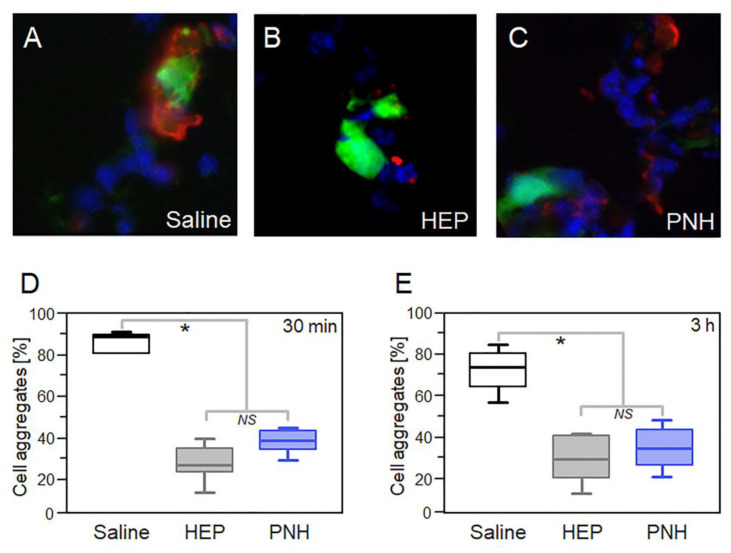
Heparan sulfate from P. nigra (PNH) hinders in vivo platelet-tumor cell aggregation. (A–C) Aggregates of MC-38GFP colon carcinoma cells (in green [GFP] and blue [DAPI]) and platelets (in red [anti-CD41]) formed in the lung microvasculature of mice were analyzed by immunofluorescence. Quantification of aggregates present in the lungs of animals treated during 30 min (D) or 3 h (E) with saline (white squares), 1 mg/kg PNH (blue) or 20 mg/kg porcine heparin (gray). Results were expressed as percentages of aggregated tumor cells (20 fields per lung, three animals per treatment) and compared by analysis of variance (ANOVA); NS (no statistical significance) and * (p < 0.05).
Figure 4
Figure 4
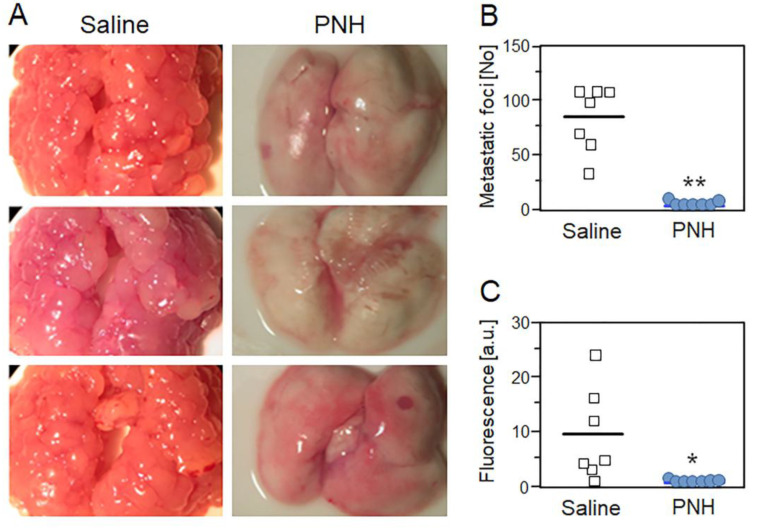
P. nigra heparan sulfate (PNH) prevents lung metastasis of colon carcinoma in mice. Representative images (A), metastatic foci (B) and fluorescence quantification (C) of lung metastases present in mice treated with a single dose of PNH (1 mg/kg; blue circles) or saline (white squares) 15 min before injection of MC-38GFP colon carcinoma cells. Results (seven animals per group) were compared by t-test; * (p < 0.05) and ** (p < 0.001).
Figure 5
Figure 5
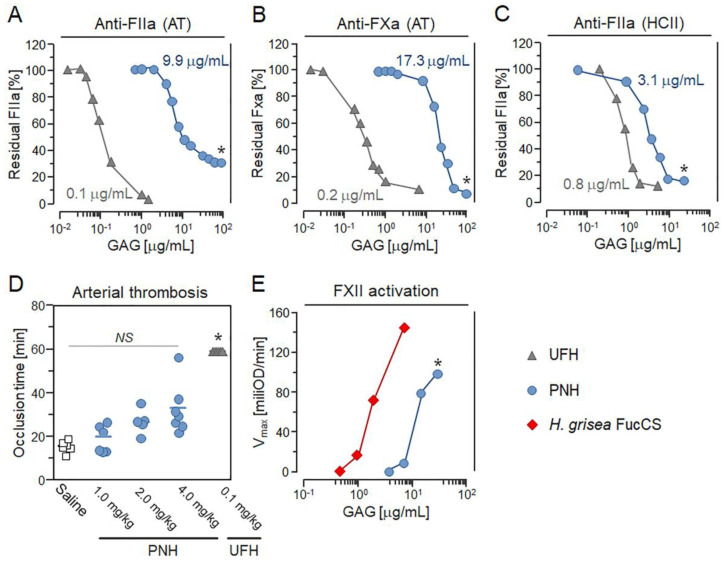
Anticoagulant, antithrombotic and pro-FXIIa activities of the heparan sulfate from P. nigra (PNH). Doses (EC50) of PNH and UFH promoting in vitro AT-mediated anti-FIIa and anti-FXa (A,B) and HCII-mediated anti-FIIa (C) activities. Results expressed as IU/mg and EC50 in panels A–C (means, three independent assays) were compared by t-test. Gray triangles—UFH and blue circles—PNH. (D) Effects of saline (white squares), UFH (0.1 mg/kg) and crescent doses of PNH (1→4 mg/kg) on the thrombus formation in arteries of mice. Occlusion times (seven animals per condition) were compared by analysis of variance (ANOVA). (E) FXII activation promoted by PNH (blue circles) and H. grisea FucCS (red diamonds) was estimated by assessing in vitro activation of prekallicrein present in human plasma with basis on the increase in absorbance (405 nm) promoted by the chromogenic substrate for kallikrein; results expressed as optical density/min (mean, three independent assays) were compared by t-test. NS (no statistical significance) and * (p < 0.05).

References

    1. Samatov T.R., Shkurnikov M.U., Tonevitskaya S.A., Tonevitsky A.G. Modelling the metastatic cascade by in vitro microfluidic platforms. Prog. Histochem. Cytochem. 2015;49:21–29. doi: 10.1016/j.proghi.2015.01.001. - DOI - PubMed
    1. Li J., Sharkey C.C., Wun B., Liesveld J.L., King M.R. Genetic engineering of platelets to neutralize circulating tumor cells. J. Control. Release. 2016;228:38–47. doi: 10.1016/j.jconrel.2016.02.036. - DOI - PMC - PubMed
    1. Umer M., Vaidyanathan R., Nguyen N.-T., Shiddiky M.J.A. Circulating tumor microemboli: Progress in molecular understanding and enrichment technologies. Biotechnol. Adv. 2018;36:1367–1389. doi: 10.1016/j.biotechadv.2018.05.002. - DOI - PubMed
    1. Borsig L., Wong R., Feramisco J., Nadeau D.R., Varki N.M., Varki A. Heparin and cancer revisited: Mechanistic connections involving platelets, P-selectin, carcinoma mucins, and tumor metastasis. Proc. Natl. Acad. Sci. USA. 2001;98:3352–3357. doi: 10.1073/pnas.061615598. - DOI - PMC - PubMed
    1. Leone K., Poggiana C., Zamarchi R. The Interplay between Circulating Tumor Cells and the Immune System: From Immune Escape to Cancer Immunotherapy. Diagnostics. 2018;8:59. doi: 10.3390/diagnostics8030059. - DOI - PMC - PubMed

LinkOut - more resources