. 2019 Dec:4:171-181.
doi: 10.3114/fuse.2019.04.09. Epub 2019 Jun 25.

Fusarium volatile, a new potential pathogen from a human respiratory sample

Affiliations

Fusarium volatile, a new potential pathogen from a human respiratory sample

A M S Al-Hatmi et al. Fungal Syst Evol. 2019 Dec.

Abstract

We describe the isolation and characterization of Fusarium volatile from a bronchoalveolar lavage (BAL) sample of a female patient living in French Guiana with underlying pulmonary infections. Phylogenetic analysis of fragments of the calmodulin (cmdA), translation elongation factor (tef1), RNA polymerase second largest subunit (rpb2), and β-tubulin (tub) loci revealed that strain CBS 143874 was closely related to isolate NRRL 25615, a known but undescribed phylogenetic species belonging to the African clade of the Fusarium fujikuroi species complex. The fungus differed phylogenetically and morphologically from related known species, and is therefore described as the new taxon Fusarium volatile. Antifungal susceptibility testing suggested that the new species is resistant to echinocandins, fluconazole, itraconazole with lower MICs against amphotericin B, voriconazole and posaconazole.

Keywords: FFSC; French Guiana; clinical samples; fungal taxonomy; phylogeny.


Figures

Fig. 1.
Fig. 1.
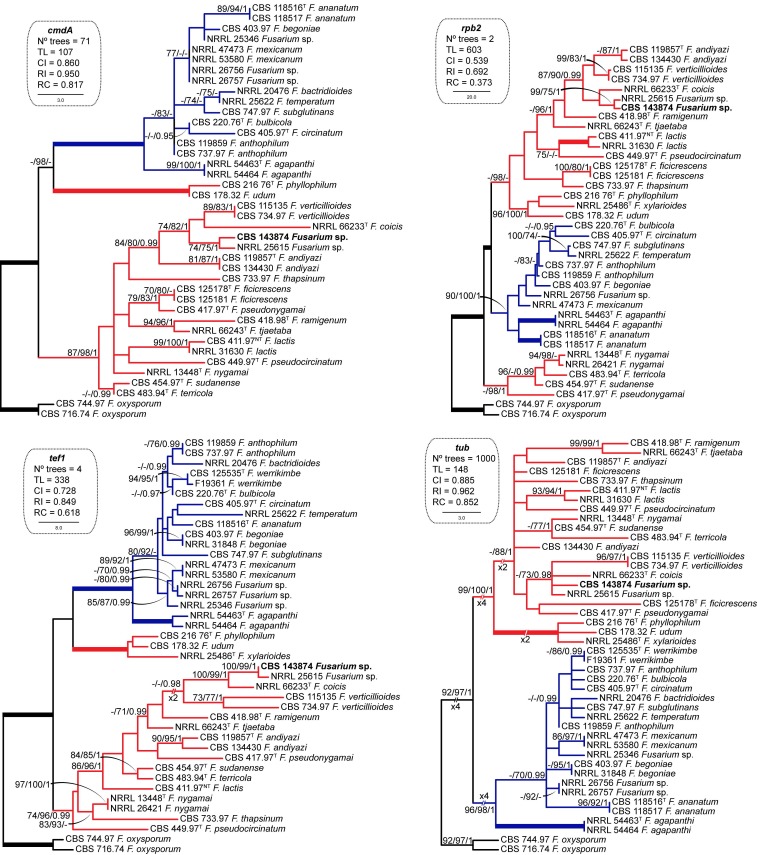
Maximum Parsimony (MP) trees obtained from the individual phylogenetic analyses of the cmdA, rpb2, tef1 and tub datasets of representative isolates of the Fusarium fujikuroi species complex. Numbers on the nodes are MP and Maximum-Likelihood (ML) bootstrap values (BS) above 70 % and Bayesian posterior probability values (PP) above 0.95. Thickened branches indicate full statistical support (MP-BS, ML-BS = 100 % and PP = 1). Coloured branches indicate the African (red) and American (blue) clades according to O’Donnell et al. (1998). The clinical isolate is highlighted in bold. Ex-type and ex-neotype strains are indicated with T and NT, respectively. The trees are rooted with Fusarium oxysporum CBS 744.97 and CBS 716.74. TL = tree length, CI = consistency index, RI = retention index, RC = rescaled consistency index.
Fig. 2.
Fig. 2.
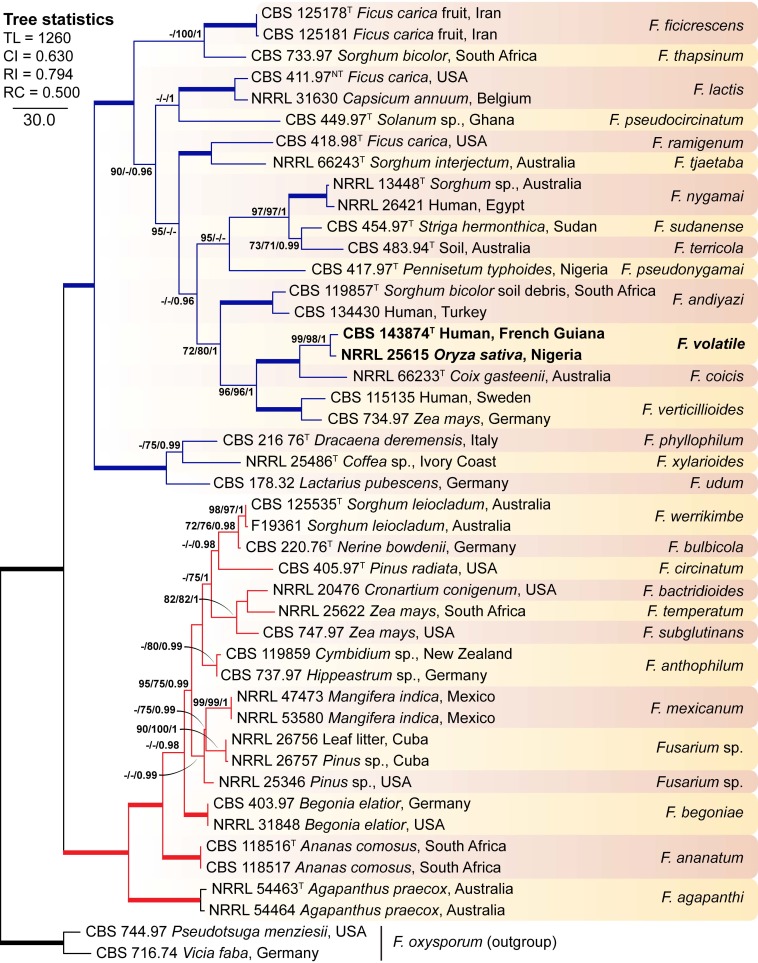
The first of 16 most parsimonious trees obtained from the combined cmdA, rpb2, tef1 and tub sequences of 43 strains belonging to the Fusarium fujikuroi species complex (FFSC). Numbers on the nodes are MP and Maximum-Likelihood (ML) bootstrap values (BS) above 70 % and Bayesian posterior probability values (PP) above 0.95. Thickened branches indicate full statistical support (MP-BS, ML-BS = 100 % and PP = 1). Coloured branches indicate the African (red) and American (blue) clades according to O’Donnell et al. (1998). Isolates and name of the new species are highlighted in bold. Ex-type and ex-neotype strains are indicated with T and NT, respectively. The tree is rooted with Fusarium oxysporum CBS 744.97 and CBS 716.74. TL = tree length, CI = consistency index, RI = retention index, RC = rescaled consistency index.
Fig. 3.
Fig. 3.
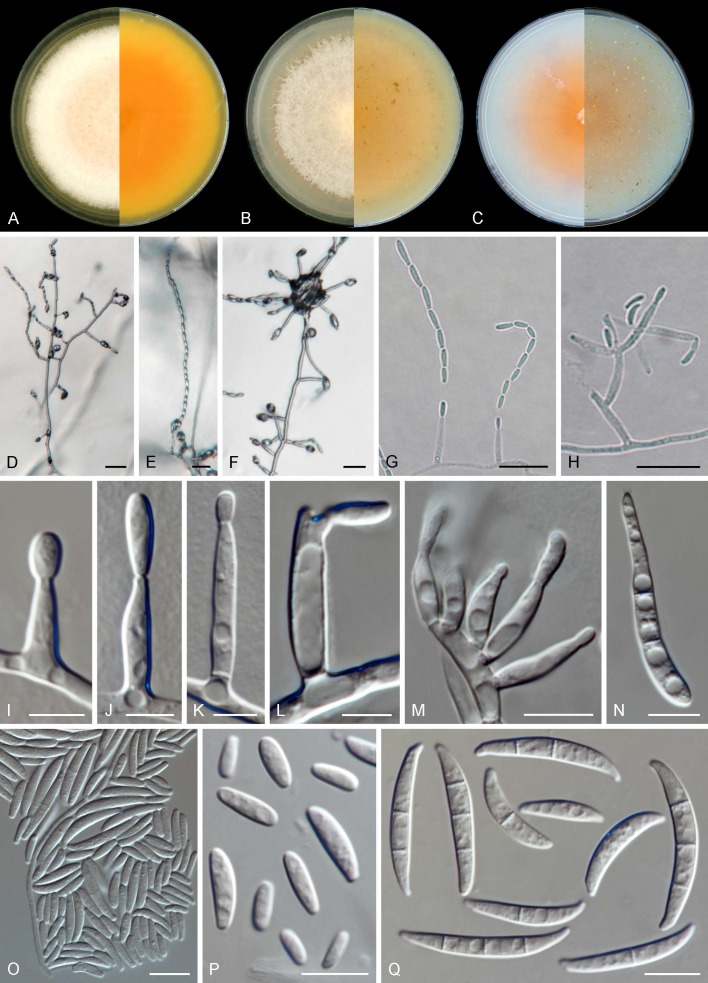
Fusarium volatile (ex-type CBS 143874). A–C. Colonies (left obverse, right reverse) on MEA, PDA and OA, respectively, after 14 d at 24 °C. D–H. Aerial conidiophores and chains of conidia. I–L. Aerial phialides. M. Sporodochial phialides. N. Aerial conidia showing microcyclic conidiation. O, P. Aerial conidia. Q. Sporodochial conidia. Scale bars: D–H = 20 μm, I–L = 5 μm, all others = 10 μm.
Fig. 4.
Fig. 4.
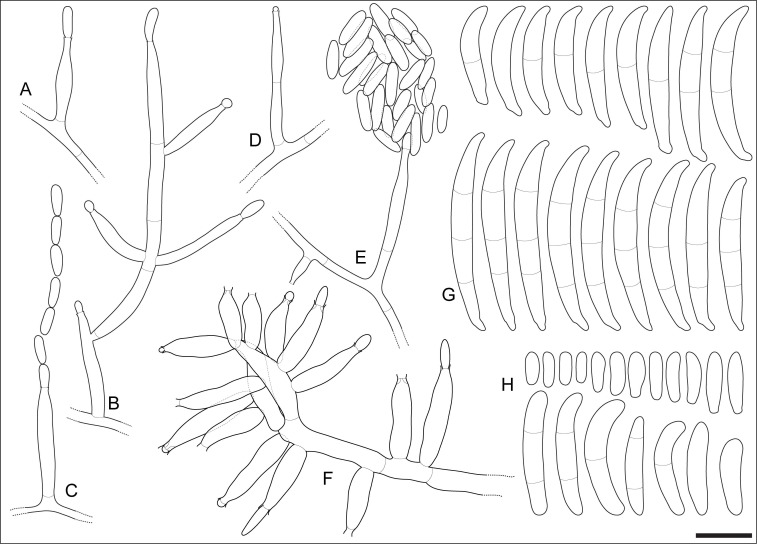
Fusarium volatile (ex-type CBS 143874). A–E. Aerial conidiophores. F. Sporodochial conidiophore. G. Sporodochial conidia. H. Aerial conidia. Scale bar = 10 μm.

References

    1. Al-Hatmi AM, Bonifaz A, Ranque R, et al. (2017). Current antifungal treatment of fusariosis. International Journal of Antimicrobial 51: 326–332. - PubMed
    1. Al-Hatmi AM, van Diepeningen AD, Curfs-Breuker I, et al. (2015). Specific antifungal susceptibility profiles of opportunists in the Fusarium fujikuroi complex. Journal of Antimicrobial Chemotherapy 70: 1068–1071. - PubMed
    1. Al-Hatmi AMS, Hagen F, Menken SBJ, et al. (2016a). Global molecular epidemiology and genetic diversity of Fusarium, a significant emerging human opportunist from 1958-2015. Emerging Microbes and Infections 5: e124. - PMC - PubMed
    1. Al-Hatmi AMS, Meis JF, de Hoog GS. (2016b). Fusarium: molecular diversity and intrinsic drug resistance. PLoS Pathogens 12: e1005464. - PMC - PubMed
    1. Aoki T, Smith JA, Mount LL, et al. (2013). Fusarium torreyae sp. nov., a pathogen causing canker disease of Florida torreya (Torreya taxifolia), a critically endangered conifer restricted to northern Florida and southwestern Georgia. Mycologia 105: 312–319. - PubMed

LinkOut - more resources