


COVID-19 and Asthma: Reflection During the Pandemic
- PMID: 32468411
- PMCID: PMC8830198
- DOI: 10.1007/s12016-020-08797-3
COVID-19 and Asthma: Reflection During the Pandemic
Abstract
Coronavirus disease 2019 (COVID-19) is a global pandemic infectious disease caused by severe acute respiratory syndrome coronavirus-2 (SARS-CoV-2), and abnormal, overactivated innate immunity and "cytokine storms" have been proposed as potential pathological mechanisms for rapid COVID-19 progression. Theoretically, asthmatic patients should have increased susceptibility and severity for SARS-CoV-2 infection due to a deficient antiviral immune response and the tendency for exacerbation elicited by common respiratory viruses. However, existing studies have not shown an expected prevalence of asthmatic individuals among COVID-19 patients. Certain aspects of type 2 immune response, including type 2 cytokines (IL-4, IL-13, etc.) and accumulation of eosinophils, might provide potential protective effects against COVID-19. Furthermore, conventional therapeutics for asthma, including inhaled corticosteroids, allergen immunotherapy (AIT), and anti-IgE monoclonal antibody, might also reduce the risks of asthmatics suffering infection of the virus through alleviating inflammation or enhancing antiviral defense. The interactions between COVID-19 and asthma deserve further attention and clarification.
Keywords: Allergic diseases; Asthma; COVID-19; SARS-CoV-2; Type 2 immune response.
Conflict of interest statement
The authors declare that they have no conflicts of interest.
Figures
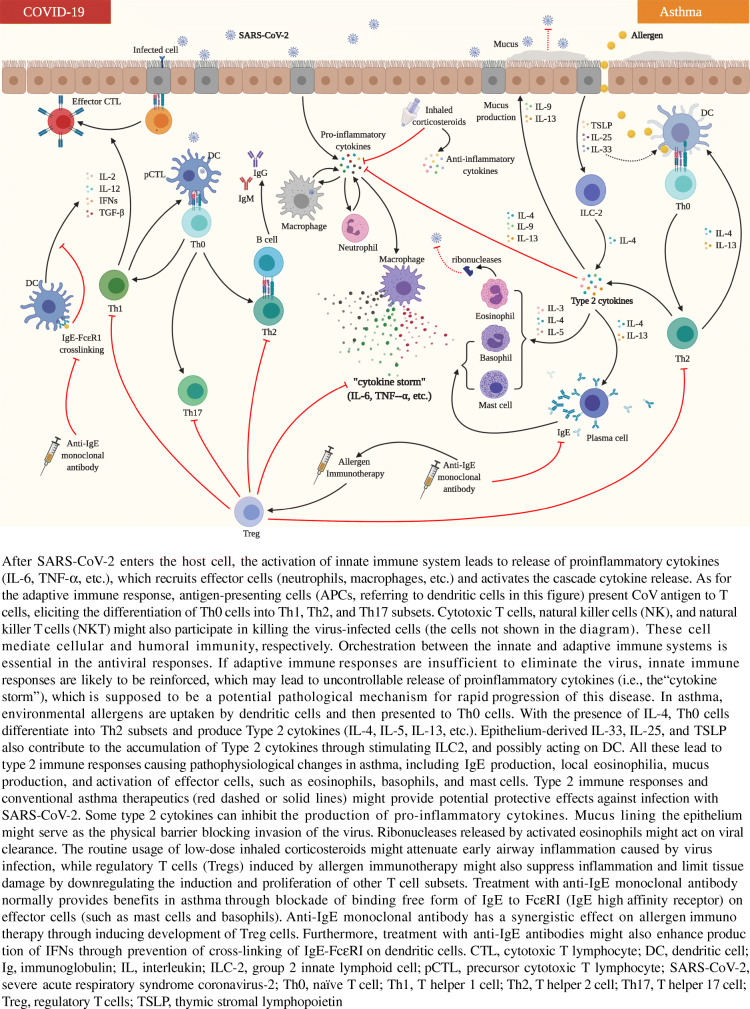
References
-
- Zhou P, Yang XL, Wang XG, Hu B, Zhang L, Zhang W, Si HR, Zhu Y, Li B, Huang CL, Chen HD, Chen J, Luo Y, Guo H, Jiang RD, Liu MQ, Chen Y, Shen XR, Wang X, Zheng XS, Zhao K, Chen QJ, Deng F, Liu LL, Yan B, Zhan FX, Wang YY, Xiao GF, Shi ZL. A pneumonia outbreak associated with a new coronavirus of probable bat origin. Nature. 2020;579(7798):270–273. doi: 10.1038/s41586-020-2012-7. - DOI - PMC - PubMed
-
- Huang C, Wang Y, Li X, Ren L, Zhao J, Hu Y, Zhang L, Fan G, Xu J, Gu X, Cheng Z, Yu T, Xia J, Wei Y, Wu W, Xie X, Yin W, Li H, Liu M, Xiao Y, Gao H, Guo L, Xie J, Wang G, Jiang R, Gao Z, Jin Q, Wang J, Cao B. Clinical features of patients infected with 2019 novel coronavirus in Wuhan, China. Lancet. 2020;395(10223):497–506. doi: 10.1016/s0140-6736(20)30183-5. - DOI - PMC - PubMed
-
- Chen N, Zhou M, Dong X, Qu J, Gong F, Han Y, Qiu Y, Wang J, Liu Y, Wei Y, Xia J, Yu T, Zhang X, Zhang L. Epidemiological and clinical characteristics of 99 cases of 2019 novel coronavirus pneumonia in Wuhan, China: a descriptive study. Lancet. 2020;395(10223):507–513. doi: 10.1016/s0140-6736(20)30211-7. - DOI - PMC - PubMed
Publication types
MeSH terms
Substances
LinkOut - more resources
Full Text Sources
Medical
Miscellaneous
