Review
. 2020 Jul;28 Suppl 1(Suppl 1):S46-S54.
doi: 10.1002/oby.22826. Epub 2020 May 28.

Ticking for Metabolic Health: The Skeletal-Muscle Clocks

Affiliations
Review

Ticking for Metabolic Health: The Skeletal-Muscle Clocks

Miguel A Gutierrez-Monreal et al. Obesity (Silver Spring). 2020 Jul.

Abstract

To be prepared for alternating metabolic demands occurring over the 24-hour day, the body preserves information on time in skeletal muscle, and in all cells, through a circadian-clock mechanism. Skeletal muscle can be considered the largest collection of peripheral clocks in the body, with a major contribution to whole-body energy metabolism. Comparison of circadian-clock gene expression between skeletal muscle of nocturnal rodents and diurnal humans reveals very common patterns based on rest/active cycles rather than light/dark cycles. Rodent studies in which the circadian clock is disrupted in skeletal muscle demonstrate impaired glucose handling and insulin resistance. Experimental circadian misalignment in humans modifies the skeletal-muscle clocks and leads to disturbed energy metabolism and insulin resistance. Preclinical studies have revealed that timing of exercise over the day can influence the beneficial effects of exercise on skeletal-muscle metabolism, and studies suggest similar applicability in humans. Current strategies to improve metabolic health (e.g., exercise) should be reinvestigated in their capability to modify the skeletal-muscle clocks by taking timing of the intervention into account.


Conflict of interest statement

Conflict of interest disclosure: All authors declared no conflicts of interest.

Figures
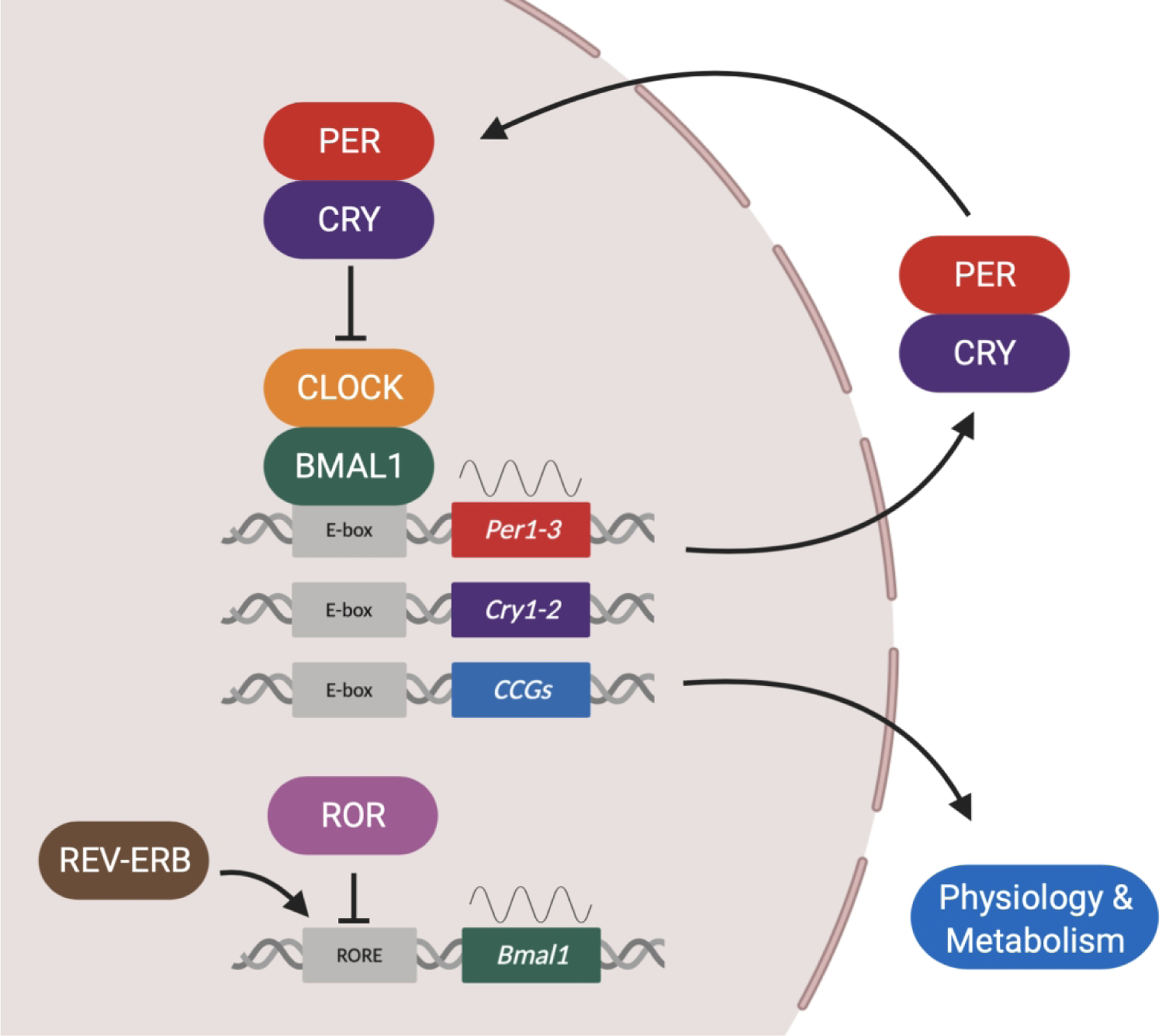
Figure 1.
Figure 1.
The molecular clock generates circadian rhythms through a transcriptional-translational feedback loop (TTFL) mechanism, in which the transcription of Period (Per1, Per2, and Per3) and Cryptochrome (Cry1 and Cry2) genes is activated by the heterocomplex formed by the PAS domain helix-loop-helix transcription factors CLOCK (or its paralogue NPAS2) and BMAL1 (also known as ARNTL) via E-boxes elements in their promoter regions. PER and CRY proteins dimerize, translocate to the nucleus, and repress their own CLOCK:BMAL1-mediated transcription. This creates a cycle that takes approximately 24 hours to be completed. In addition to the main loop, a secondary feedback loop comprises the nuclear receptors ROR and REV-ERB that activates or represses, respectively, the expression of Bmal1 gene by acting on ROR-binding elements (ROREs) within its promoter. CLOCK:BMAL1 activates the transcription of clock-controlled genes (CCGs) in a tissue-specific manner and these genes are critical for cell physiology and metabolism.
Figure 2:
Figure 2:. A.
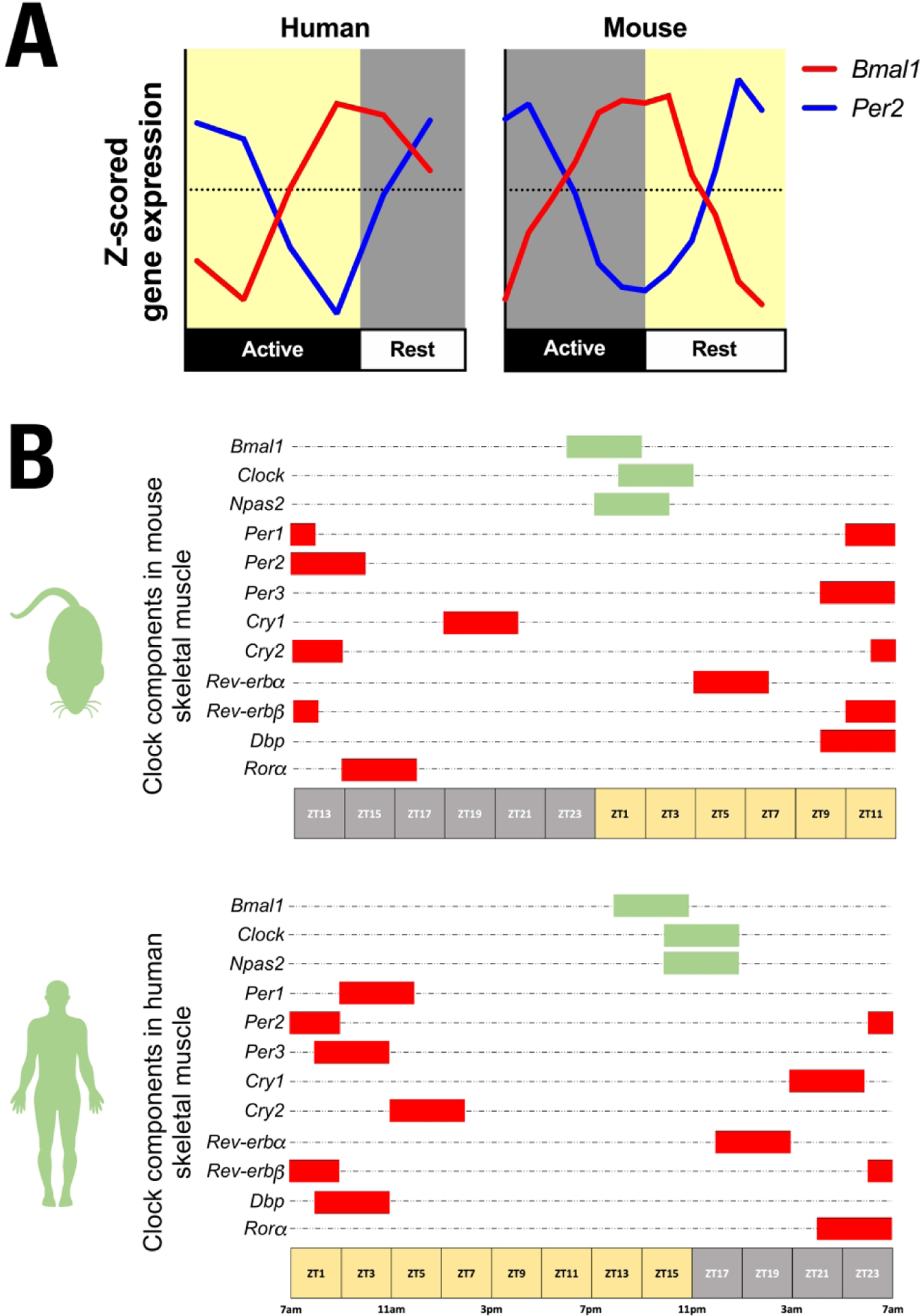
Normalized expression of core clock genes, Bmal1 and Per2, in skeletal muscle of humans and mice over time of day. The patterns of Bmal1 and Per2 expression are similar when viewed from rest/active phases of the day. Human skeletal muscle data was extracted from Perrin et al. (17) and mouse gastrocnemius data was extracted from Zhang et al. (3). Bmal1 circadian expression profile is represented by the red line and Per2 by the blue line. B. Representation of peak times of expression of a larger composite of clock genes and CCGs in mouse skeletal muscle (top panel) and human skeletal muscle (bottom panel). Genes of the positive limb are represented by green bars and genes of the negative limb by red bars. Zeitgeber time 0 (ZT0) refers to the time when lights are switched on, e.g. in human studies at 7AM. For illustration purposes, three hour time frames were used taking the mean value of peak expression of the respective gene from comparable human (17, 18) and mice (3, 4, 23) studies as the center. Note that if corrected for the rest/activity cycle, peak expression patterns across the clock components are similar in both species.

References

    1. Miller BH, McDearmon EL, Panda S, et al. Circadian and CLOCK-controlled regulation of the mouse transcriptome and cell proliferation. Proc Natl Acad Sci U S A 2007;104:3342–3347. - PMC - PubMed
    1. McCarthy JJ, Andrews JL, McDearmon EL, et al. Identification of the circadian transcriptome in adult mouse skeletal muscle. Physiol Genomics 2007;31:86–95. - PMC - PubMed
    1. Zhang R, Lahens NF, Ballance HI, Hughes ME, Hogenesch JB. A circadian gene expression atlas in mammals: Implications for biology and medicine. Proc Natl Acad Sci 2014;111:16219–16224. - PMC - PubMed
    1. Hodge BA, Wen Y, Riley LA, et al. The endogenous molecular clock orchestrates the temporal separation of substrate metabolism in skeletal muscle. Skelet Muscle 2015;5. - PMC - PubMed
    1. Janssen I, Heymsfield SB, Wang ZM, Ross R. Skeletal muscle mass and distribution in 468 men and women aged 18–88 yr. J Appl Physiol Bethesda Md 1985 2000;89:81–88. - PubMed

Publication types

LinkOut - more resources