Efficacy of Savolitinib vs Sunitinib in Patients With MET-Driven Papillary Renal Cell Carcinoma: The SAVOIR Phase 3 Randomized Clinical Trial
- PMID: 32469384
- PMCID: PMC7260692
- DOI: 10.1001/jamaoncol.2020.2218
Efficacy of Savolitinib vs Sunitinib in Patients With MET-Driven Papillary Renal Cell Carcinoma: The SAVOIR Phase 3 Randomized Clinical Trial
Erratum in
-
Change to Licensing Type.JAMA Oncol. 2020 Sep 1;6(9):1473. doi: 10.1001/jamaoncol.2020.2873. JAMA Oncol. 2020. PMID: 32584396 Free PMC article. No abstract available.
Abstract
Importance: Papillary renal cell carcinoma (PRCC) is the most common type of non-clear cell RCC. Because some cases of PRCC are MET-driven, MET inhibition could be a targeted treatment approach. In previous studies, savolitinib (AZD6094, HMPL-504, volitinib), a highly selective MET-tyrosine kinase inhibitor, demonstrated antitumor activity in this patient group.
Objective: To determine whether savolitinib is a better treatment option for this patient population, vs standard of care, sunitinib.
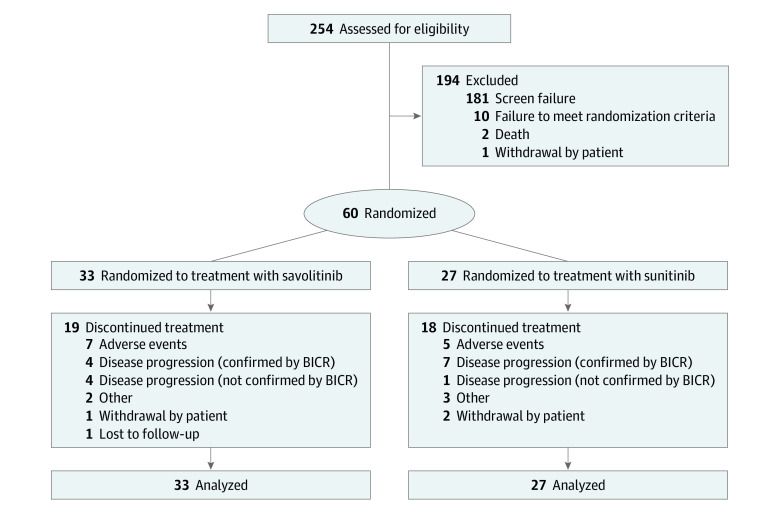
Design, setting, and participants: The SAVOIR phase 3, open-label, randomized clinical trial was a multicenter study carried out in 32 centers in 7 countries between July 2017 and the data cutoff in August 2019. Overall, 360 to 450 patients were to be screened to randomize approximately 180 patients. Patients were adults with MET-driven (centrally confirmed), metastatic PRCC, with 1 or more measurable lesions. Exclusion criteria included prior receipt of sunitinib or MET inhibitor treatment. Overall, 254 patients were screened.
Interventions: Patients received 600 mg of savolitinib orally once daily (qd), or 50 mg of sunitinib orally qd for 4 weeks, followed by 2 weeks without treatment.
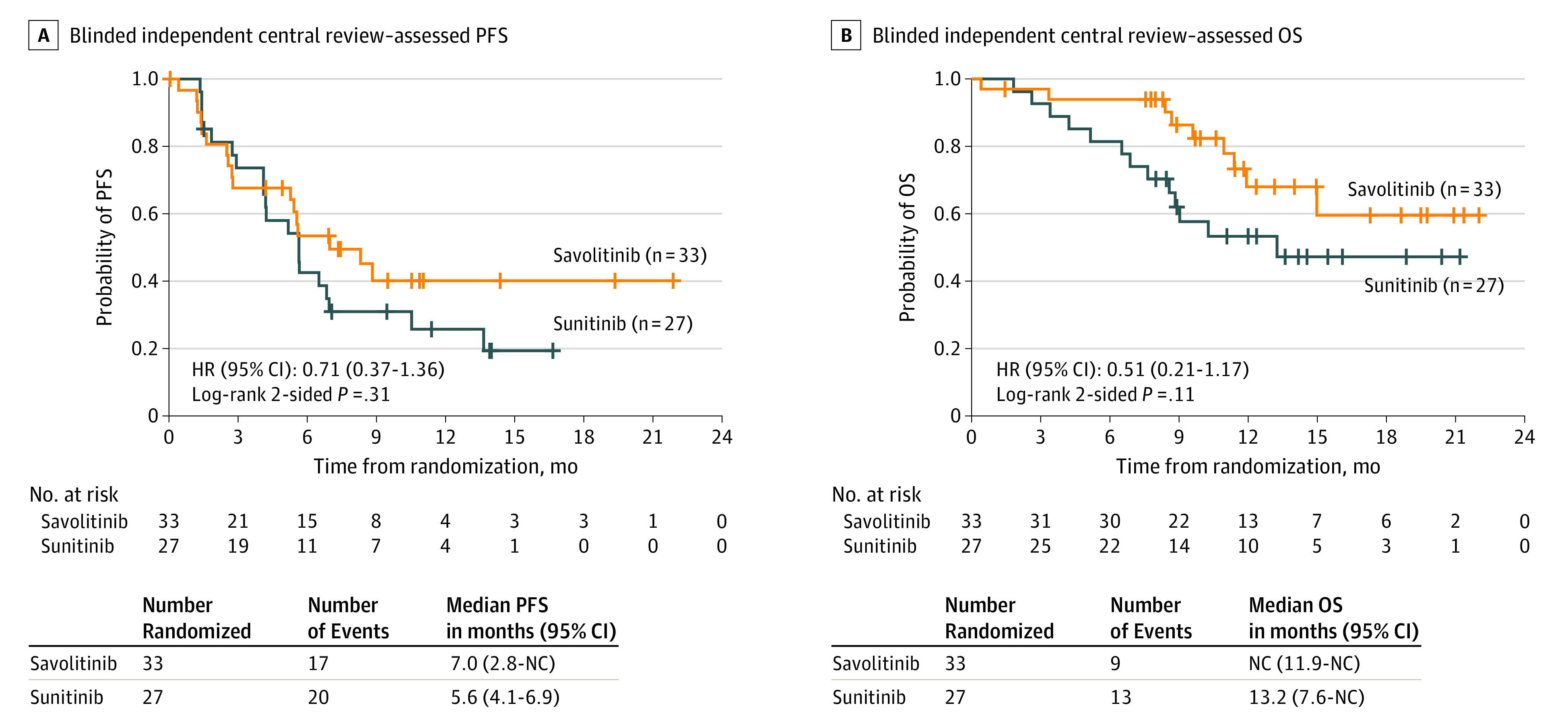
Main outcomes and measures: The primary end point was progression-free survival (PFS, assessed by investigator and confirmed by blinded independent central review). Secondary end points included overall survival (OS), objective response rate (ORR), duration of response, and safety/tolerability.
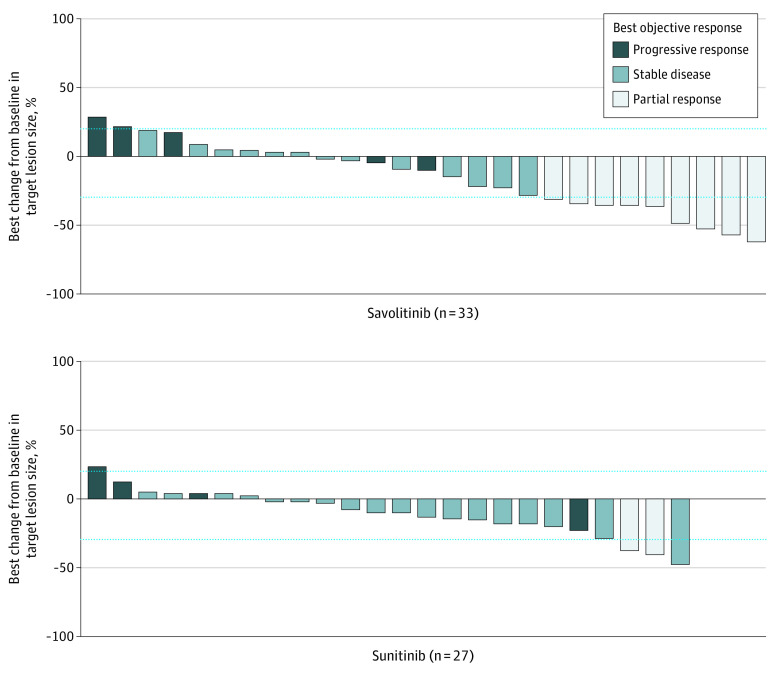
Results: At data cutoff, 60 patients were randomized (savolitinib n = 33; sunitinib n = 27); most patients had chromosome 7 gain (savolitinib, 30 [91%]; sunitinib, 26 [96%]) and no prior therapy (savolitinib, 28 [85%]; sunitinib, 25 [93%]). For savolitinib and sunitinib, 4 (12%) and 10 (37%) patients were women, and the median (range) age was 60 (23-78) and 65 (31-77) years, respectively. Following availability of external data on PFS with sunitinib in patients with MET-driven disease, study enrollment was closed. Progression-free survival, OS, and ORR were numerically greater with savolitinib vs sunitinib. Median PFS was not statistically different between the 2 groups: 7.0 months (95% CI, 2.8-not calculated) for savolitinib and 5.6 months (95% CI, 4.1-6.9) for sunitinib (hazard ratio [HR], 0.71; 95% CI, 0.37-1.36; P = .31). For savolitinib and sunitinib respectively, grade 3 or higher adverse events (AEs) were reported in 14 (42%) and 22 (81%) of patients and AE-related dose modifications in 10 (30%) and 20 (74%). After discontinuation, 12 (36%) and 5 (19%) of patients on savolitinib and sunitinib respectively, received subsequent anticancer therapy.
Conclusions and relevance: Although patient numbers and follow-up were limited, savolitinib demonstrated encouraging efficacy vs sunitinib, with fewer grade 3 or higher AEs and dose modifications. Further investigation of savolitinib as a treatment option for MET-driven PRCC is warranted.
Trial registration: ClinicalTrials.gov Identifier: NCT03091192.
Conflict of interest statement
Figures
Comment in
-
Re: Toni K. Choueiri, Daniel Y.C. Heng, Jae Lyun Lee, et al. Efficacy of Savolitinib vs Sunitinib in Patients With MET-Driven Papillary Renal Cell Carcinoma: The SAVOIR Phase 3 Randomized Clinical Trial. JAMA Oncol. In press. https://doi.org/10.1001/jamaoncol.2020.2218: SAVOIR: From Own Goal to Winning Goal?Eur Urol Oncol. 2020 Aug;3(4):561-562. doi: 10.1016/j.euo.2020.06.008. Epub 2020 Jul 9. Eur Urol Oncol. 2020. PMID: 32653414 No abstract available.
References
Publication types
MeSH terms
Substances
Associated data
LinkOut - more resources
Full Text Sources
Medical
Miscellaneous