


Fresh fruit consumption may decrease the long-term risk of esophageal cancer mortality: A 30-year follow-up study in the Linxian Dysplasia Nutrition Intervention trial (NIT)
- PMID: 32469462
- PMCID: PMC7327702
- DOI: 10.1111/1759-7714.13482
Fresh fruit consumption may decrease the long-term risk of esophageal cancer mortality: A 30-year follow-up study in the Linxian Dysplasia Nutrition Intervention trial (NIT)
Abstract
Background: The objective of this study was to explore the association between fresh fruit consumption and long-term risk of upper gastrointestinal cancer (UGI) in the Linxian Dysplasia Nutrition Intervention Trial (NIT) cohort.
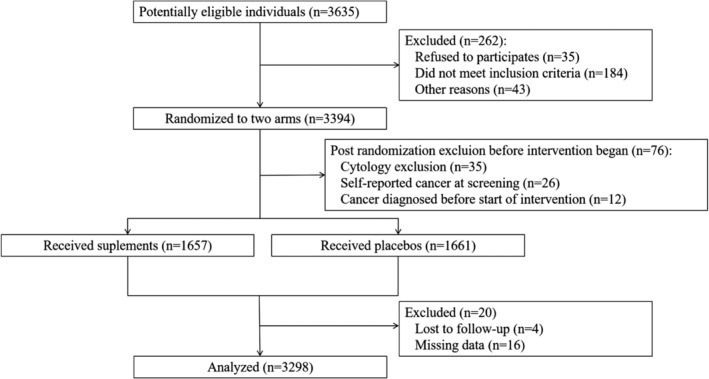
Methods: A cohort of 3318 subjects with esophageal squamous dysplasia participated in the Linxian Dysplasia NIT in May 1985 and were followed up until 30 September 2015. Demographic characteristics, lifestyle, and history of diseases were collected at the baseline. The primary endpoint was death from esophageal squamous cell carcinoma (ESCC), gastric cardia carcinoma (GCC), and gastric noncardia carcinoma (GNCC). Hazard ratios (HRs) and 95% confidence intervals (95% CIs) were estimated using the Cox proportional hazard model.
Results: In the 30-year follow-up, a total of 541 ESCC, 284 GCC, and 77 GNCC deaths occurred. Relative to those who never or rarely consumed fresh fruit, the risk of ESCC mortality in participants who consumed fresh fruit more than 12 times/year were significantly decreased by 37.3% (HR = 0.63, 95% CI: 0.49-0.81). In the subgroup analyses, significantly protective effects on ESCC mortality were observed especially in females (HR = 0.59, 95% CI: 0.40-0.89), non-smokers (HR = 0.67, 95% CI: 0.48-0.94), and nondrinkers (HR = 0.69, 95% CI: 0.51-0.93).
Conclusions: Consuming fresh fruit more than 12 times/year may reduce the long-term risk of ESCC mortality in this dysplasia population, particularly in females, non-smokers, and nondrinkers. Future studies are needed to confirm these findings.
Keywords: Esophageal squamous cell carcinoma; Linxian dysplasia nutrition intervention trial; fresh fruit consumption; gastric cardia carcinoma; noncardia carcinoma.
© 2020 The Authors. Thoracic Cancer published by China Lung Oncology Group and John Wiley & Sons Australia, Ltd.
Figures
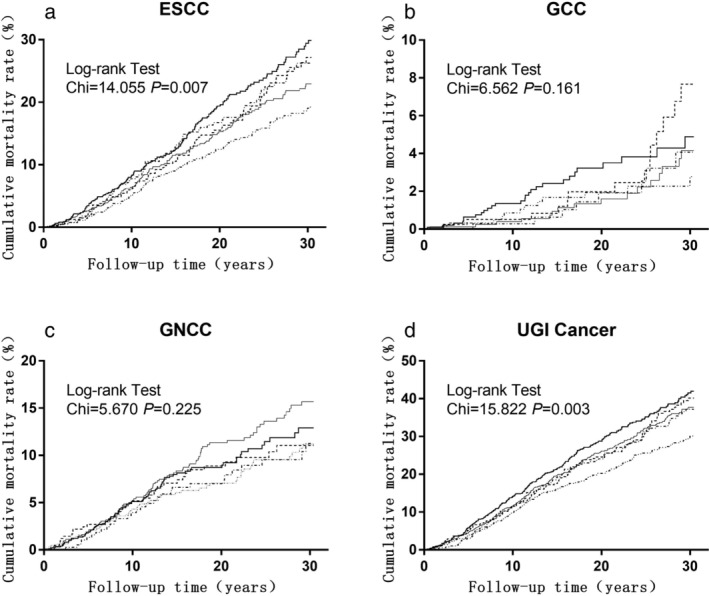
 None,
None,  1–3 times/year,
  4–6 times/year,
  7–12 times/year, and
  >12 times/year], (b) Gastric cardia carcinoma (GCC) [
 None,
None,  1–3 times/year,
  4–6 times/year,
  7–12 times/year, and
  >12 times/year], Gastric noncardia carcinoma (GNCC) [
 None,
None,  1–3 times/year,
  4–6 times/year,
  7–12 times/year, and
  >12 times/year] and total UGI cancer (d) [
 None,
None,  1–3 times/year,
  4–6 times/year,
  7–12 times/year, and
  >12 times/year].
  None
None :1–3 times/year
 : 4–6 times/year
 : 7–12 times/year
 : >12 times/year.
References
-
- Bray F, Ferlay J, Soerjomataram I, Siegel RL, Torre LA, Jemal A. Global cancer statistics 2018: GLOBOCAN estimates of incidence and mortality worldwide for 36 cancers in 185 countries. CA Cancer J Clin 2018; 68 (6): 394–424. - PubMed
-
- Chen W, Zheng R, Baade PD et al Cancer statistics in China, 2015. CA Cancer J Clin 2016; 66 (2): 115–32. - PubMed
-
- Johnson IT. Understanding the association between diet and nutrition in upper gastrointestinal cancer. Expert Rev Gastroenterol Hepatol 2015; 9 (11): 1347–9. - PubMed
-
- Enzinger PC, Mayer RJ. Esophageal cancer. N Engl J Med 2003; 349 (23): 2241–52. - PubMed
Publication types
MeSH terms
Grants and funding
LinkOut - more resources
Full Text Sources
Medical
