


Gradual positive and negative affect induction: The effect of verbalizing affective content
- PMID: 32469910
- PMCID: PMC7259663
- DOI: 10.1371/journal.pone.0233592
Gradual positive and negative affect induction: The effect of verbalizing affective content
Abstract
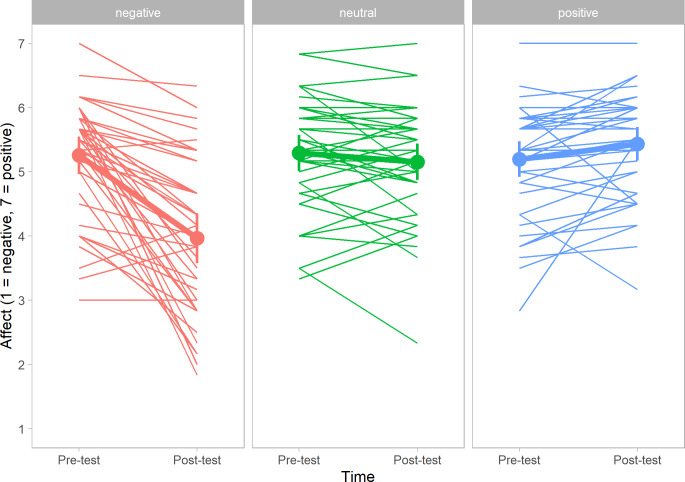
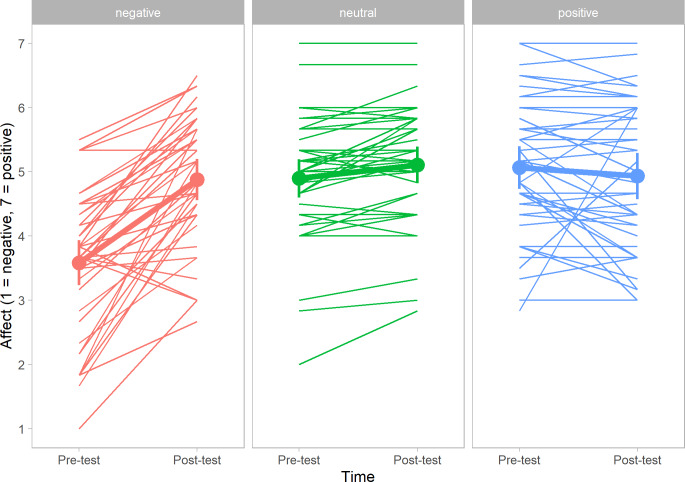
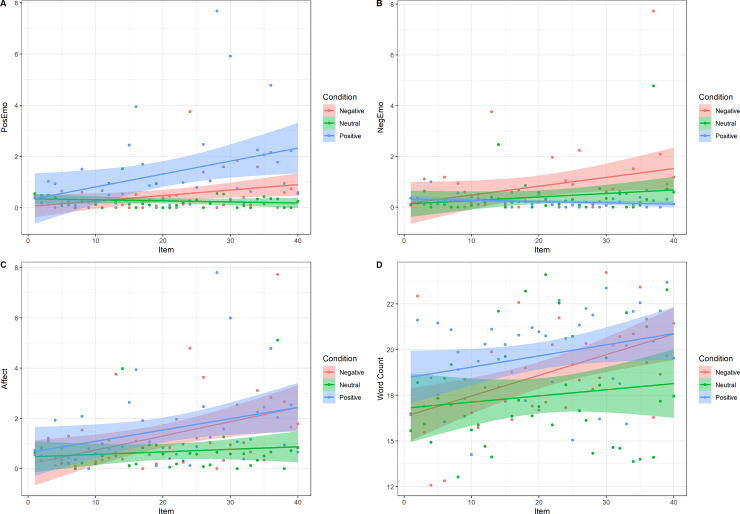
In this paper, we study the effect of verbalizing affective pictures on affective state and language production. Individuals describe (Study I: Spoken Descriptions of Pictures) or passively view (Study II: Passively Viewing Pictures) 40 pictures for the International Affective Picture System (IAPS) that gradually increase from neutral to either positive or negative content. We expected that both methods would result in successful affect induction, and that the effect would be stronger for verbally describing pictures than for passively viewing them. Results indicate that speakers indeed felt more negative after describing negative pictures, but that describing positive (compared to neutral) pictures did not result in a more positive state. Contrary to our hypothesis, no differences were found between describing and passively viewing the pictures. Furthermore, we analysed the verbal picture descriptions produced by participants on various dimensions. Results indicate that positive and negative pictures were indeed described with increasingly more affective language in the expected directions. In addition to informing our understanding of the relationship between (spoken) language production and affect, these results also potentially pave the way for a new method of affect induction that uses free expression.
Conflict of interest statement
The authors have declared that no competing interests exist.
Figures
References
-
- Velten Jr E. A laboratory task for induction of mood states. Behaviour research and therapy. 1968;6: 473–82. - PubMed
-
- Pennebaker JW, Francis ME, Booth RJ. Linguistic inquiry and word count: LIWC 2001. Mahway: Lawrence Erlbaum Associates; 2001;71: 2001.
-
- Velten Jr EC. The induction of elation and depression through the reading of structured sets of mood-statements. Doctoral dissertation, University of Southern California; 1967. Available from: 10.1016/0005-7967(68)90028-4 - DOI
-
- Jennings PD, McGinnis D, Lovejoy S, Stirling J. Valence and arousal ratings for Velten mood induction statements. Motivation and Emotion. 2000;24: 285–97.
Publication types
MeSH terms
LinkOut - more resources
Full Text Sources
