


Training specificity performing single-joint vs. multi-joint resistance exercises among physically active females: A randomized controlled trial
- PMID: 32469946
- PMCID: PMC7259582
- DOI: 10.1371/journal.pone.0233540
Training specificity performing single-joint vs. multi-joint resistance exercises among physically active females: A randomized controlled trial
Abstract
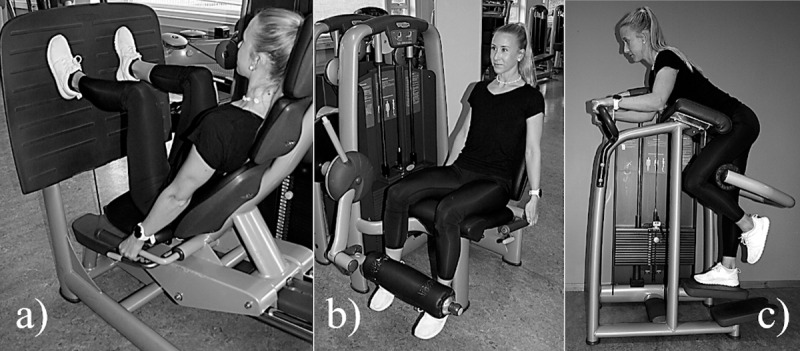
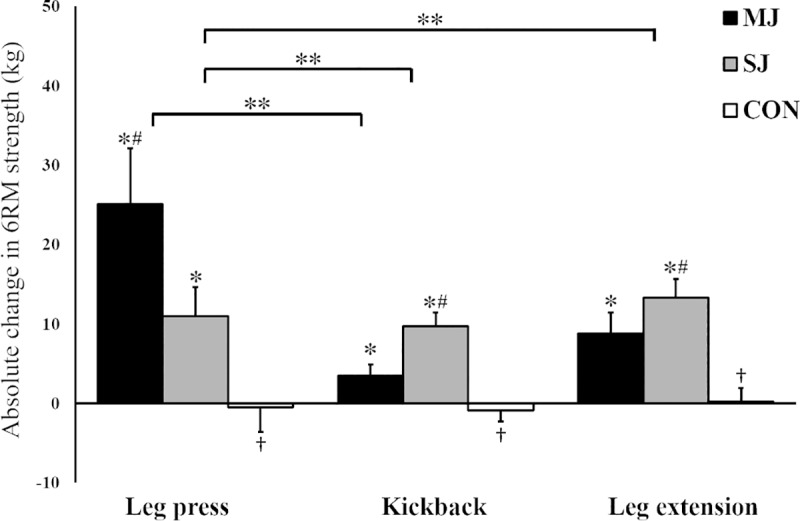
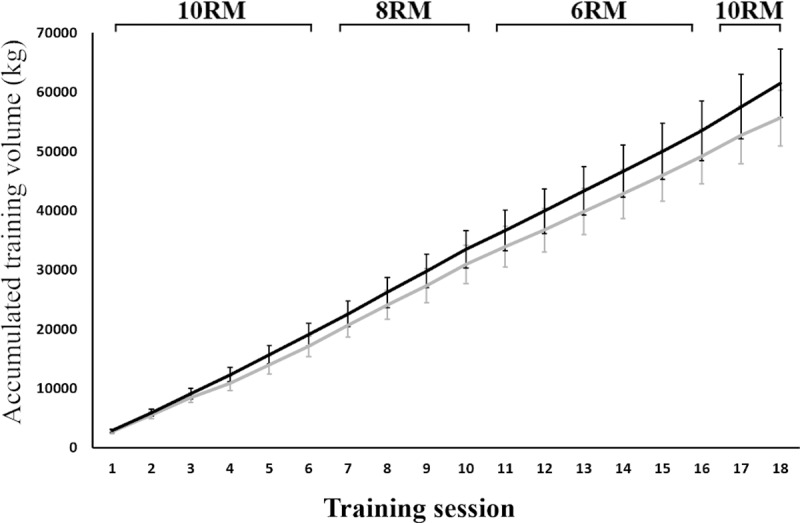
Resistance-training of the lower limbs can be performed using exercises moving one (single-joint exercises) or several joints (multi-joint exercises). This study compared the effects of training one multi-joint exercise (leg press) or two single-joint exercises (leg extension and kickback) on dynamic and isometric strength and the transferability of dynamic strength between exercises. Fifty-three physically active women were randomized to a multi-joint (MJ) training group (age = 21.95±0.82 years, mass = 64.85±5.76 kg, height = 167.35±2.47 cm; n = 20), single-joint (SJ) training group (age = 22.56±1.66 years, mass = 64.85±5.76 kg, height = 165.94±2.84 cm; n = 18), or a control (CON) group (age = 21.27±0.68 years, mass = 68.43±4.86 kg, height = 168.63±2.84 cm; n = 15). The training groups participated in an 8-week supervised single- or multi-joint lower limb training consisting of 18 sessions. Pre- and post-training, six repetitions maximum (RM) and maximal voluntary isometric contraction in the three exercises were assessed, along with electromyography of the superficial quadriceps muscles. Improvements in all dynamic exercises were greatest after training the specific exercises (ES = 1.26-2.14, P<0.001-0.025) and all were greater in the training groups than in the CON group (ES = 1.43-3.31, P<0.001-0.021). The SJ group improved 6RM in leg extension and kickback more than leg press (ES = 1.51 and 2.04, respectively, P<0.001), whereas the MJ group improved leg press 6RM more than kickback (ES = 1.10, P = 0.002). However, leg press and leg extension strength improved similarly in the MJ group (ES = 0.54, P = 0.072). All strength and electromyographic measures remained unchanged in the CON group (ES = 0.00-0.44, P = 0.412-0.966). Improved dynamic strength in leg press, kickback and leg extension is best attained by training the specific exercises, but both training modalities can improve strength across all exercises.
Conflict of interest statement
The authors have declared that no competing interests exist.
Figures
References
-
- Wernbom M, Augustsson J, Thomee R. The influence of frequency, intensity, volume and mode of strength training on whole muscle cross-sectional area in humans. Sports Med. 2007;37(3):225–64. - PubMed
-
- Sale D, MacDougall D. Specificity in strength training: a review for the coach and athlete. Can J Appl Sport Sci. 1981;6(2):87–92. - PubMed
-
- Behm DG, Sale DG. Velocity specificity of resistance training. Sports Med. 1993;15(6):374–88. - PubMed
-
- Appleby BB, Cormack SJ, Newton RU. Specificity and Transfer of Lower-Body Strength: Influence of Bilateral or Unilateral Lower-Body Resistance Training. J Strength Cond Res. 2019;33(2):318–26. - PubMed
-
- ACSM. American College of Sports Medicine position stand. Progression models in resistance training for healthy adults. Med Sci Sports Exerc. 2009;41(3):687–708. - PubMed
Publication types
MeSH terms
LinkOut - more resources
Full Text Sources
