


The effect of surgical trauma on circulating free DNA levels in cancer patients-implications for studies of circulating tumor DNA
- PMID: 32471011
- PMCID: PMC7400779
- DOI: 10.1002/1878-0261.12729
The effect of surgical trauma on circulating free DNA levels in cancer patients-implications for studies of circulating tumor DNA
Abstract
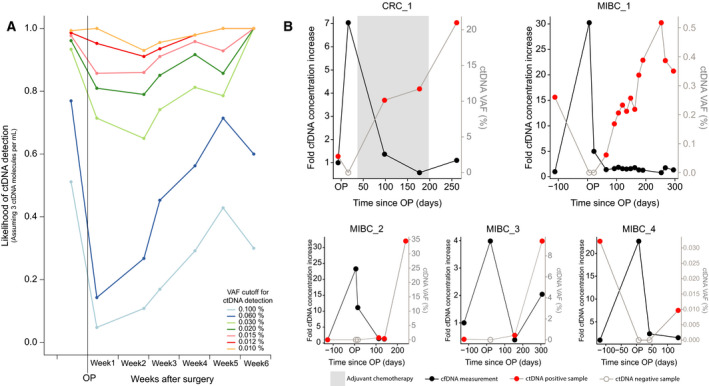
Detection of circulating tumor DNA (ctDNA) post-treatment is an emerging marker of residual disease. ctDNA constitutes only a minor fraction of the cell-free DNA (cfDNA) circulating in cancer patients, complicating ctDNA detection. This is exacerbated by trauma-induced cfDNA. To guide optimal blood sample timing, we investigated the duration and magnitude of surgical trauma-induced cfDNA in patients with colorectal or bladder cancer. DNA levels were quantified in paired plasma samples collected before and up to 6 weeks after surgery from 436 patients with colorectal cancer and 47 patients with muscle-invasive bladder cancer. To assess whether trauma-induced cfDNA fragments are longer than ordinary cfDNA fragments, the concentration of short (< 1 kb) and long (> 1 kb) fragments was determined for 91 patients. Previously reported ctDNA data from 91 patients with colorectal cancer and 47 patients with bladder cancer were used to assess how trauma-induced DNA affects ctDNA detection. The total cfDNA level increased postoperatively-both in patients with colorectal cancer (mean threefold) and bladder cancer (mean eightfold). The DNA levels were significantly increased up to 4 weeks after surgery in both patient cohorts (P = 0.0005 and P ≤ 0.0001). The concentration of short, but not long, cfDNA fragments increased postoperatively. Of 25 patients with radiological relapse, eight were ctDNA-positive and 17 were ctDNA-negative in the period with trauma-induced DNA. Analysis of longitudinal samples revealed that five of the negative patients became positive shortly after the release of trauma-induced cfDNA had ceased. In conclusion, surgery was associated with elevated cfDNA levels, persisting up to 4 weeks, which may have masked ctDNA in relapse patients. Trauma-induced cfDNA was of similar size to ordinary cfDNA. To mitigate the impact of trauma-induced cfDNA on ctDNA detection, it is recommended that a second blood sample collected after week 4 is analyzed for patients initially ctDNA negative.
Keywords: bladder cancer; cell-free DNA; circulating tumor DNA; colorectal cancer; trauma.
© 2020 The Authors. Published by FEBS Press and John Wiley & Sons Ltd.
Conflict of interest statement
Sethi and Zimmermann are employees of Natera, Inc. and own stock, or options to stock, in the company. The remaining authors have nothing to disclose.
Figures

References
-
- Biagi JJ, Raphael MJ, Mackillop WJ, Kong W, King WD and Booth CM (2011) Association between time to initiation of adjuvant chemotherapy and survival in colorectal cancer a systematic review and meta‐analysis. JAMA 305, 2335–2342. - PubMed
-
- Christensen E, Birkenkamp‐Demtröder K, Sethi H, Shchegrova S, Salari R, Nordentoft I, Wu H‐T, Knudsen M, Lamy P, Lindskrog SV et al (2019) Early detection of metastatic relapse and monitoring of therapeutic efficacy by ultra‐deep sequencing of plasma cell‐free dna in patients with urothelial bladder carcinoma. J Clin Oncol 37, 1547–1557. - PubMed
Publication types
MeSH terms
Substances
Grants and funding
- 1309-00006B/Strategiske Forskningsråd/International
- FID1839672/Dansk Kraeftforsknings Fond/International
- 4183-00619/Det Frie Forskningsråd/International
- 7016-00369B/Det Frie Forskningsråd/International
- R107-A7035/Kraeftens Bekaempelse/International
- R124-A7508/Kraeftens Bekaempelse/International
- R133-A8520-00-S41/Kraeftens Bekaempelse/International
- R146-A9466-16-S2/Kraeftens Bekaempelse/International
- NNF14OC0012747/Novo Nordisk Fonden/International
- NNF17OC0024464/Novo Nordisk Fonden/International
- NNF17OC0025052/Novo Nordisk Fonden/International
LinkOut - more resources
Full Text Sources
Medical
