Review
. 2020 May 27;21(11):3776.
doi: 10.3390/ijms21113776.

Maternal Obesity and the Uterine Immune Cell Landscape: The Shaping Role of Inflammation

Affiliations
Review

Maternal Obesity and the Uterine Immune Cell Landscape: The Shaping Role of Inflammation

Lauren E St-Germain et al. Int J Mol Sci. .

Abstract

Inflammation is often equated to the physiological response to injury or infection. Inflammatory responses defined by cytokine storms control cellular mechanisms that can either resolve quickly (i.e., acute inflammation) or remain prolonged and unabated (i.e., chronic inflammation). Perhaps less well-appreciated is the importance of inflammatory processes central to healthy pregnancy, including implantation, early stages of placentation, and parturition. Pregnancy juxtaposed with disease can lead to the perpetuation of aberrant inflammation that likely contributes to or potentiates maternal morbidity and poor fetal outcome. Maternal obesity, a prevalent condition within women of reproductive age, associates with increased risk of developing multiple pregnancy disorders. Importantly, chronic low-grade inflammation is thought to underlie the development of obesity-related obstetric and perinatal complications. While diverse subsets of uterine immune cells play central roles in initiating and maintaining healthy pregnancy, uterine leukocyte dysfunction as a result of maternal obesity may underpin the development of pregnancy disorders. In this review we discuss the current knowledge related to the impact of maternal obesity and obesity-associated inflammation on uterine immune cell function, utero-placental establishment, and pregnancy health.

Keywords: immune cells; inflammation; maternal obesity; placentation; pregnancy.


Conflict of interest statement

The authors declare no conflict of interest.

Figures
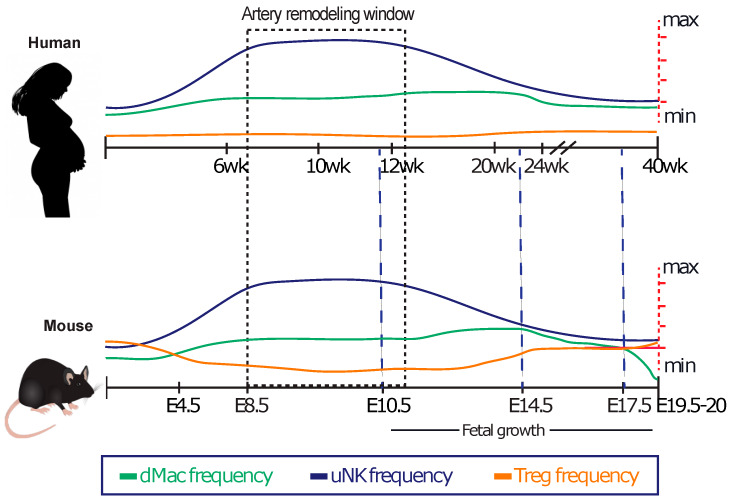
Figure 1
Figure 1
Timeline of human and mouse pregnancies with relative abundance of major decidual leukocytes. Important hallmarks during pregnancy are shown as well as the abundance of decidual Mφ (green), uNKs (blue), regulatory T cells (Tregs) (orange), and total CD3+ T cells (purple) [23,24,25]. Y-axis represents percent of total leukocytes in the decidua. wk, week; E, embryonic day.
Figure 2
Figure 2
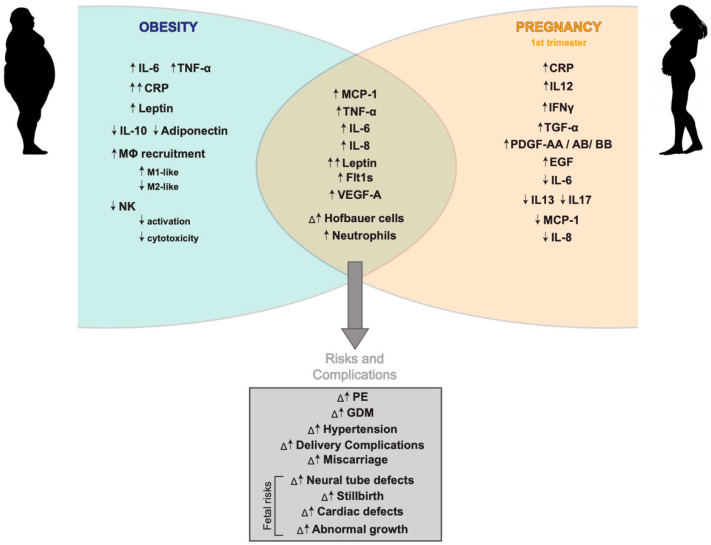
Schematic diagram of major inflammatory and immune characteristics observed in obesity and pregnancy. Important pro- and anti- inflammatory secretory factors released in the context of obesity and early pregnancy and their overlap during maternal obesity, along with the risks and complications this poses for both the fetus and the mother throughout pregnancy are shown.
Figure 3
Figure 3
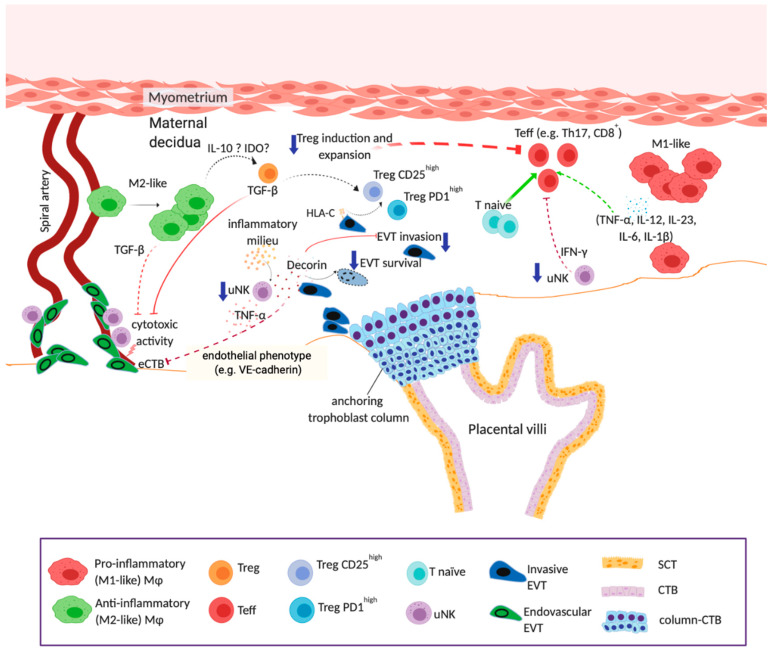
Proposed model of the effects of obesity on the intrauterine environment. Obesity-linked inflammation may affect uterine immune cell biology by: (a) disrupting the crosstalk between trophoblasts and uterine leukocytes resulting in impaired trophoblast invasion and artery remodeling [129,185,211,224,243,244,245], and (b) creating imbalances in immunoregulatory and pro-inflammatory uterine leukocytes that in turn potentiate maternal-fetal intolerance [60,211,246,247]. When inflammation is present in the intrauterine environment, homeostasis is disrupted leading to alterations in the frequencies and functions of important immunoregulatory cell populations that in turn impact spiral artery remodeling and trophoblast functions (invasion) and survival. Dashed lines indicate inefficient or inadequate induction/activation (depicted in green) or blockage/inhibition (depicted in red). Abbreviations: Teff, T effector cell; T naïve, naïve T cell; SCT, syncytiotrophoblast; CTB, villous cytotrophoblast; column-CTB, anchoring column cytotrophoblast. This figure was created using BioRender.com.

References

    1. Mor G., Cardenas I., Abrahams V., Guller S. Inflammation and pregnancy: The role of the immune system at the implantation site. Ann. N. Y. Acad. Sci. 2011;1221:80–87. doi: 10.1111/j.1749-6632.2010.05938.x. - DOI - PMC - PubMed
    1. Robson A., Harris L.K., Innes B.A., Lash G.E., Aljunaidy M.M., Aplin J.D., Baker P.N., Robson S.C., Bulmer J.N. Uterine natural killer cells initiate spiral artery remodeling in human pregnancy. FASEB J. 2012;26:4876–4885. doi: 10.1096/fj.12-210310. - DOI - PubMed
    1. Romero R., Espinoza J., Gonçalves L.F., Kusanovic J.P., Friel L.A., Nien J.K. Inflammation in preterm and term labour and delivery. Semin. Fetal Neonatal Med. 2006;11:317–326. doi: 10.1016/j.siny.2006.05.001. - DOI - PMC - PubMed
    1. Kalagiri R.R., Carder T., Choudhury S., Vora N., Ballard A.R., Govande V., Drever N., Beeram M.R., Uddin M.N. Inflammation in Complicated Pregnancy and Its Outcome. Am. J. Perinatol. 2016;33:1337–1356. doi: 10.1055/s-0036-1582397. - DOI - PubMed
    1. Sacks G.P., Studena K., Sargent I.L., Redman C.W.G. Normal pregnancy and preeclampsia both produce inflammatory changes in peripheral blood leukocytes akin to those of sepsis. Am. J. Obstet. Gynecol. 1998;179:80–86. doi: 10.1016/S0002-9378(98)70254-6. - DOI - PubMed

LinkOut - more resources