


In-Hospital Mortality in Patients Receiving Percutaneous Coronary Intervention According to Nurse Staffing Level: An Analysis of National Administrative Health Data
- PMID: 32471103
- PMCID: PMC7313060
- DOI: 10.3390/ijerph17113799
In-Hospital Mortality in Patients Receiving Percutaneous Coronary Intervention According to Nurse Staffing Level: An Analysis of National Administrative Health Data
Abstract
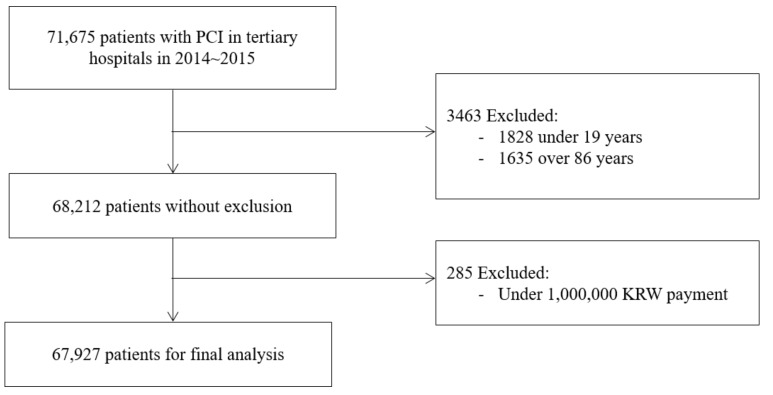
The increasing incidence of ischemic heart disease is concomitantly increasing percutaneous coronary intervention (PCI) treatments. Adequate nurse staffing has enhanced quality of care and this study was conducted to determine the relationship between survival-related PCI treatment and the level of nursing staff who care for patients admitted to receive PCI. National Health Insurance claims data from 2014 to 2015 for 67,927 patients who underwent PCI in 43 tertiary hospitals were analyzed. The relationships of nurse staffing in intensive care units (ICUs) and general wards with survival after PCI were investigated using logistic regression analyses with a generalized estimation model. The in-hospital mortality rate in ICUs was lower in hospitals with first-grade nurse staffing {odds ratio (OR) = 0.33, 95% confidence interval (CI) = 0.23-0.48}, second-grade nurse staffing (OR = 0.55, 95% CI = 0.40-0.77), or third-grade nurse staffing (OR = 0.71, 95% CI = 0.53-0.95) than in hospitals with fifth-grade nurse staffing. Nurse staffing in general wards was not related to in-hospital mortality due to PCI treatment. This study found that nurse staffing in PCI patients requiring short-term intensive care significantly affected patient survival. An understanding of the importance of managing the ICU nursing workforce for PCI treatment is required.
Keywords: in-hospital mortality; nurses; percutaneous coronary intervention; personnel staffing.
Conflict of interest statement
The authors declare that there are no conflicts of interest regarding the publication of this paper.
Figures
References
-
- Kim J. Analysis of recent treatment trend of ischemic heart disease. HIRA Health Insur. Rev. Agency. 2017;11:59–67.
-
- Kim J.D., Kang Y.K. 2011 National Health Insurance Statistical Yearbook. HIRA (Health Insur. Rev. Agency)·NHIS (National Health Insurance Service); Seoul, Korea: 2012.
-
- Kim Y.-I., Kim S.T. 2018 National Health Insurance Statistical Yearbook. HIRA (Health Insur. Rev. Agency)·NHIS (National Health Insurance Service); Wonju-Si, Korea: 2019.
-
- Korea S. Causes of Death Statistics in 2018. [(accessed on 9 February 2020)]; Available online: http://kostat.go.kr/portal/korea/kor_nw/1/6/2/index.board?bmode=read&bSe...
Publication types
MeSH terms
LinkOut - more resources
Full Text Sources
Miscellaneous
