. 2020 May 27;5(2):85.
doi: 10.3390/tropicalmed5020085.

Identification of Mutations in Antimalarial Resistance Gene Kelch13 from plasmodium falciparum Isolates in Kano, Nigeria

Affiliations

Identification of Mutations in Antimalarial Resistance Gene Kelch13 from plasmodium falciparum Isolates in Kano, Nigeria

Umar F Abubakar et al. Trop Med Infect Dis. .

Abstract

Malaria control relies on first-line treatments that use artemisinin-combination therapies (ACT). Unfortunately, mutations in the plasmodium falciparum kelch13 gene result in delayed parasite clearance. Research on what is causing ACT failure is non-existent in northwestern Nigeria. Thus, the presence of mutations in kelch13 in P. falciparum isolates from Kano, Nigeria was investigated in this study. Microscopic examination of 154 blood samples obtained from patients revealed a high prevalence of P. falciparum infection (114 positive individuals, slide positivity rate = 74.03%). The 114 patients were administered Cartef® (ACT) and out of the 50 patients that returned for the 14-day follow up, 11 were positive for P. falciparum (slide positivity rate = 22%). On day 0, 80 samples out of 114 and 11 samples on day 14 (91 out of 125 microscopy-positive samples) were positive with Plasmodium according to the PCR of cytochrome oxidase I, which corresponds to 72.8%. A fragment of the kelch13 gene encompassing the propeller domains was sequenced in 49 samples, alongside samples of the susceptible strain pf_3D7. Low polymorphism was observed, suggesting a lack of selection on this gene, and only six mutations (Glu433Gly, Phe434Ile, Phe434Ser, Ile684Asn, Ile684Thr and Glu688Lys) were found. The epidemiologic impact of these mutations and their potential role in ACT resistance needs to be investigated further.

Keywords: P. falciparum; SNP; artemisinin combination therapy; kelch13; malaria; mutation; resistance.


Conflict of interest statement

The authors declare no conflict of interest.

Figures
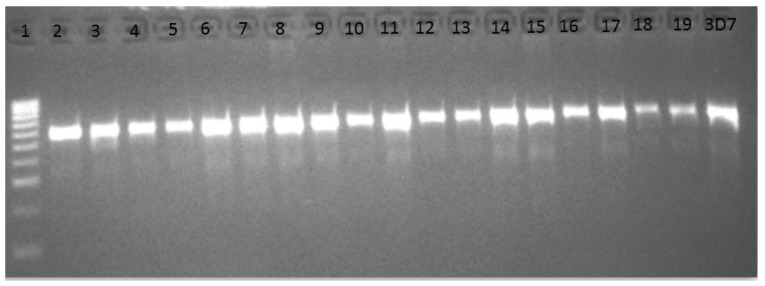
Figure 1
Figure 1
Cytochrome oxidase I (COX I) PCR confirmation of Plasmodium infection. Lane 1 = Molecular ladder (Hyper ladder IV: 50–1013 bp, Bioline), lanes 2–19 = 540 bp representing COX I gene of malaria parasite. Lane 20 is the band from the 3D7 reference susceptible strain.
Figure 2
Figure 2
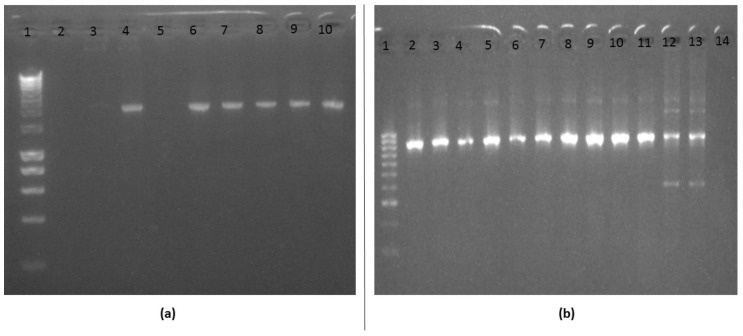
Agarose gel of PCR for amplification of kelch13 fragments. (a) first round PCR, lane 1 = molecular ladder (Hyper ladder 1200 bp–10 kb, Bioline); lanes 3, 4, 6, 7, 8, and 9 represent samples from malaria-infected individuals with 2097 bp fragment. Lane 10 = 3D7 reference susceptible Plasmodium strain; lane 2 is negative control with no DNA and lane 5 is example of sample that failed; (b) nested PCR, lane 1 = molecular ladder (Hyper ladder IV, 50–1013 bp, Bioline), lanes 2–12 = band size of 849 bp, corresponding to kelch13 propeller domain of Plasmodium isolates; lane 13 = 3D7 and lane 14 is negative control with no DNA. Non-specific bands were seen in the samples in lanes 12 and 13. Note: the samples in panel 2a and 2b are not correlated.
Figure 3
Figure 3
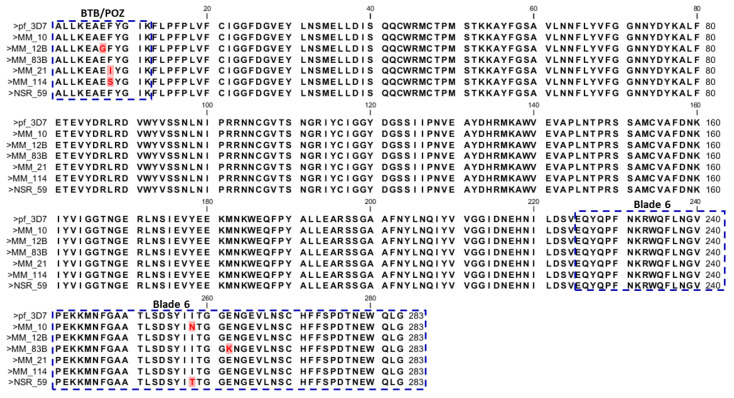
Comparison of amino acid sequences from field isolates with the amino acids of Pf_3D7 sequence. Residues with mutations are in red and highlighted. MM_83B and MM_12B are sequences from isolate of patients that responded to the 14-day follow up and were still infected with Plasmodium. Nucleotide positions were compared to the description in the literature: 350–442, BTB/POZ, 442–475; blade 1475–527; blade 2527–574; blade 3574–614; blade 4614–666; blade 5666–727, blade 6. Different amino acids are in red and highlighted in pink.
Figure 4
Figure 4
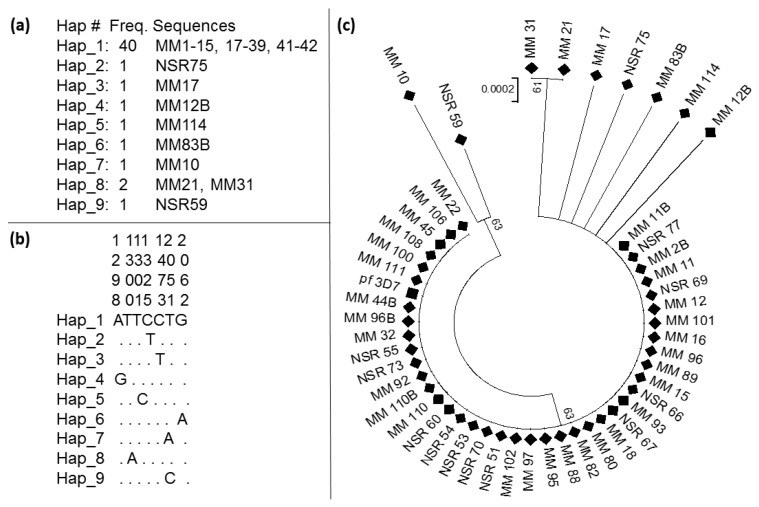
Genetic variability of fragments of kelch13 gene. (a) Summary of haplotype frequencies; (b) nucleotide substitution positions; and (c) a maximum likelihood phylogenetic tree of sequences with all field sequences presented in a diamond shape and the sequence from pf_3D7 in a block square.

References

    1. WHO . World Malaria Report 2019. World Health Organization; Geneva, Switzerland: 2019. 9241565721.
    1. WHO . World Malaria Report. World Health Organization; Geneva, Switzerland: 2011.
    1. Bhatt S., Weiss D.J., Cameron E., Bisanzio D., Mappin B., Dalrymple U., Battle K.E., Moyes C.L., Henry A., Eckhoff P.A., et al. The effect of malaria control on Plasmodium falciparum in Africa between 2000 and 2015. Nature. 2015;526:207–211. doi: 10.1038/nature15535. - DOI - PMC - PubMed
    1. Ashley E.A., Dhorda M., Fairhurst R.M., Amaratunga C., Lim P., Suon S., Sreng S., Anderson J.M., Mao S., Sam B., et al. Spread of artemisinin resistance in Plasmodium falciparum malaria. N. Engl. J. Med. 2014;371:411–423. doi: 10.1056/NEJMoa1314981. - DOI - PMC - PubMed
    1. FMoH . National Antimalarial Treatment Guidelines Policy Federal Ministry of Health, National Malaria and Vector Control Division. Federal Ministry of Health; Abuja-Nigeria, Nigeria: 2005.

LinkOut - more resources