


Adapting the myPlan safety app to respond to intimate partner violence for women in low and middle income country settings: app tailoring and randomized controlled trial protocol
- PMID: 32471469
- PMCID: PMC7260790
- DOI: 10.1186/s12889-020-08901-4
Adapting the myPlan safety app to respond to intimate partner violence for women in low and middle income country settings: app tailoring and randomized controlled trial protocol
Abstract
Background: Intimate partner violence (IPV) is a leading threat to women's health and safety globally. Women in abusive relationships make critical decisions about safety and harm reduction while weighing multiple competing priorities, such as safety of children, housing and employment. In many low- and middle-income countries (LMIC), IPV prevention and response services are limited and women lack access to safety planning resources. In high-resource settings, an interactive safety decision aid app (myPlan) has been found valuable in reducing decisional conflict and empowering women to take action in accordance with their safety priorities. This paper describes 1) the community-participatory formative process used to adapt the myPlan app content, interface, and implementation for the Kenya context, and 2) the randomized clinical trial study protocol for efficacy evaluation of myPlan Kenya.
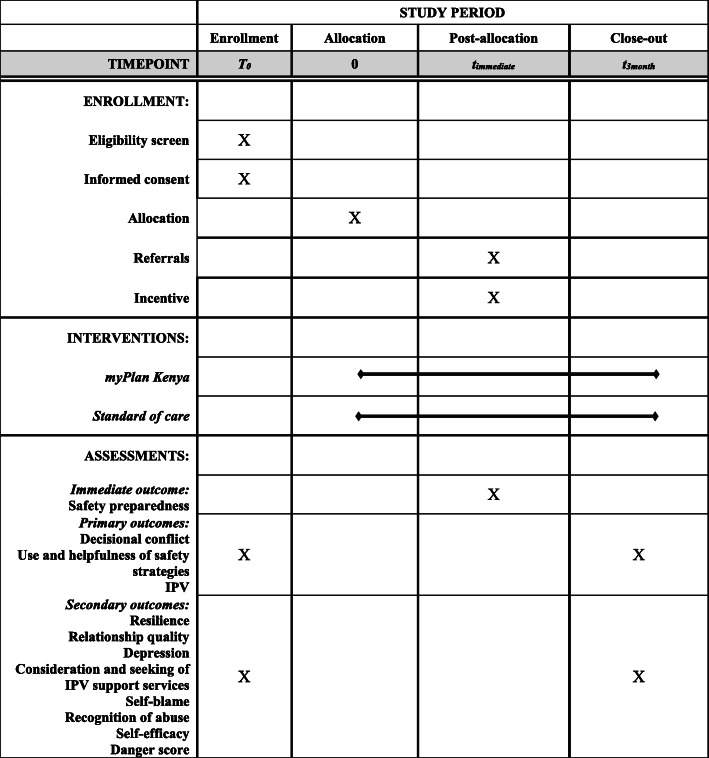
Methods: A community-participatory formative process engaged service providers and stakeholders, as well as IPV survivors for adaptation, followed by an in-depth pilot and final refinements. A randomized clinical trial design will then be used to determine efficacy of the myPlan Kenya app compared to standard care among women reporting IPV or fear of partner and living in an urban settlement. myPlan Kenya app provides and solicits information on a) relationship health; b) safety priorities; and c) severity of relationship violence. Based on the woman's inputs, the evidence-based algorithm developed for myPlan Kenya generates a tailored safety plan. Outcome measures are assessed at baseline, immediate post-intervention, and 3-month post-baseline. Difference-in-differences analysis compares primary (e.g. safety preparedness, safety behavior, IPV), and secondary outcomes (e.g. resilience, mental health, service utilization, self-blame) across timepoints by group.
Discussion: Formative phase revealed high feasibility and acceptability of a technology-based intervention for safety planning in this LMIC setting. This phase generated essential refinements to myPlan Kenya app readability, content and implementation, including increased visualization of messaging, and implementation via community health volunteers (CHVs). The resulting trial will be the first to evaluate efficacy of a community-partnered technology-based IPV intervention in a LMIC. Our adaptation process and trial results will inform researchers and interventionists to integrate multiple data sources to adapt IPV intervention content and interface in settings where technology-based interventions for IPV are novel and literacy is limited.
Trial registration: Pan African Clinical Trial Registry approval received 25 April 2018 (PACTR201804003321122); retrospectively registered.
Keywords: Harm reduction; Intimate partner violence; Safety planning.
Conflict of interest statement
The authors declare they have no competing interests.
Figures

References
-
- UN. Sustainable Development Goal 5: Achieve gender equality and empower all women and girls. https://www.un.org/sustainabledevelopment/gender-equality/. Published 2016. Accessed.
-
- WHO . WHO multi-country study on women’s health and domestic violence against women: summary report of initial results on prevalence, health outcomes and women’s responses. Geneva: World Health Organization; 2005.
-
- Ellsberg M, Jansen HA, Heise L, et al. Intimate partner violence and women's physical and mental health in the WHO multi-country study on women's health and domestic violence: an observational study. Lancet. 2008;371(9619):1165–1172. - PubMed
-
- Glass N, Fredland N, Campbell J, Yonas M, Sharps P, Kub J. Adolescent dating violence: prevalence, risk factors, health outcomes, and implications for clinical practice. J Obstet Gynecol Neonatal Nurs. 2003;32(2):227–238. - PubMed
Publication types
MeSH terms
LinkOut - more resources
Full Text Sources
Medical
Research Materials
Miscellaneous
