Earlier is better when treating rheumatoid arthritis: but can we detect a window of opportunity?
- PMID: 32471854
- PMCID: PMC7299505
- DOI: 10.1136/rmdopen-2020-001242
Earlier is better when treating rheumatoid arthritis: but can we detect a window of opportunity?
Abstract
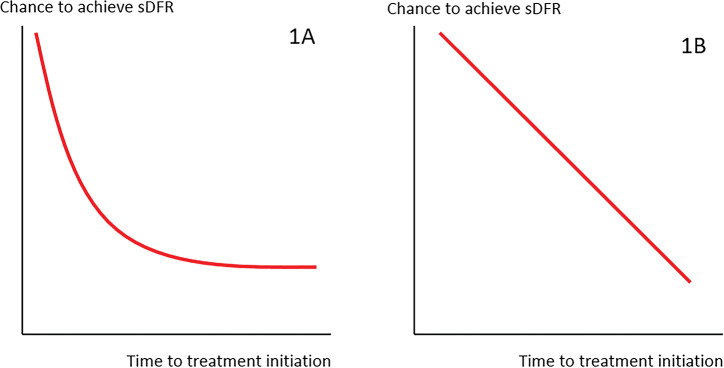
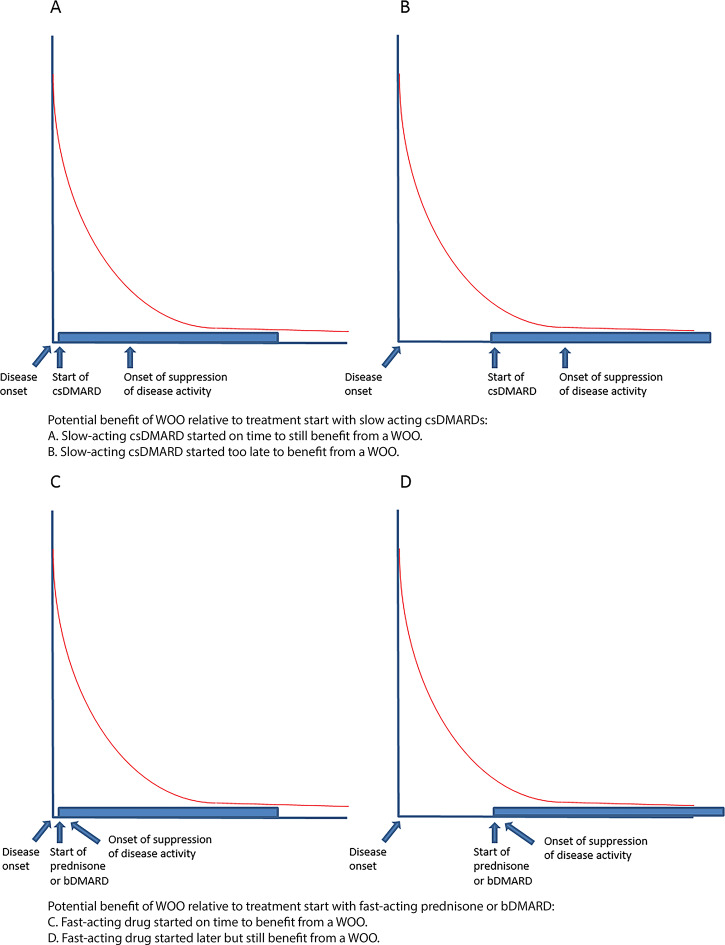
Objectives: The window of opportunity (WOO) hypothesis suggests a limited time frame to stop rheumatoid arthritis (RA). We hypothesised that a WOO could either be represented by a hyperbolic ('curved') decline in the chance to achieve the outcome sustained drug-free remission (sDFR) over time, after which achieving sDFR is not possible anymore, or by a more gradual linear decline approaching zero chance to achieve sDFR.
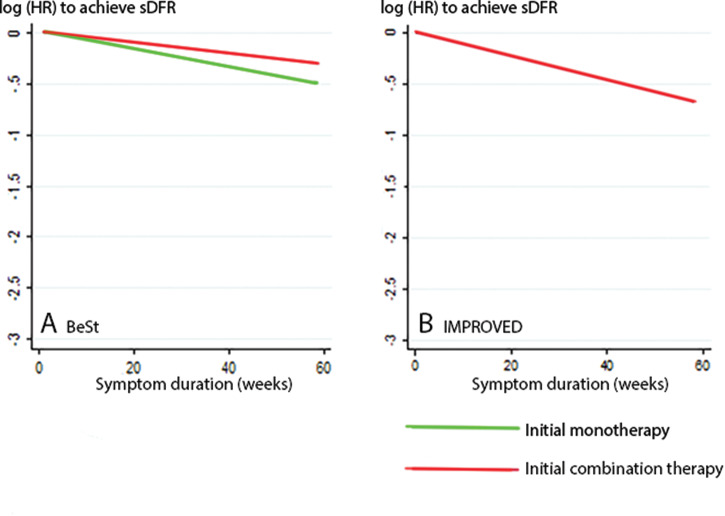
Methods: Patients with RA (symptom duration <2 years) were included from two randomised trials: BehandelStrategieën (BeSt), n=508 and Induction therapy with Methotrexate and Prednisone in Rheumatoid Or Very Early arthritic Disease (IMPROVED), n=479. Cox-regression was performed to assess the shape of the association between symptom duration and sDFR (Disease Activity Score<1.6, no disease-modifying anti-rheumatic drugs for ≥1 year) for patients starting slow-acting monotherapy (IMPROVED, BeSt) or fast-acting combination therapy (BeSt). Likelihood ratio tests were used to compare the fit of linear and non-linear models in both databases separately. Predictions from the best fitting models were used to assess whether the absolute risk to achieve sDFR approaches zero with increasing symptom duration.
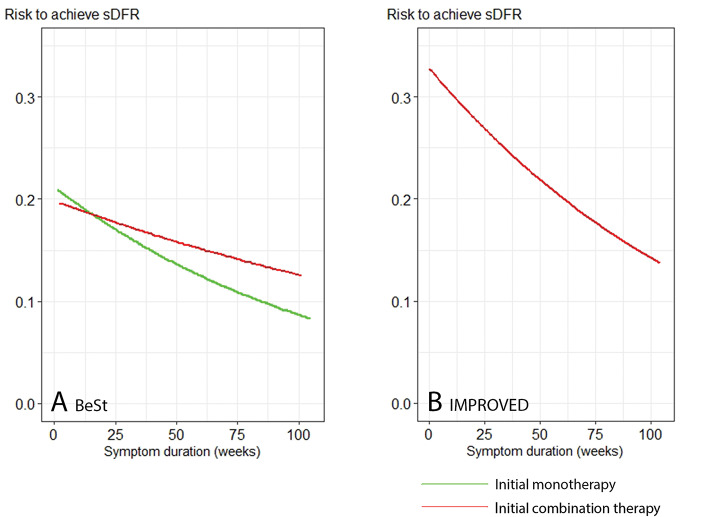
Results: In BeSt and IMPROVED, 54/226 and 110/421 patients achieved sDFR with fast-acting treatment, and 53/243 (BeSt) with slow-acting treatment. Non-linear models did not fit better than linear models (fast-acting treatment BeSt p=0.743, IMPROVED p=0.337; slow-acting treatment BeSt p=0.609). After slow-acting monotherapy, linear models declined steeper. None of the models approached zero chance to achieve sDFR over time.
Conclusions: The chance to achieve sDFR decreased gradually over time, and decreased fastest in patients starting slow-acting monotherapy. In both treatment groups, we found no evidence for a WOO within 2 years symptom duration.
Keywords: Bone mineral density; Corticosteroids; DMARDs (biologic); DMARDs (synthetic); Disease activity; Osteoarthritis; Osteoporosis; Rheumatoid arthritis.
© Author(s) (or their employer(s)) 2020. Re-use permitted under CC BY-NC. No commercial re-use. See rights and permissions. Published by BMJ.
Conflict of interest statement
Competing interests: None declared.
Figures
References
Publication types
MeSH terms
Substances
LinkOut - more resources
Full Text Sources
Medical