


How to increase chlamydia testing in primary care: a qualitative exploration with young people and application of a meta-theoretical model
- PMID: 32471931
- PMCID: PMC7677464
- DOI: 10.1136/sextrans-2019-054309
How to increase chlamydia testing in primary care: a qualitative exploration with young people and application of a meta-theoretical model
Abstract
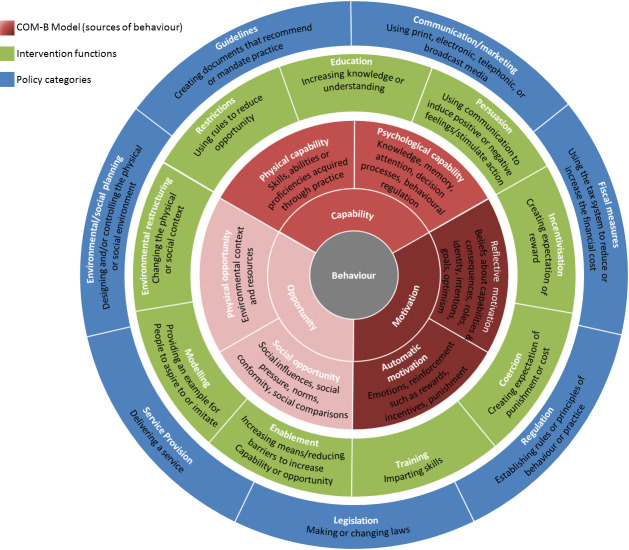
Objective: The objective of this study was to explore young people's perspectives barriers to chlamydia testing in general practice and potential intervention functions and implementation strategies to overcome identified barriers, using a meta-theoretical framework (the Behaviour Change Wheel (BCW)).
Methods: Twenty-eight semistructured individual interviews were conducted with 16-24 year olds from across the UK. Purposive and convenience sampling methods were used (eg, youth organisations, charities, online platforms and chain-referrals). An inductive thematic analysis was first conducted, followed by thematic categorisation using the BCW.
Results: Participants identified several barriers to testing: conducting self-sampling inaccurately (physical capability); lack of information and awareness (psychological capability); testing not seen as a priority and perceived low risk (reflective motivation); embarrassment, fear and guilt (automatic motivation); the UK primary care context and location of toilets (physical opportunity) and stigma (social opportunity). Potential intervention functions raised by participants included education (eg, increase awareness of chlamydia); persuasion (eg, use of imagery/data to alter beliefs); environmental restructuring (eg, alternative sampling methods) and modelling (eg, credible sources such as celebrities). Potential implementation strategies and policy categories discussed were communication and marketing (eg, social media); service provision (eg, introduction of a young person's health-check) and guidelines (eg, standard questions for healthcare providers).
Conclusions: The BCW provided a useful framework for conceptually exploring the wide range of barriers to testing identified and possible intervention functions and policy categories to overcome said barriers. While greater education and awareness and expanded opportunities for testing were considered important, this alone will not bring about dramatic increases in testing. A societal and structural shift towards the normalisation of chlamydia testing is needed, alongside approaches which recognise the heterogeneity of this population. To ensure optimal and inclusive healthcare, researchers, clinicians and policy makers alike must consider patient diversity and the wider health issues affecting all young people.
Keywords: adolescent; behavioural science; chlamydia infection; general practice; qualitative research.
© Author(s) (or their employer(s)) 2020. Re-use permitted under CC BY. Published by BMJ.
Conflict of interest statement
Competing interests: None declared.
Figures
References
-
- Public Health England Sexually transmitted infections and Chlamydia screening in England, 2018, 2019. Available: https://assets.publishing.service.gov.uk/government/uploads/system/uploa...
-
- England PH. Information to support the commissioning of Chlamydia screening in general practice and community pharmacies. National Chlamydia screening programme. London: PHE, 2014. https://assets.publishing.service.gov.uk/government/uploads/system/uploa...
Publication types
MeSH terms
LinkOut - more resources
Full Text Sources
Medical
