. 2020 Jun 16;117(24):13670-13679.
doi: 10.1073/pnas.1918307117. Epub 2020 May 29.

Combined inhibition of JAK/STAT pathway and lysine-specific demethylase 1 as a therapeutic strategy in CSF3R/CEBPA mutant acute myeloid leukemia

Affiliations

Combined inhibition of JAK/STAT pathway and lysine-specific demethylase 1 as a therapeutic strategy in CSF3R/CEBPA mutant acute myeloid leukemia

Theodore P Braun et al. Proc Natl Acad Sci U S A. .

Abstract

Acute myeloid leukemia (AML) is a deadly hematologic malignancy with poor prognosis, particularly in the elderly. Even among individuals with favorable-risk disease, approximately half will relapse with conventional therapy. In this clinical circumstance, the determinants of relapse are unclear, and there are no therapeutic interventions that can prevent recurrent disease. Mutations in the transcription factor CEBPA are associated with favorable risk in AML. However, mutations in the growth factor receptor CSF3R are commonly co-occurrent in CEBPA mutant AML and are associated with an increased risk of relapse. To develop therapeutic strategies for this disease subset, we performed medium-throughput drug screening on CEBPA/CSF3R mutant leukemia cells and identified sensitivity to inhibitors of lysine-specific demethylase 1 (LSD1). Treatment of CSF3R/CEBPA mutant leukemia cells with LSD1 inhibitors reactivates differentiation-associated enhancers driving immunophenotypic and morphologic differentiation. LSD1 inhibition is ineffective as monotherapy but demonstrates synergy with inhibitors of JAK/STAT signaling, doubling median survival in vivo. These results demonstrate that combined inhibition of JAK/STAT signaling and LSD1 is a promising therapeutic strategy for CEBPA/CSF3R mutant AML.

Keywords: CSF3R; LSD1; acute myeloid leukemia; epigenetics; targeted.


Conflict of interest statement

Competing interest statement: B.J.D. declares the following potential competing interests: Monojul, Patient True Talk; SAB: Aileron Therapeutics, ALLCRON, Cepheid, Gilead Sciences, Vivid Biosciences, Celgene & Baxalta (inactive); SAB and stock: Aptose Biosciences, Blueprint Medicines, Beta Cat, GRAIL, Third Coast Therapeutics, CTI BioPharma (inactive); scientific founder and stock: MolecularMD; board of directors and stock: Amgen; board of directors: Burroughs Wellcome Fund, CureOne; joint steering committee: Beat AML LLS; clinical trial funding: Novartis, Bristol-Myers Squibb, Pfizer; royalties: OHSU #606-Novartis exclusive license, OHSU #2573; Dana-Farber Cancer Institute #2063 - Merck exclusive license. J.E.M. receives grant funding from the Gilead Research Scholars Program. The remaining authors declare no competing interests.

Figures
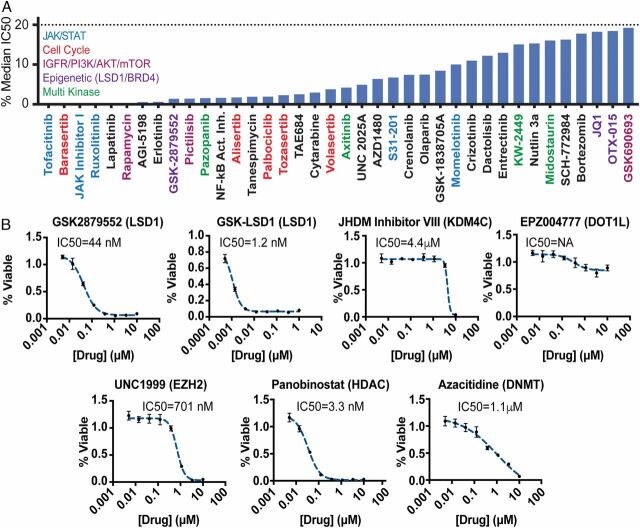
Fig. 1.
Fig. 1.
CEBPA/CSF3R mutant AML demonstrates sensitivity to JAK/STAT and LSD1 inhibition. (A) Mouse bone marrow cells immortalized through retroviral transduction with CSF3RT618I and CEBPAV314VW were screened against a panel of 175 inhibitors with established sensitivities in primary patient samples. Drugs with an IC50 < 20% median IC50 of all prior samples are shown. (B) CEBPA/CSF3R mutant AML cells were screened against a panel of epigenetic inhibitors with cytotoxicity assessed after 72 h of culture.
Fig. 2.
Fig. 2.
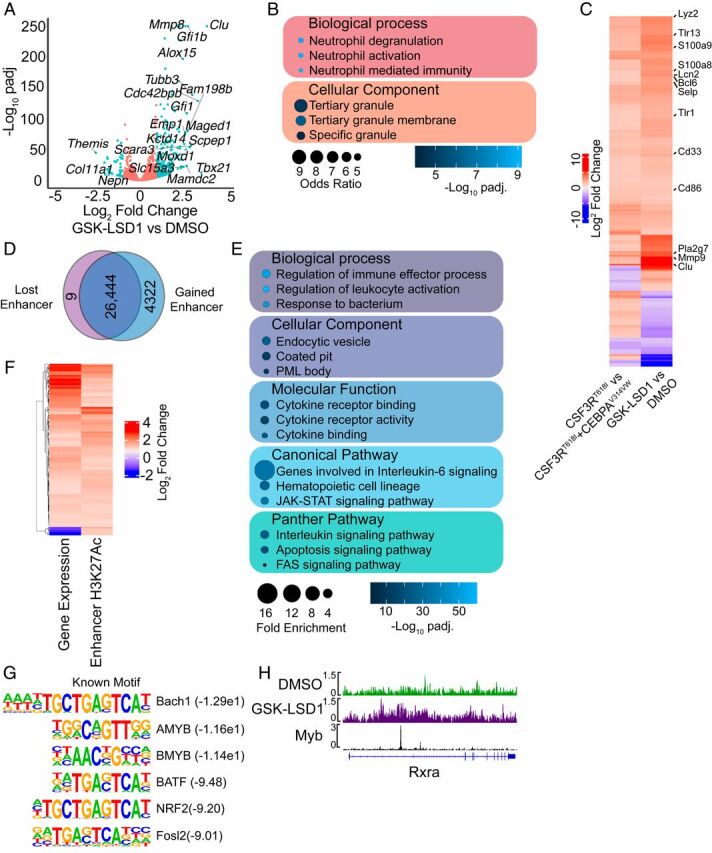
LSD1 inhibition reactivates differentiation-associated enhancers. (A) Differential gene expression assessed by RNA-seq in CEBPA/CSF3R mutant AML cells treated with GSK-LSD1 (4 nM) or DMSO for 48 h (n = 3/group). (B) Gene ontology analysis performed on genes with increased expression after LSD1 inhibitor treatment. (C) Correlation of genes differentially expressed in mouse bone marrow cells expressing CSF3RT618I or CSF3RT618I/CEBPAV314VW or upon LSD1 inhibitor treatment. (D) CEBPA/CSF3R AML cells were treated with GSK-LSD1 (4 nM) or DMSO for 48 h and subjected to histone mark ChIP-seq (n = 2/group). Enhancers were defined as the presence of H3K4me1 and H3K27Ac along with the absence of H3K4me3. Differential H3K27Ac signal at enhancers in response to GSK-LSD1 treatment. (E) Gene ontology analysis on enhancers with increased H3K27Ac in response to GSK-LSD1 treatment. (F) Correlation between differential gene expression and differential enhancer H3K27Ac in response to GSK-LSD1 treatment. (G) Motif enrichment analysis at enhancers with gained H3K27Ac in response to GSK-LSD1 treatment. (H) Example of gained enhancer at the Rxra locus with an overlapping Myb peak.
Fig. 3.
Fig. 3.
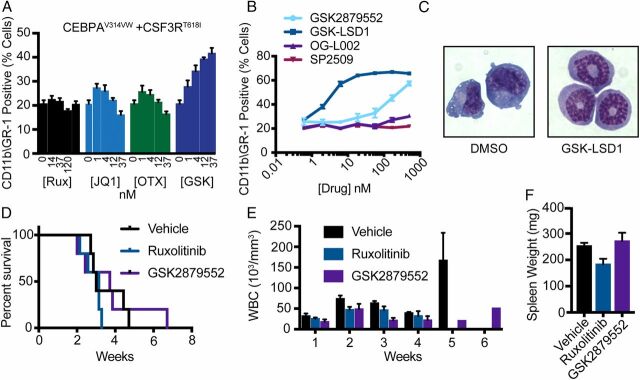
JAK/STAT and LSD1 inhibition fails to improve survival in vivo. (A) GR-1 and CD11b expression as measured by flow cytometry in HoxB8 ER cells expressing CSF3RT618I and CEBPAV314VW after 48 h of estrogen withdrawal and treatment with ruxolitinib, CPI-0610, OTX-015, JQ1, or GSK2879552 (n = 3/dose). (B) GR-1 and CD11b expression by flow cytometry in murine bone marrow cells immortalized through expression of CEBPAV314VW + CSF3RT618I and treated for 72 h with GSK2879552, GSK-LSD1, OG-L002, or SP2509 (n = 3/dose). (C) Representative images from CEBPA/CSF3R AML cells treated with 5 nM GSK-LSD1 for 72 h. (D) Survival posttreatment initiation for mice transplanted with 10,000 cells expressing CSF3RT618I and CEBPAV314VW and treated with GSK2879552 at 1.5 mg/kg/day or ruxolitinib at 90 mg/kg/day by twice daily oral gavage starting at week 2. (E) Weekly WBC count posttreatment initiation. (F) Spleen weight at time of survival endpoint (n = 4 to 5/group). In all cases, values are represented as mean ± SEM. Survival was assessed by the log-rank test. Significance of other comparisons was assessed by Student’s t test for two group comparisons or ANOVA with Sidak’s posttest, as appropriate.
Fig. 4.
Fig. 4.
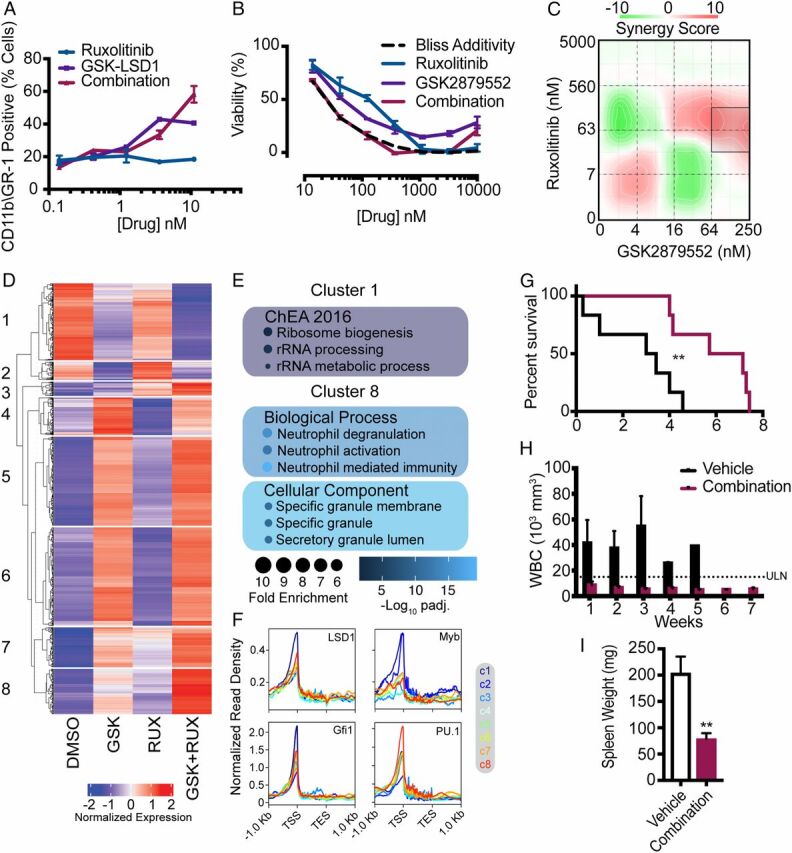
Combined inhibition of JAK/STAT signaling and LSD1 demonstrates synergy in vitro and improves survival in vivo. (A) GR-1 and CD11b expression measured by flow cytometry in murine bone marrow cells immortalized through expression of CEBPAV314VW + CSF3RT618I and treated for 72 h with ruxolitinib, GSK-LSD1, or the combination (n = 3/group). (B) Viability of murine bone marrow cells immortalized through expression of CEBPAV314VW + CSF3RT618I and treated for 72 h with ruxolitinib, GSK-2879552, or the combination. (C) Drug matrix of murine bone marrow cells immortalized through expression of CEBPAV314VW + CSF3RT618I and treated for 72 h with ruxolitinib and GSK-2879552 with synergy assessed by zero interaction potency score. (D) RNA-seq performed on CEBPA/CSF3R mutant AML cells treated with ruxolitinib (50 nM), GSK-LSD1 (2 nM), both drugs in combination, or DMSO (n = 3/group). Gene expression displayed by K-means clustering. (E) Gene ontology analysis of select clusters from D. (F) Overlap of ChIP-seq peaks for LSD1, Myb, Gfi1, and PU.1 with the promoters of differentially expressed genes separated by cluster. (G) Survival posttreatment initiation for mice transplanted with 10,000 cells expressing both oncogenes and treated with GSK2879552 at 1.5 mg/kg/day and ruxolitinib at 180 mg/kg/day or vehicle by oral gavage as a twice daily divided dose starting at week 3. (H) Weekly WBC count post treatment initiation. (I) Spleen weight at time of survival endpoint (n = 5 to 6/group). In all cases, values are represented as mean ± SEM. **P < 0.01. Survival was assessed by log-rank test. Significance of other comparisons was assessed by Student’s t test for two group comparisons or ANOVA with Sidak’s posttest, as appropriate.

References

    1. Yates J. W., Wallace H. J. Jr., Cytosine arabinoside (NSC-63878) and daunorubicin (NSC-83142) therapy in acute nonlymphocytic leukemia. Cancer Chemother. Rep. 57, 485–488 (1973). - PubMed
    1. Döhner H.et al. ., Diagnosis and management of AML in adults: 2017 ELN recommendations from an international expert panel. Blood 129, 424–447 (2017). - PMC - PubMed
    1. Avellino R., Delwel R., Expression and regulation of C/EBPα in normal myelopoiesis and in malignant transformation. Blood 129, 2083–2091 (2017). - PubMed
    1. Zhang P.et al. ., Enhancement of hematopoietic stem cell repopulating capacity and self-renewal in the absence of the transcription factor C/EBP alpha. Immunity 21, 853–863 (2004). - PubMed
    1. Pabst T.et al. ., Dominant-negative mutations of CEBPA, encoding CCAAT/enhancer binding protein-alpha (C/EBPalpha), in acute myeloid leukemia. Nat. Genet. 27, 263–270 (2001). - PubMed

Publication types

MeSH terms