. 2020 Sep 23;41(5):1033-1036.
doi: 10.1093/jbcr/iraa086.

Managing Burns During COVID-19 Outbreak

Affiliations

Managing Burns During COVID-19 Outbreak

Shivangi Saha et al. J Burn Care Res. .

Abstract

The coronavirus disease pandemic has affected our practice as healthcare professionals. As burn surgeons, we are obliged to provide the best possible care to our patients. However, due to the risk of viral transmission, the goal should be to provide safe care to our patients as well as ensure the safety of the whole team providing burn care. The burn patients are usually debilitated and require a prolonged hospital stay and multiple operative procedures which put them and everyone involved in their care at increased risk of coronavirus infections and transmission. This warrants special caution to the burn team while managing such patients. In this review, we aim to highlight the key considerations for burn care teams while dealing with burn patients during the COVID-19 pandemic.


Figures

Figure 1.
Figure 1.
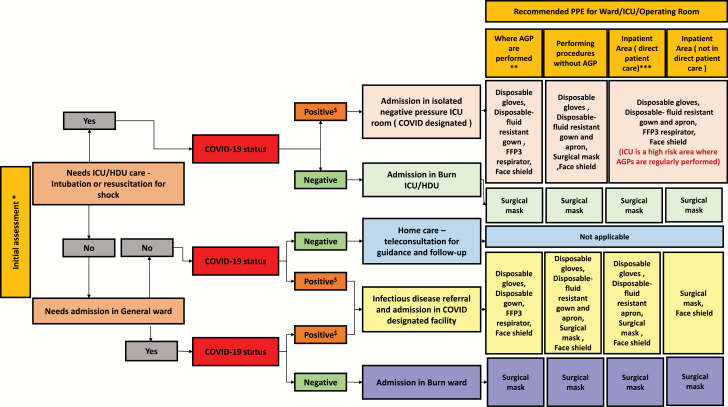
An algorithm for decision making for management of burns, admission facility, and recommended safety measures to be worn during the course of hospital stay (adapted from COVID-19: Good Practice for Surgeons and Surgical Teams, Royal College of Surgeons). *At initial assessment in the emergency department, disposable gloves, disposable gown and apron, fluid-resistant mask (type IIR), and face shield should be worn. Every patient presenting for treatment should be treated as a potential infected case and should be tested if screening indicates. Ideally, the surgical mask should be a fluid-resistant (type IIR) facemask. The overall filter efficiency of FFP1, FFP2, and FFP3 masks is 80%, 94%, and 99%, respectively.**The following procedures are currently considered to be AGP (aerosol-generating procedures) for COVID-19: intubation, extubation, and related procedures, eg, manual ventilation and open suctioning of the respiratory tract (including the upper respiratory tract); tracheotomy/tracheostomy procedures (insertion/open suctioning/removal); bronchoscopy and upper ENT airway procedures that involve suctioning; surgical procedures involving high-speed devices; noninvasive ventilation, eg, Bilevel positive airway pressure ventilation and continuous positive airway pressure ventilation, high-frequency oscillatory ventilation, and high-flow nasal oxygen. ***Direct patient care: involves working within 2 m of a positive case or direct contact. Note: Hand hygiene should be performed at entry and exit and frequently in between for all categories irrespective of whether PPE is worn. ICU, intensive care unit; HDU, high dependency unit; AGP, aerosol-generating procedure. $A COVID-positive patient should wear a surgical mask, in addition, if the patient undergoes an AGP, a protective hood may be used.
Figure 2.
Figure 2.
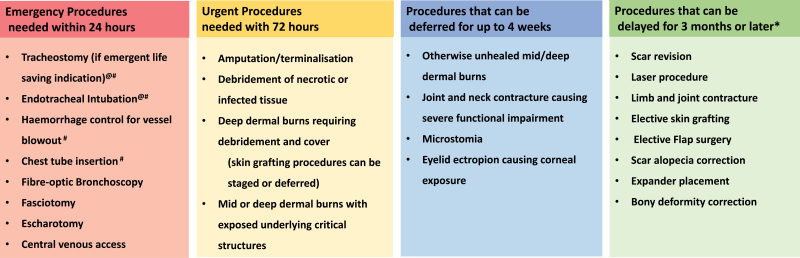
Guide for prioritization of procedures and surgeries on burn patients (adapted from the clinical guide to surgical prioritization during the coronavirus pandemic). #Lifesaving procedures that need to be done within minutes to hours. @Ranked highest among the AGPs (aerosol-generating procedures). *Till the pandemic curve flattens or is settled as per definition.

References

    1. Lancet T. COVID-19: protecting health-care workers. Lancet 2020;395:922. - PMC - PubMed
    1. Huang S-B, Chang W-H, Huang C-H et al. Management of elderly burn patients. Int J Gerontol 2008;2:91–7.
    1. Burns. https://www.who.int/news-room/fact-sheets/detail/burns; accessed 31 Mar. 2020.
    1. Training | Personal Protective Equipment (PPE) | Public Health Planners | Ebola (Ebola Virus Disease) | CDC. https://www.cdc.gov/vhf/ebola/healthcare-us/ppe/training.html. Published 25 July 2019; accessed 31 Mar. 2020.
    1. Black JRM, Bailey C, Przewrocka J, Dijkstra KK, Swanton C. COVID-19: the case for health-care worker screening to prevent hospital transmission. Lancet 2020;395:1418–20. doi: 10.1016/S0140-6736(20)30917-X - DOI - PMC - PubMed