Review
. 2020 Jun 1;9(1):19.
doi: 10.1186/s40035-020-00197-z.

Mitochondria as a target for neuroprotection: role of methylene blue and photobiomodulation

Affiliations
Review

Mitochondria as a target for neuroprotection: role of methylene blue and photobiomodulation

Luodan Yang et al. Transl Neurodegener. .

Abstract

Mitochondrial dysfunction plays a central role in the formation of neuroinflammation and oxidative stress, which are important factors contributing to the development of brain disease. Ample evidence suggests mitochondria are a promising target for neuroprotection. Recently, methods targeting mitochondria have been considered as potential approaches for treatment of brain disease through the inhibition of inflammation and oxidative injury. This review will discuss two widely studied approaches for the improvement of brain mitochondrial respiration, methylene blue (MB) and photobiomodulation (PBM). MB is a widely studied drug with potential beneficial effects in animal models of brain disease, as well as limited human studies. Similarly, PBM is a non-invasive treatment that promotes energy production and reduces both oxidative stress and inflammation, and has garnered increasing attention in recent years. MB and PBM have similar beneficial effects on mitochondrial function, oxidative damage, inflammation, and subsequent behavioral symptoms. However, the mechanisms underlying the energy enhancing, antioxidant, and anti-inflammatory effects of MB and PBM differ. This review will focus on mitochondrial dysfunction in several different brain diseases and the pathological improvements following MB and PBM treatment.

Keywords: Methylene blue; Mitochondrial dysfunction; Neuroprotection; Photobiomodulation.


Conflict of interest statement

The authors declare that they have no competing interests.

Figures
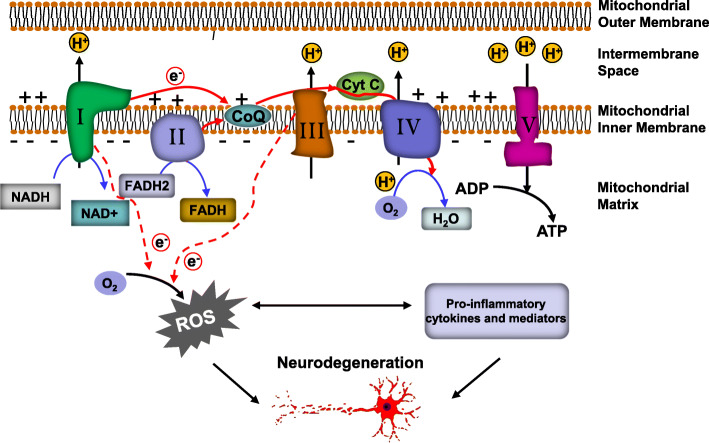
Fig. 1
Fig. 1
Diagram of electron leakage in brain disease. Electrons in the mitochondrial ETC are transferred along a series of four protein complexes (Complexes I-IV) with the aid of electron transporters NADH, FADH2, ubiquinone (Co-enzyme Q10, CoQ), and cytochrome c (Cyt c). As a result of this electron transfer, protons are pumped by Complexes I, III, and IV from the mitochondrial matrix into the intermembrane space, thereby generating an electrochemical gradient across the inner mitochondrial membrane. This gradient is used to propel ATP synthase (Complex V) to produce ATP. Although this process is highly efficient, electrons can escape from Complex I and Complex III and be transferred to O2, which is reduced to the radical O2•−. This ROS production is exacerbated under pathological conditions such as brain disease and activates inflammatory processes, thereby establishing a cycle of ROS production, inflammation, and neuronal damage
Fig. 2
Fig. 2
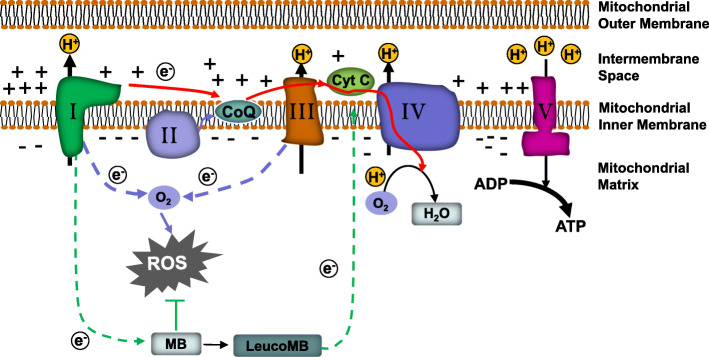
Primary Mechanisms Underlying Mitochondria Protection through MB. MB reroutes the pathway of electron transfer by working as an alternative electron transporter. By bypassing the ETC between Complex I and Complex III, MB efficiently attenuates electron leakage and subsequent ROS generation
Fig. 3
Fig. 3
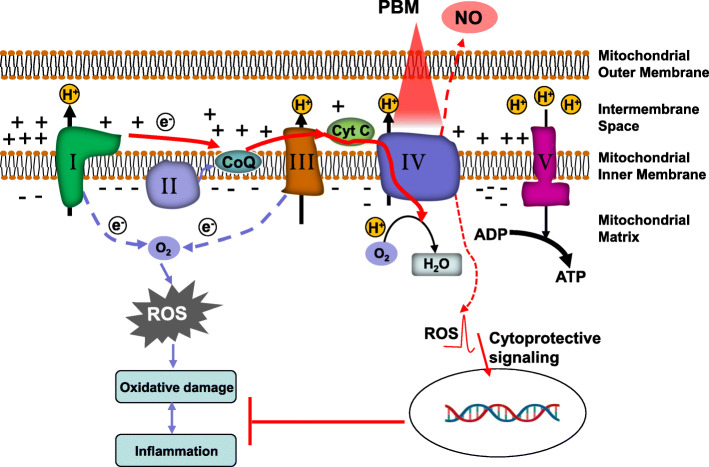
Primary Mechanisms Underlying Mitochondria Protection through PBM. PBM treatment causes NO to dissociate from Complex IV (cytochrome c oxidase, CCO), causing the complex’s activity to increase. This allows the flux of electrons, the pumping of protons, and the synthesis of ATP to increase, thereby boosting cellular energy levels. In addition, when PBM stimulates Complex IV activity in normal cells, mitochondrial membrane potential is increased above normal baseline levels, resulting in a brief and rather modest increase in ROS production. The short burst of ROS is able to activate cytoprotective signaling, which attenuate ROS induced oxidative damage and neuroinflammation
Fig. 4
Fig. 4
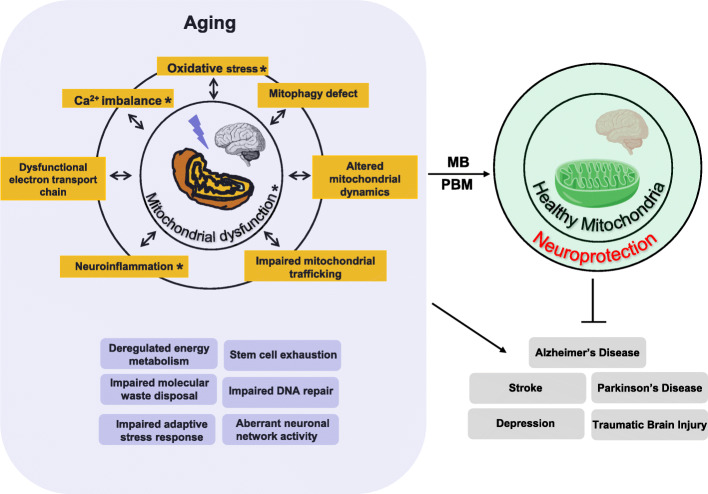
Mitochondrial related changes associated with mitochondrial dysfunction. Mitochondrial dysfunction, oxidative damage, dysregulated neuronal Ca2+, and neuroinflammation are hallmarks of brain aging (the other six hallmarks are deregulated energy metabolism, stem cell exhaustion, impaired molecular waste disposal, impaired DNA repair, impaired adaptive stress response, and aberrant neuronal network activity) . Increasing evidence suggested the hallmarks of brain aging affect several brain disease etiologies [316, 317]. MB and PBM can attenuate the pathological symptoms of several brain diseases and lead to neuroprotection by reducing various aspects of mitochondrial dysfunction

References

    1. Chaturvedi RK, Flint BM. Mitochondrial diseases of the brain. Free Rad Biol Med. 2013;63:1–29. - PubMed
    1. Tian WF, Zeng S, Sheng Q, Chen JL, Weng P, Zhang XT, et al. Methylene Blue Protects the Isolated Rat Lungs from Ischemia-Reperfusion Injury by Attenuating Mitochondrial Oxidative Damage. Lung. 2018;196:73–82. - PubMed
    1. Szarka N, Pabbidi MR, Amrein K, Czeiter E, Berta G, Pohoczky K, et al. Traumatic Brain Injury Impairs Myogenic Constriction of Cerebral Arteries: Role of Mitochondria-Derived H2O2 and TRPV4-Dependent Activation of BKca Channels. J Neurotrauma. 2018. - PMC - PubMed
    1. Yang L, Tucker D, Dong Y, Wu C, Lu Y, Li Y, et al. Photobiomodulation therapy promotes neurogenesis by improving post-stroke local microenvironment and stimulating neuroprogenitor cells. Exp Neurol. 2018;299:86–96. - PMC - PubMed
    1. Niizuma K, Yoshioka H, Chen H, Kim GS, Jung JE, Katsu M, et al. Mitochondrial and apoptotic neuronal death signaling pathways in cerebral ischemia. Biochim Biophys Acta. 2010;1802:92–99. - PMC - PubMed

Publication types

MeSH terms