. 2020 May 31;21(1):378.
doi: 10.1186/s12864-020-6688-8.

Discovering candidate imprinted genes and imprinting control regions in the human genome

Affiliations

Discovering candidate imprinted genes and imprinting control regions in the human genome

Minou Bina. BMC Genomics. .

Abstract

Background: Genomic imprinting is a process thereby a subset of genes is expressed in a parent-of-origin specific manner. This evolutionary novelty is restricted to mammals and controlled by genomic DNA segments known as Imprinting Control Regions (ICRs) and germline Differentially Methylated Regions (gDMRs). Previously, I showed that in the mouse genome, the fully characterized ICRs/gDMRs often includes clusters of 2 or more of a set of composite-DNA-elements known as ZFBS-morph overlaps.

Results: Because of the importance of the ICRs to regulating parent-of-origin specific gene expression, I developed a genome-wide strategy for predicting their positions in the human genome. My strategy consists of creating plots to display the density of ZFBS-morph overlaps along the entire chromosomal DNA sequences. In initial evaluations, I found that peaks in these plots pinpointed several of the known ICRs/gDMRs along the DNA in chromosomal bands. I deduced that in density-plots, robust peaks corresponded to actual or candidate ICRs in the DNA. By locating the genes in the vicinity of candidate ICRs, I could discover potential imprinting genes. Additionally, my assessments revealed a connection between several of the potential imprinted genes and human developmental anomalies. Examples include Leber congenital amaurosis 11, Coffin-Siris syndrome, progressive myoclonic epilepsy-10, microcephalic osteodysplastic primordial dwarfism type II, and microphthalmia, cleft lip and palate, and agenesis of the corpus callosum.

Conclusion: With plots displaying the density of ZFBS-morph overlaps, researchers could locate candidate ICRs and imprinted genes. Since the datafiles are available for download and display at the UCSC genome browser, it is possible to examine the plots in the context of Single nucleotide polymorphisms (SNPs) to design experiments to discover novel ICRs and imprinted genes in the human genome.

Keywords: Developmental; Gene regulation; Genetics; Genomic imprinting; MLL; Mammals; Syndrome; ZFP57.


Conflict of interest statement

The author declares that she has no competing interests.

Figures
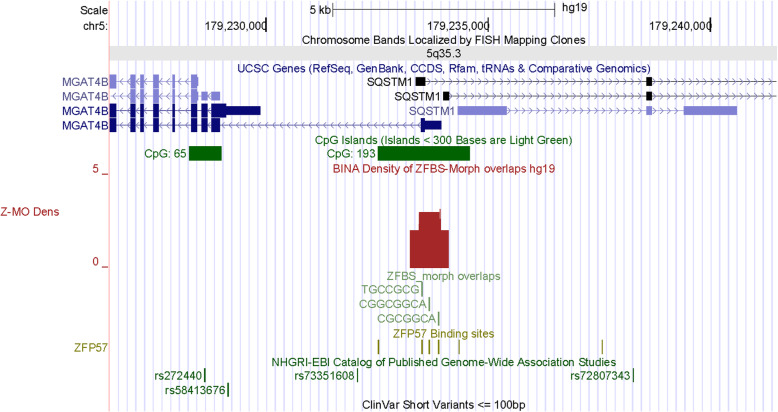
Fig. 1
Fig. 1
A candidate ICR mapping to overlapping transcripts (MGAT4B and SQSTM1). High-throughput experimental analysis has identified SQSTM1 as a candidate imprinted gene [15]. The density-plots include a peak corresponding to a candidate ICR for imprinted expression of SQSTM1. Furthermore, the position of this ICR predicts parent-of-origin specific expression for the longest transcript produced from MGAT4B
Fig. 2
Fig. 2
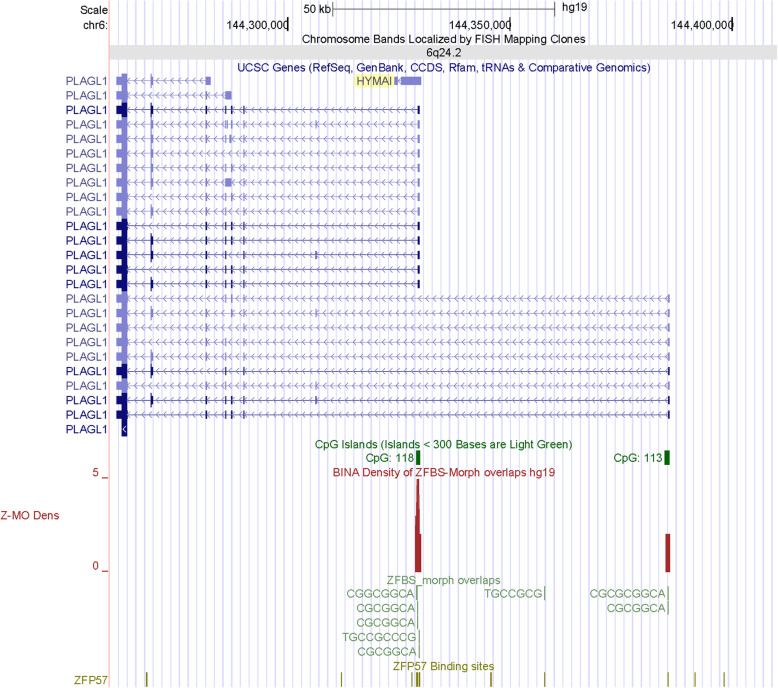
The position of a robust density peak locating the ICR in the PLAGL1 locus. In descending order, tracks display the positions of the chromosomal bands (gray), genes and transcripts (blue), CGIs (green), peaks in the density-plots (maroon). The sequences of ZFBS-Morph overlaps are shown in pack format (hunter green), the canonical ZFP57 in dense format (olive green)
Fig. 3
Fig. 3
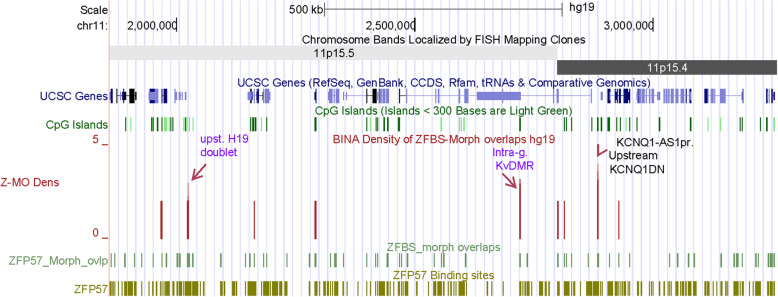
The positions of peaks in a density-plot covering 1.4 Mb long DNA. The density-plot is shown in full format. The other tracks are shown in dense-format. Purple letters denote the known ICRs. Black letters denote an intergenic candidate ICR
Fig. 4
Fig. 4
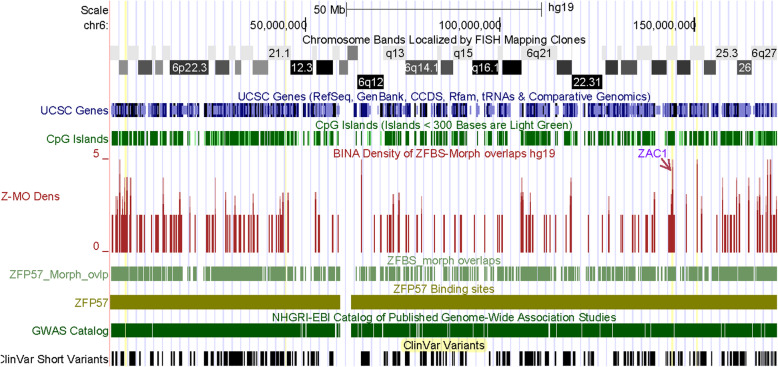
The positions of density peaks along the entire Chr6. At the UCSC genome browser, one could examine the peak positions with respect to genes, in the context of clinical variants, and Genome-wide Association Studies (GWAS). These tracks facilitate examining the potential imprinted genes in the context of diseases, genetic abnormalities, and genome-wide variants associated with a trait. Note that within nearly 172 Mb DNA, clearly discernable is a very robust peak corresponding to the ICR of ZAC1. Along the chromosome are additional robust peaks for candidate ICRs
Fig. 5
Fig. 5
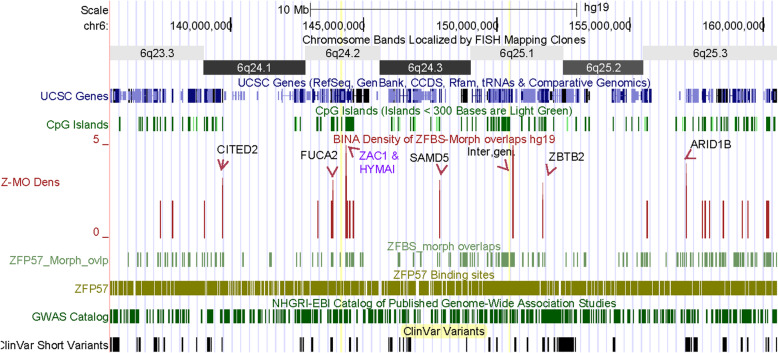
Discovering candidate ICRs and novel imprinting genes in Chr6. The displayed chromosomal section includes several density peaks dispersed across several bands. One of the robust peaks corresponds to the ICR of ZAC1 and HYMAI. The remaining robust peaks define the positions of candidate ICRs for potential imprinted genes or transcripts
Fig. 6
Fig. 6
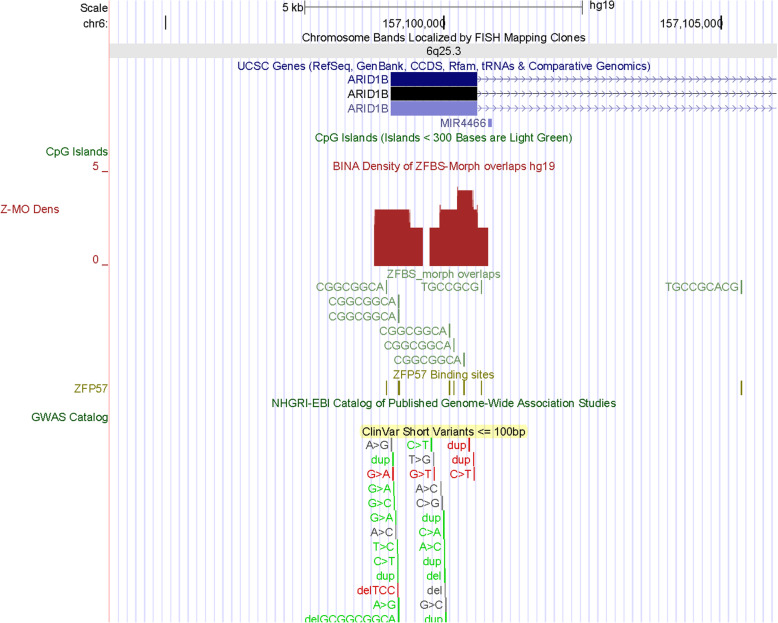
A candidate ICR regulating parent-of-origin specific expression of ARID1B. The official name of ARID1B is KDM5B. In mouse Arid1b is a known imprinted gene [29]
Fig. 7
Fig. 7
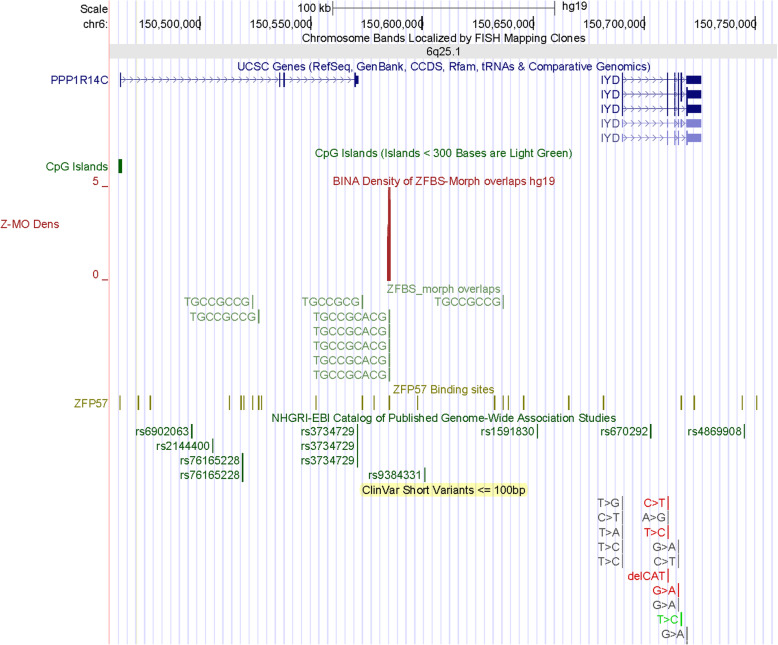
An intergenic candidate ICR regulating parent-of-origin specific expression of PPP1R14C and IYD. GWAS identified several potentially significant SNPs in PPP1R14C. Thyroid dyshormonogenesis-4 (TDH4) is caused by homozygous mutations in IYD. Patients with this defect lack the ability to deiodinate radiolabeled monoiodotyrosine and diiodotyrosine [40]
Fig. 8
Fig. 8
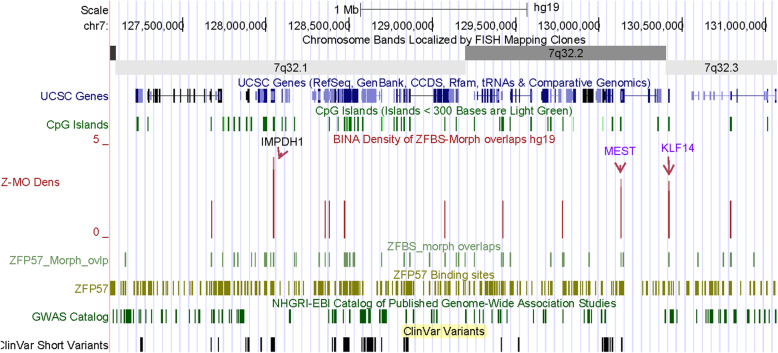
A long DNA section from Chr7q. The displayed section contains the ICR in the MEST locus, a known imprinting gene (KF14), and a candidate ICR for a potential imprinted gene (IMPDH1)
Fig. 9
Fig. 9
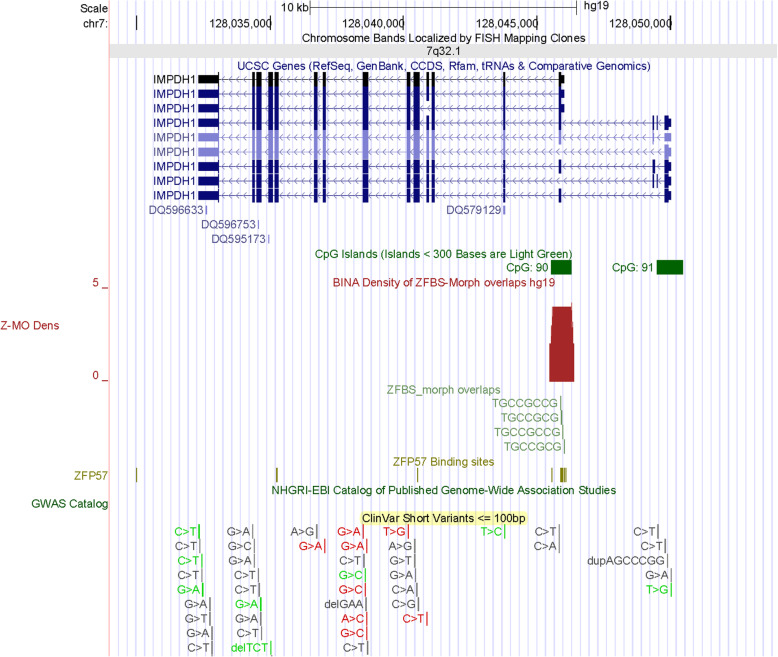
A candidate ICR in the IMPDH1 locus. The corresponding peak maps to a CGI that encompasses TSSs of several intragenic IMPDH1 transcripts
Fig. 10
Fig. 10
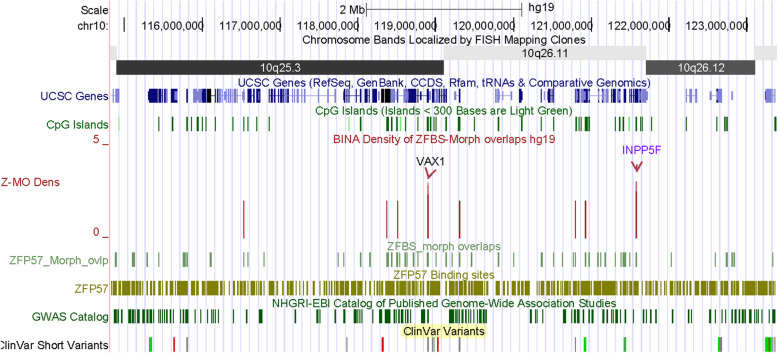
A long DNA section encompassing two robust density peaks. One of the peaks maps to the known ICR in INPP5F locus
Fig. 11
Fig. 11
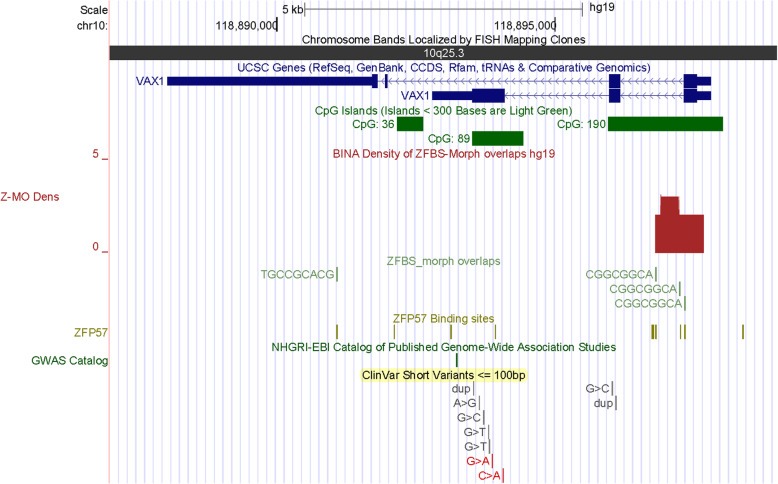
A candidate ICR regulating expression of a potential imprinted gene. The corresponding density peak is in a CGI that encompasses TSSs of VAX1 transcripts

References

    1. Grafodatskaya D, Choufani S, Basran R, Weksberg R. An update on molecular diagnostic testing of human imprinting disorders. J Pediatr Genet. 2017;6(1):3–17. - PMC - PubMed
    1. Strogantsev R, Ferguson-Smith AC. Proteins involved in establishment and maintenance of imprinted methylation marks. Brief Funct Genomics. 2012;11(3):227–239. - PubMed
    1. Stewart KR, Veselovska L, Kelsey G. Establishment and functions of DNA methylation in the germline. Epigenomics. 2016;8(10):1399–1413. - PMC - PubMed
    1. Holz-Schietinger C, Reich NO. The inherent processivity of the human de novo methyltransferase 3A (DNMT3A) is enhanced by DNMT3L. J Biol Chem. 2010;285(38):29091–29100. - PMC - PubMed
    1. Quenneville S, Verde G, Corsinotti A, Kapopoulou A, Jakobsson J, Offner S, Baglivo I, Pedone PV, Grimaldi G, Riccio A, et al. In embryonic stem cells, ZFP57/KAP1 recognize a methylated hexanucleotide to affect chromatin and DNA methylation of imprinting control regions. Mol Cell. 2011;44(3):361–372. - PMC - PubMed

LinkOut - more resources