


Comparison of mathematical and comparative slaughter methodologies for determination of heat production and energy retention in broilers
- PMID: 32475460
- PMCID: PMC7597740
- DOI: 10.1016/j.psj.2020.02.005
Comparison of mathematical and comparative slaughter methodologies for determination of heat production and energy retention in broilers
Abstract
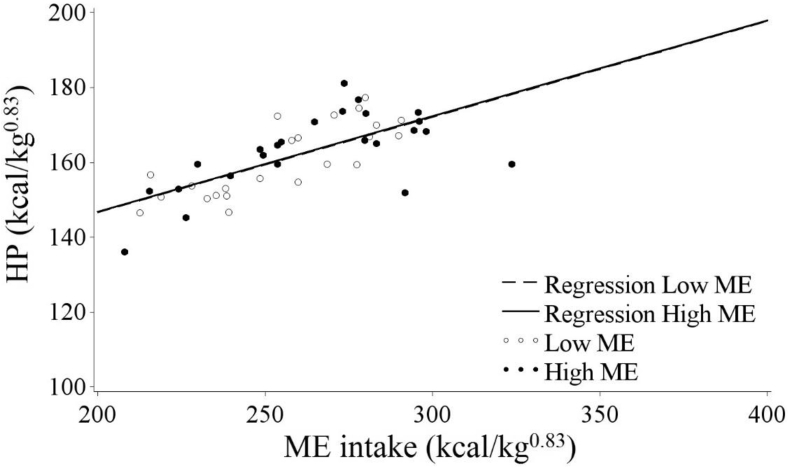
Understanding factors affecting ME availability for productive processes is an important step in optimal feed formulation. This study compared a modelling methodology with the comparative slaughter technique (CST) to estimate energy partitioning to heat production and energy retention (RE) and to investigate differences in heat dissipation. At hatch, 50 broilers were randomly allocated in one of 4 pens equipped with a precision feeding station. From day 14 to day 45, they were either fed with a low-ME (3,111 kcal/kg ME) or a high-ME (3,383 kcal/kg ME) diet. At day 19, birds were assigned to pair-feeding in groups of 6 with lead birds eating ad libitum (100%) and follow birds eating at either 50, 60, 70, 80, or 90% of the paired lead's cumulative feed intake. Heat production and RE were estimated by CST and with a nonlinear mixed model explaining daily ME intake (MEI) as a function of metabolic BW and average daily gain (ADG). The energy partitioning model predicted MEI = (145.10 + u) BW0.83 + 1.09 × BW-0.18 × ADG1.19 + ε. The model underestimated heat production by 13.4% and overestimated RE by 22.8% compared with the CST. The model was not able to distinguish between net energy for gain values of the diets (1,448 ± 18.5 kcal/kg vs. 1,493 ± 18.0 kcal/kg for the low-ME and high-ME diet, respectively), whereas the CST found a 148 kcal/kg difference between the low-ME and high-ME diets (1,101 ± 22.5 kcal/kg vs. 1,249 ± 22.0 kcal/kg, respectively). The estimates of the net energy for gain values of the 2 diets decreased with increasing feed restriction. The heat increment of feeding did not differ between birds fed with the low- or high-ME diet (26% of MEI). Additional measurements on heat dissipation, physical activity, and immune status indicated that the energetic content of the diet and feed restriction affect some parameters (shank temperature, feeding station visits) but not others (leukocyte counts, heterophil to lymphocyte ratio, and immune cell function).
Keywords: energetic modeling; maintenance; net energy.
Copyright © 2020. Published by Elsevier Inc.
Figures


References
-
- Birkett S., de Lange K. Limitations of conventional models and a conceptual framework for a nutrient flow representation of energy utilization by animals. Br. J. Nutr. 2001;86:647–659. - PubMed
-
- Bravo D., Pirgozliev V., Rose S.P. A mixture of carvacrol, cinnamaldehyde, and capsicum oleoresin improves energy utilization and growth performance of broiler chickens fed maize-based diet. J. Anim. Sci. 2014;92:1531–1536. - PubMed
-
- Buyse J., Decuypere E., Berghman L., Kühn E.R., Vandesande F. Effect of dietary protein content on episodic growth hormone secretion and on heat production of male broiler chickens. Br. Poult. Sci. 1992;33:1101–1109. - PubMed
-
- Byerly T.C., Kessler J.W., Gous R.M., Thomas O.P. Feed requirements for egg production. Poult. Sci. 1980;59:2500–2507.
-
- Carré B., Lessire M., Juin H. Prediction of the net energy value of broiler diets. Animal. 2014;8:1395–1401. - PubMed
Publication types
MeSH terms
LinkOut - more resources
Full Text Sources
