Anti-Sm Antibody, Damage Index, and Corticosteroid Use Are Associated with Cardiac Involvement in Systemic Lupus Erythematosus: Data from a Prospective Registry Study
- PMID: 32476300
- PMCID: PMC7261696
- DOI: 10.3346/jkms.2020.35.e139
Anti-Sm Antibody, Damage Index, and Corticosteroid Use Are Associated with Cardiac Involvement in Systemic Lupus Erythematosus: Data from a Prospective Registry Study
Abstract
Background: Disease-specific factors that predispose patients to diverse cardiac diseases in systemic lupus erythematosus (SLE) have been established. The aim of this study was to identify risk factors for cardiac involvement in patients with SLE drawn from the Korean Lupus Network (KORNET) registry.
Methods: A total of 437 patients with SLE recruited from the KORNET registry were included in the analysis. The Cox proportional hazard model was used to identify risk factors for the development of cardiac involvement during the follow-up period. The hazard ratios for risk factors of cardiac involvement were assessed using Kaplan-Meier curves and log-rank test.
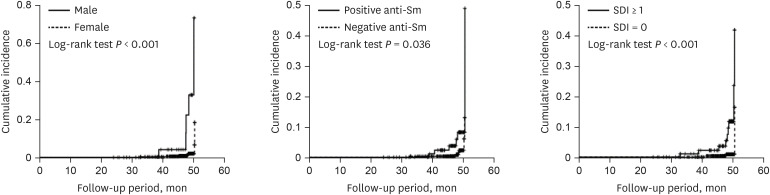
Results: Of 437 patients with SLE, 12 patients (2.7%) developed new cardiac involvement during a median follow-up period of 47.6 months. Frequencies in men and in patients with anti-Sm antibody, anti-Ro antibody, and at least one Systemic Lupus International Collaborating Clinics/American College of Rheumatology damage index (SDI) score in patients with cardiac involvement were higher, compared to those without cardiac involvement (P < 0.001, P = 0.026, P = 0.015, and P < 0.001, respectively). Men gender, older age, anti-Sm antibody, SDI, and corticosteroid dosage were potent predictors for cardiac involvement in patients with SLE in the determination of risk factors for cardiac involvement. Men, anti-Sm antibody positivity, and SDI ≥ 1 increased incidence rates of cardiac involvement for (P < 0.001, P = 0.036, and P < 0.001, respectively).
Conclusion: The results of this study reveal that SLE-related factors such as anti-Sm antibody, SDI, and corticosteroid dosage at baseline are risk factors for cardiac involvement in SLE.
Keywords: Autoimmunity; Cardiovascular Disease; Steroid; Systemic Lupus Erythematous.
© 2020 The Korean Academy of Medical Sciences.
Conflict of interest statement
The authors have no potential conflicts of interest to disclose.
Figures
References
-
- Lisnevskaia L, Murphy G, Isenberg D. Systemic lupus erythematosus. Lancet. 2014;384(9957):1878–1888. - PubMed
-
- Tsokos GC. Systemic lupus erythematosus. N Engl J Med. 2011;365(22):2110–2121. - PubMed
-
- Borchers AT, Keen CL, Shoenfeld Y, Gershwin ME. Surviving the butterfly and the wolf: mortality trends in systemic lupus erythematosus. Autoimmun Rev. 2004;3(6):423–453. - PubMed
-
- Aviña-Zubieta JA, To F, Vostretsova K, De Vera M, Sayre EC, Esdaile JM. Risk of myocardial infarction and stroke in newly diagnosed systemic lupus erythematosus: a general population-based study. Arthritis Care Res (Hoboken) 2017;69(6):849–856. - PubMed
-
- Tselios K, Gladman DD, Su J, Ace O, Urowitz MB. Evolution of risk factors for atherosclerotic cardiovascular events in systemic lupus erythematosus: a longterm prospective study. J Rheumatol. 2017;44(12):1841–1849. - PubMed
MeSH terms
Substances
Grants and funding
LinkOut - more resources
Full Text Sources
Medical
Research Materials