


Long-Term Association of Venous Thromboembolism With Frailty, Physical Functioning, and Quality of Life: The Atherosclerosis Risk in Communities Study
- PMID: 32476561
- PMCID: PMC7429054
- DOI: 10.1161/JAHA.119.015656
Long-Term Association of Venous Thromboembolism With Frailty, Physical Functioning, and Quality of Life: The Atherosclerosis Risk in Communities Study
Abstract
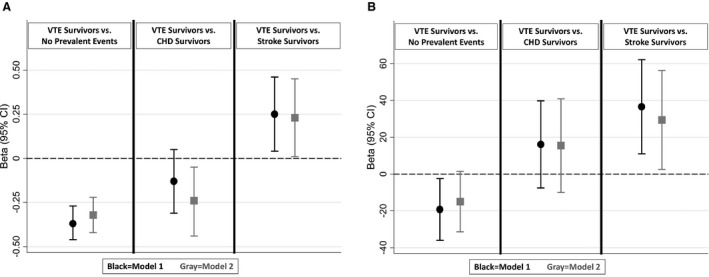
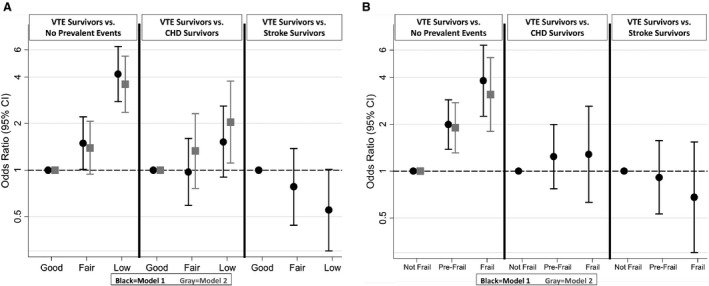
Background Relatively little is known about the long-term consequences of venous thromboembolism (VTE) on physical functioning. We compared long-term frailty status, physical function, and quality of life among survivors of VTE with survivors of coronary heart disease (CHD) and stroke, and with those without these diseases. Methods and Results Cases of VTE, CHD, and stroke were continuously identified since ARIC (Atherosclerosis Risk in Communities Study) recruitment during 1987 to 1989. Functional measures were objectively captured at ARIC clinic visits 5 (2011-2013) and 6 (2016-2017); quality of life was self-reported. The 6161 participants at visit 5 were, on average, 75.7 (range, 66-90) years of age. By visit 5, 3.2% had had a VTE, 6.9% CHD, and 3.4% stroke. Compared with those without any of these conditions, VTE survivors were more likely to be frail (odds ratio [OR], 3.11; 95% CI, 1.80-5.36) and have low (<10) versus good scores on the Short Physical Performance Battery (OR, 3.59; 95% CI, 2.36-5.47). They also had slower gait speed, less endurance, and lower physical quality of life. VTE survivors were similar to coronary heart disease and stroke survivors on categorical frailty and outcomes on Short Physical Performance Battery assessment. When score on the Short Physical Performance Battery instrument was modeled continuously, VTE survivors performed better than stroke survivors but worse than CHD survivors. Conclusions VTE survivors had triple the odds of frailty and poorer physical function than those without the vascular diseases considered. Their function was somewhat worse than that of CHD survivors, but better than stroke survivors. These findings suggest that VTE patients may benefit from additional efforts to improve postevent physical functioning.
Keywords: frailty; physical function; quality of life; venous thromboembolism.
Figures
References
-
- Benjamin EJ, Muntner P, Alonso A, Bittencourt MS, Callaway CW, Carson AP, Chamberlain AM, Chang AR, Cheng S, Das SR, et al. Heart disease and stroke statistics 2019 update: a report from the American Heart Association. Circulation. 2019;e56–e528. - PubMed
-
- Tagalakis V, Patenaude V, Kahn SR, Suissa S. Incidence of and mortality from venous thromboembolism in a real‐world population: the Q‐VTE Study Cohort. Am J Med. 2013;832.e13–832.e21. - PubMed
-
- Gaertner S, Cordeanu EM, Nouri S, Faller AM, Frantz AS, Mirea C, Bilbault P, Ohlmann P, Le Ray I, Stephan D. Rivaroxaban versus standard anticoagulation for symptomatic venous thromboembolism (REMOTEV observational study): analysis of 6‐month outcomes. Int J Cardiol. 2017;103–109. - PubMed
Publication types
MeSH terms
Grants and funding
LinkOut - more resources
Full Text Sources
Medical
