


Identification of apolipoprotein A-I in BALF as a biomarker of sarcoidosis
- PMID: 32476874
- PMCID: PMC7170057
- DOI: 10.36141/svdld.v35i1.5834
Identification of apolipoprotein A-I in BALF as a biomarker of sarcoidosis
Abstract
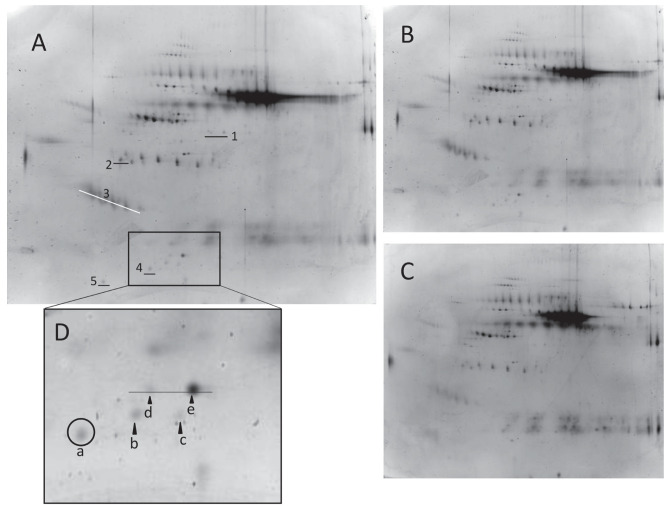
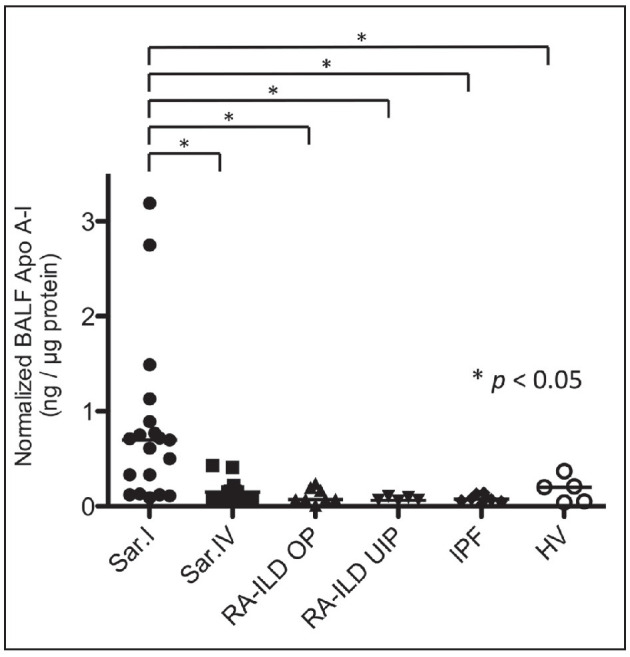
Background: Sarcoidosis goes into remission in two-thirds of patients with sarcoidosis, but about 20 % of patients develop pulmonary fibrosis. The mechanisms of pulmonary fibrosis in sarcoidosis and differences in pathogenesis between clinical stages are still unclear. Objectives: The aim of this study was investigating proteins associated with clinical stages by comparing bronchoalveolar lavage fluid (BALF) protein between stage I and stage IV using proteome analysis. Methods: Proteomic differences in BALF were compared between stage I and stage IV by examining BALF from 8 stage I patients and 5 stage IV patients by two-dimensional gel electrophoresis and mass spectrometry. Results: In individual comparisons of BALF samples, the levels of apolipoprotein (Apo) A-I fragment, fibrinogen γ chain, calcyphosine, complement C3, and surfactant protein A were significantly higher in stage I than in stage IV. In contrast, none of the proteins examined significantly higher in stage IV than in stage I. To confirm the results of Apo A-I in the BALF proteome, we performed enzyme-linked immunosorbent assay (ELISA) in a larger group. The concentration of BALF Apo A-I was significantly higher in stage I patients than in stage IV patients (0.70 [0.13-0.89] vs. 0.15 [0.08-0.21] ng/μg protein, p=0.003). Conclusion: The involvement of BALF Apo A-I in sarcoidosis may differ between stage I and stage IV. (Sarcoidosis Vasc Diffuse Lung Dis 2018; 35: 5-15).
Keywords: apolipoprotein A-I; bronchoalveolar lavage fluid; interstitial pneumonia; proteomics; sarcoidosis.
Copyright: © 2018.
Figures

References
-
- Statement on sarcoidosis. Joint Statement of the American Thoracic Society (ATS), the European Respiratory Society (ERS) and the World Association of Sarcoidosis and Other Granulomatous Disorders (WASOG) adopted by the ATS Board of Directors and by the ERS Executive Committee, February 1999. AJRCCM. 1999;160:736–55. - PubMed
-
- Li X, Chyu KY, Faria Neto JR, et al. Differential effects of apolipoprotein A-I-mimetic peptide on evolving and established atherosclerosis in apolipoprotein E-null mice. Circulation. 2004;110:1701–5. - PubMed
-
- Kim TH, Lee YH, Kim KH, et al. Role of lung apolipoprotein A-I in idiopathic pulmonary fibrosis: antiinflammatory and antifibrotic effect on experimental lung injury and fibrosis. AJRCCM. 2010;182:633–42. - PubMed
-
- Park SW, Lee EH, Lee EJ, et al. Apolipoprotein A1 potentiates lipoxin A4 synthesis and recovery of allergen-induced disrupted tight junctions in the airway epithelium. Clin Exp Allergy. 2013;43:914–27. - PubMed
LinkOut - more resources
Full Text Sources
Miscellaneous