


The Effectiveness of the Expanded Food and Nutrition Education Program (EFNEP) on Diet Quality as Measured by the Healthy Eating Index
- PMID: 32477034
- PMCID: PMC7232890
- DOI: 10.1177/1559827619872733
The Effectiveness of the Expanded Food and Nutrition Education Program (EFNEP) on Diet Quality as Measured by the Healthy Eating Index
Abstract
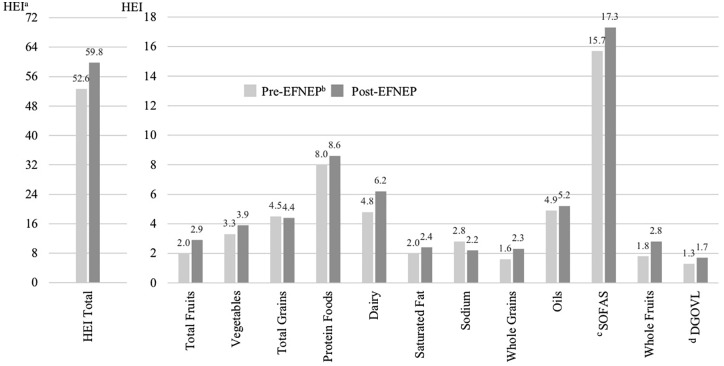
The objective of the study was to assess the relationship between participation in the Expanded Food and Nutrition Education Program (EFNEP) and food-related behavior change, as measured by the Healthy Eating Index (HEI)-2005, using a single-state, case study approach. Pre-EFNEP and post-EFNEP participation HEI scores as well as demographic, geographic, socioeconomic, and program participation characteristics from fiscal years 2013-2016 were analyzed using summary statistics and Ordinary Least Squares regressions. HEI scores were adjusted for age, sex, race, rural/urban residence, county, highest grade achieved, income, number of children, public assistance programs, and number of hours in EFNEP in the analysis. The total HEI score and several HEI subscores improved from pre-EFNEP to post-EFNEP at the 5% significance level or better. Sodium and total grains scores decreased post-EFNEP: P = .003 and P = .05, respectively. Participation in Women, Infants, and Children or the Supplemental Nutrition Assistance Program had no effect on HEI scores or changes in scores post-EFNEP. Spending less than 7 hours in the program was associated with a smaller improvement in total HEI score (P = .05) and an increased intake of sodium (P = .03), compared with spending 7 to 16 hours in the program. Overall, EFNEP participation was associated with improvements in diet quality.
Keywords: Expanded Food and Nutrition Education Program (EFNEP); Healthy Eating Index (HEI); eating behavior; nutrition education; nutritive quality.
© 2019 The Author(s).
Conflict of interest statement
Declaration of Conflicting Interests: The author(s) declared no potential conflicts of interest with respect to the research, authorship, and/or publication of this article.
Figures
References
-
- Fontenot K, Semega J, Kollar M. US Census Bureau, Current Population Reports, P60-263: Income and Poverty in the United States: 2017. Washington, DC: US Government Printing Office; 2018.
-
- Coleman-Jensen A, Rabbitt MP, Gregory CA, Singh A. Household Food Security in the United States in 2017. Washington, DC: US Department of Agriculture, Economic Research Service; 2018. Economic Research Report No. 256.
-
- US Department of Agriculture, Economic Research Service. Key statistics and graphics: food security status of US households in 2017. https://www.ers.usda.gov/topics/food-nutrition-assistance/food-security-.... Accessed March 5, 2019.
-
- Holben DH; American Dietetic Association. Position of the American Dietetic Association: food insecurity in the United States. J Am Diet Assoc. 2010;110:1368-1377. - PubMed
-
- The State of Obesity. Socioeconomics and obesity. http://stateofobesity.org/socioeconomics-obesity/. Accessed March 5, 2019.
LinkOut - more resources
Full Text Sources