


Population Genomics of Mycobacterium leprae Reveals a New Genotype in Madagascar and the Comoros
- PMID: 32477280
- PMCID: PMC7233131
- DOI: 10.3389/fmicb.2020.00711
Population Genomics of Mycobacterium leprae Reveals a New Genotype in Madagascar and the Comoros
Abstract
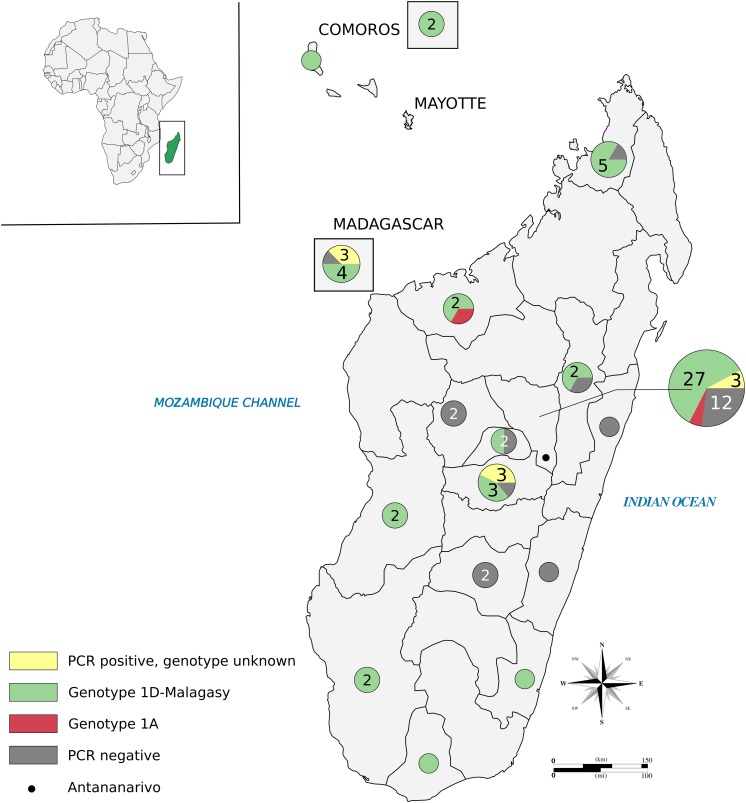
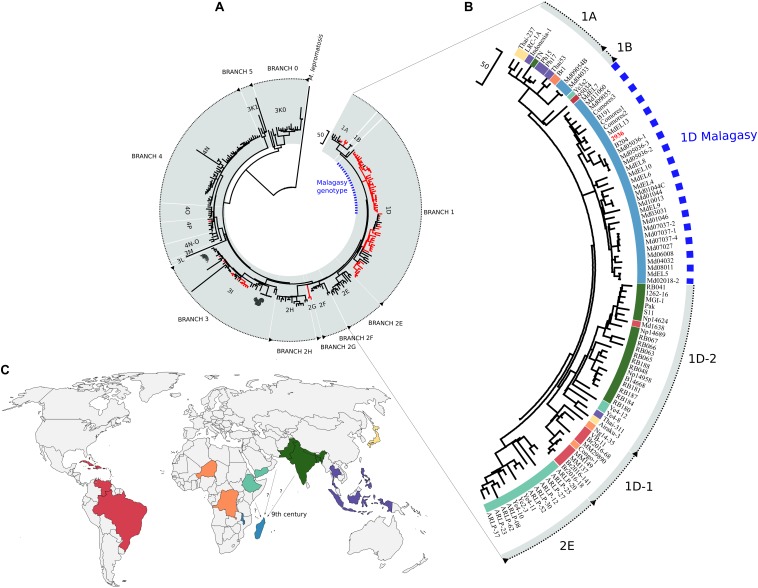
Human settlement of Madagascar traces back to the beginning of the first millennium with the arrival of Austronesians from Southeast Asia, followed by migrations from Africa and the Middle East. Remains of these different cultural, genetic, and linguistic legacies are still present in Madagascar and other islands of the Indian Ocean. The close relationship between human migration and the introduction and spread of infectious diseases, a well-documented phenomenon, is particularly evident for the causative agent of leprosy, Mycobacterium leprae. In this study, we used whole-genome sequencing (WGS) and molecular dating to characterize the genetic background and retrace the origin of the M. leprae strains circulating in Madagascar (n = 30) and the Comoros (n = 3), two islands where leprosy is still considered a public health problem and monitored as part of a drug resistance surveillance program. Most M. leprae strains (97%) from Madagascar and Comoros belonged to a new genotype as part of branch 1, closely related to single nucleotide polymorphism (SNP) type 1D, named 1D-Malagasy. Other strains belonged to the genotype 1A (3%). We sequenced 39 strains from nine other countries, which, together with previously published genomes, amounted to 242 genomes that were used for molecular dating. Specific SNP markers for the new 1D-Malagasy genotype were used to screen samples from 11 countries and revealed this genotype to be restricted to Madagascar, with the sole exception being a strain from Malawi. The overall analysis thus ruled out a possible introduction of leprosy by the Austronesian settlers and suggests a later origin from East Africa, the Middle East, or South Asia.
Keywords: Comoros; Madagascar; Mycobacterium leprae; genomics; leprosy; phylogeography.
Copyright © 2020 Avanzi, Lécorché, Rakotomalala, Benjak, Rapelanoro Rabenja, Ramarozatovo, Cauchoix, Rakoto-Andrianarivelo, Tió-Coma, Leal-Calvo, Busso, Boy-Röttger, Chauffour, Rasamoelina, Andrianarison, Sendrasoa, Spencer, Singh, Dashatwar, Narang, Berland, Jarlier, Salgado, Moraes, Geluk, Randrianantoandro, Cambau and Cole.
Figures
References
-
- Cambau E., Saunderson P., Matsuoka M., Cole S. T., Kai M., Suffys P., et al. (2018). Antimicrobial resistance in leprosy: results of the first prospective open survey conducted by a WHO surveillance network for the period 2009-15. Clin. Microbiol. Infect. 24 1305–1310. 10.1016/j.cmi.2018.02.022 - DOI - PMC - PubMed
LinkOut - more resources
Full Text Sources
