Review
. 2020 May 14:11:791.
doi: 10.3389/fimmu.2020.00791. eCollection 2020.

Immunogenicity of Protein Therapeutics: A Lymph Node Perspective

Affiliations
Review

Immunogenicity of Protein Therapeutics: A Lymph Node Perspective

Kristy Fu et al. Front Immunol. .

Abstract

The continuous development of molecular biology and protein engineering technologies enables the expansion of the breadth and complexity of protein therapeutics for in vivo administration. However, the immunogenicity and associated in vivo development of antibodies against therapeutics are a major restriction factor for their usage. The B cell follicular and particularly germinal center areas in secondary lymphoid organs are the anatomical sites where the development of antibody responses against pathogens and immunogens takes place. A growing body of data has revealed the importance of the orchestrated function of highly differentiated adaptive immunity cells, including follicular helper CD4 T cells and germinal center B cells, for the optimal generation of these antibody responses. Understanding the cellular and molecular mechanisms mediating the antibody responses against therapeutics could lead to novel strategies to reduce their immunogenicity and increase their efficacy.

Keywords: ADA; B cells; Tfh cell; follicle; germinal center; therapeutics.


Figures

Figure 1
Figure 1
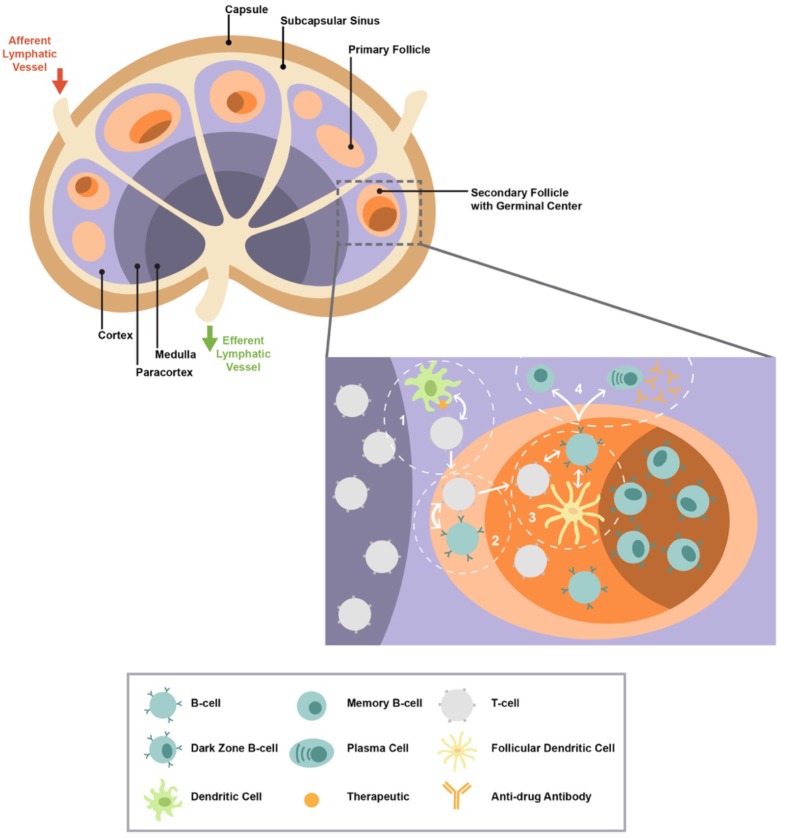
The lymph node structure/organization is shown. A zoomed T cell/follicular area with the major cell types involved in the development of antibody responses is shown. The presence of therapeutic within the lymph node can initiate a cascade of immune reactions ultimately leading to T cell-dependent germinal center (GC) activity and the generation of plasma cells and memory B cells that can produce antibodies. The cascade begins with (1) dendritic cells that present the therapeutic interaction with CD4 T cells resulting in their activation and differentiation; (2) activated CD4 T cells begin interacting with B cells, ultimately leading to further differentiation of both cell types and therefore trafficking into follicles/GCs; (3) within the GC, follicular CD4 T cells interact with GC B cells and follicular dendritic cell (FDC); (4) helping B cells promotes their maturation to memory and plasma cells.

References

    1. Pratt KP. Anti-drug antibodies: emerging approaches to predict, reduce or reverse biotherapeutic immunogenicity. Antibodies. (2018) 31:7. 10.3390/antib7020019 - DOI - PMC - PubMed
    1. Kuka M, Iannacone M. Viral subversion of B cell responses within secondary lymphoid organs. Nat Rev Immunol. (2018) 18:255–65. 10.1038/nri.2017.133 - DOI - PMC - PubMed
    1. Bar-Ephraim YE, Mebius RE. Innate lymphoid cells in secondary lymphoid organs. Immunol Rev. (2016) 271:185–99. 10.1111/imr.12407 - DOI - PubMed
    1. Magrone T, Jirillo E. Development and organization of the secondary and tertiary lymphoid organs: influence of microbial and food antigens. Endocr Metab Immune Disord Drug Targets. (2019) 19:128–35. 10.2174/1871530319666181128160411 - DOI - PubMed
    1. Onder L, Morbe U, Pikor N, Novkovic M, Cheng HW, Hehlgans T, et al. Lymphatic endothelial cells control initiation of lymph node organogenesis. Immunity. (2017) 47:80–92. 10.1016/j.immuni.2017.05.008 - DOI - PubMed

Publication types