Review
. 2020 May 14:10:213.
doi: 10.3389/fcimb.2020.00213. eCollection 2020.

Bacterial Community Interactions During Chronic Respiratory Disease

Affiliations
Review

Bacterial Community Interactions During Chronic Respiratory Disease

Allison L Welp et al. Front Cell Infect Microbiol. .

Abstract

Chronic respiratory diseases including chronic rhinosinusitis, otitis media, asthma, cystic fibrosis, non-CF bronchiectasis, and chronic obstructive pulmonary disease are a major public health burden. Patients suffering from chronic respiratory disease are prone to persistent, debilitating respiratory infections due to the decreased ability to clear pathogens from the respiratory tract. Such infections often develop into chronic, life-long complications that are difficult to treat with antibiotics due to the formation of recalcitrant biofilms. The microbial communities present in the upper and lower respiratory tracts change as these respiratory diseases progress, often becoming less diverse and dysbiotic, correlating with worsening patient morbidity. Those with chronic respiratory disease are commonly infected with a shared group of respiratory pathogens including Haemophilus influenzae, Streptococcus pneumoniae, Staphylococcus aureus, Pseudomonas aeruginosa, and Moraxella catarrhalis, among others. In order to understand the microbial landscape of the respiratory tract during chronic disease, we review the known inter-species interactions among these organisms and other common respiratory flora. We consider both the balance between cooperative and competitive interactions in relation to microbial community structure. By reviewing the major causes of chronic respiratory disease, we identify common features across disease states and signals that might contribute to community shifts. As microbiome shifts have been associated with respiratory disease progression, worsening morbidity, and increased mortality, these underlying community interactions likely have an impact on respiratory disease state.

Keywords: antibiotic resistance; biofilm; polymicrobial; pulmonary; respiratory tract.


Figures

Figure 1
Figure 1
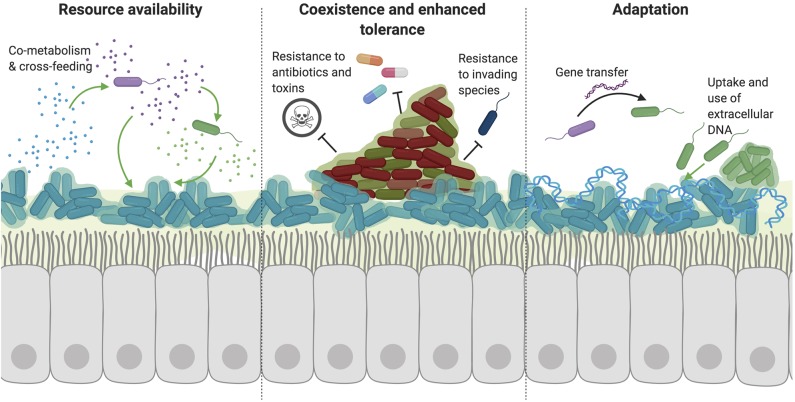
Cooperative interactions favor the persistence of multiple species. A number of cooperative interactions have been described among species, which can broadly be broken down into three main categories. (1) Bacteria benefit from the resources released or metabolized by other species. Through mechanisms such as co-metabolism and cross-feeding, species can utilize complex nutrients that they may be unable to metabolize or access themselves. Additionally, the secretion of public goods from one species (such as siderophores, enzymes, or signaling molecules) also benefits neighboring bacteria by releasing resources into the extracellular environment. (2) The coexistence of multiple species of bacteria in a polymicrobial biofilm also allows the sharing of resources and cross-species signaling due to the close proximity of these species. Importantly, certain species can protect and shield other neighboring species in a biofilm through enhanced tolerance to antibiotics, immune radicals, and other toxic small molecules. (3) Interactions with other species also result in adaptation to improve survival in the host environment. While many organisms might evolve to evade toxic effects from competitive species, adaptation also occurs through horizontal gene transfer and uptake of exogenous bacterial DNA from the environment. The presence of this DNA alone can also aid in biofilm formation through incorporation into the extracellular biofilm matrix.
Figure 2
Figure 2
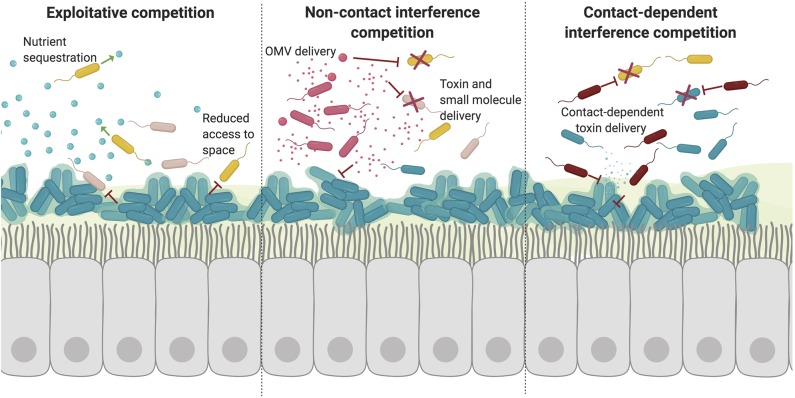
Competitive interactions disrupt microbial communities. Competitive bacterial interactions can be exploitative or interfering, which is often energetically expensive and tightly regulated. (1) Exploitative competition takes advantage of extracellular nutrients and compounds released by other species. Such competition is often for trace metals which are actively sequestered but essential for bacterial growth. Other essential resources also include access to space. Formation of recalcitrant biofilms on epithelial surfaces restricts the colonization and growth of other species. (2) Bacteria can also interfere with other species growth and signaling through the active secretion and transport of toxic molecules. There are a variety of processes used to deliver toxic molecules over a distance including direct release into the extracellular environment and packaging into vesicles. (3) Finally, specific competition with neighboring bacteria can also occur via direct contact. In this way, bacteria can specifically deliver toxins directly to other cells in close proximity through mechanisms including contact-dependent inhibition and type VI secretion.
Figure 3
Figure 3
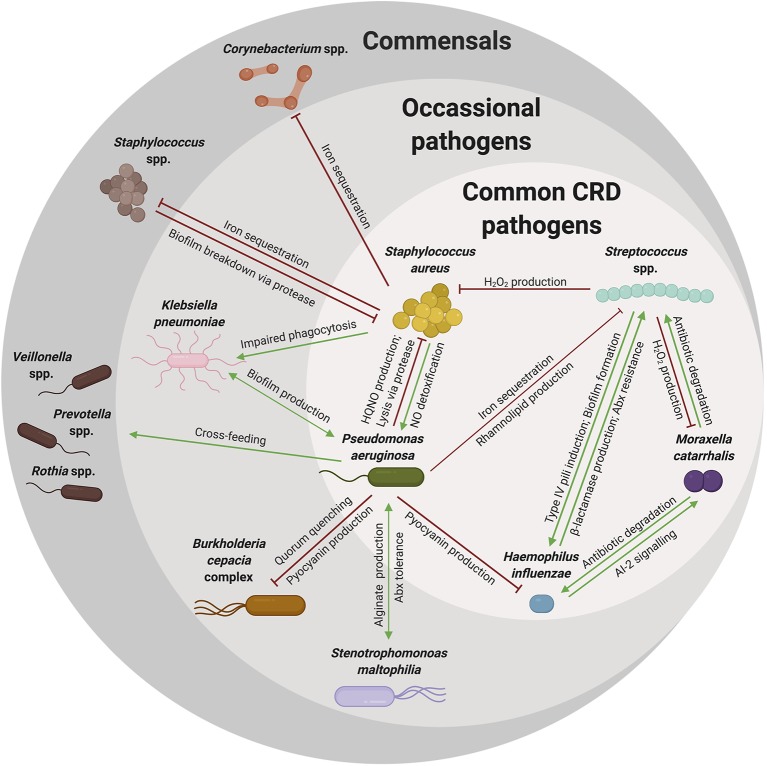
A complex web of microbial interactions shape microbial communities. Many organisms reside in the respiratory tract of young patients with respiratory disease. However, as patients age, these communities become increasingly dysbiotic, likely due to interactions among colonizing organisms and newly acquired pathogens. Many interactions have been described between commensal organisms and pathogenic species that might explain the microbial community shifts noted over a patient's lifetime. As illustrated here, many of these pathogens are shared among the various types of chronic respiratory diseases (common CRD pathogens), while other pathogens are not shared among all CRD, but rather indicated in one or few CRD (occasional pathogens), but still contribute to notable community shifts. Commensal species are also an important component of the respiratory microbiome, directly involved in competition with pathogenic species. Some of the cooperative (green arrow) and competitive (red) interactions described in this review are summarized in this web, with the arrow indicating directionality of effects. These interactions are diverse and likely complicated by respiratory symptoms and therapeutic strategies. Although complex, an understanding of these interactions can explain observed microbial shifts and may give us insight into overarching microbial community dynamics.

References

    1. Abreu N. A., Nagalingam N. A., Song Y., Roediger F. C., Pletcher S. D., Goldberg A. N., et al. (2012). Sinus microbiome diversity depletion and Corynebacterium tuberculostearicum enrichment mediates rhinosinusitis. Sci. Transl. Med. 4:151ra124. 10.1126/scitranslmed.3003783 - DOI - PMC - PubMed
    1. Acuin J. (2007). Chronic suppurative otitis media. BMJ. Clin. Evid. 2007:0507. - PMC - PubMed
    1. Alcoforado Diniz J., Coulthurst S. J. (2015). Intraspecies competition in Serratia marcescens is mediated by type VI-secreted rhs effectors and a conserved effector-associated accessory protein. J. Bacteriol. 197, 2350–2360. 10.1128/JB.00199-15 - DOI - PMC - PubMed
    1. Allesen-Holm M., Barken K. B., Yang L., Klausen M., Webb J. S., Kjelleberg S., et al. (2006). A characterization of DNA release in Pseudomonas aeruginosa cultures and biofilms. Mol. Microbiol. 59, 1114–1128. 10.1111/j.1365-2958.2005.05008.x - DOI - PubMed
    1. Anderson M. S., Garcia E. C., Cotter P. A. (2014). Kind discrimination and competitive exclusion mediated by contact-dependent growth inhibition systems shape biofilm community structure. PLoS Pathog. 10:e1004076. 10.1371/journal.ppat.1004076 - DOI - PMC - PubMed

Publication types

Substances