. 2020 May 12:17:1079-1087.
doi: 10.1016/j.omtm.2020.05.005. eCollection 2020 Jun 12.

Circulating miR-4763-3p Is a Novel Potential Biomarker Candidate for Human Adult Fulminant Myocarditis

Affiliations

Circulating miR-4763-3p Is a Novel Potential Biomarker Candidate for Human Adult Fulminant Myocarditis

Xiang Nie et al. Mol Ther Methods Clin Dev. .

Abstract

Circulating microRNAs (miRNAs) are potential biomarkers in various diseases. However, whether they could serve as biomarkers for human adult fulminant myocarditis (FM) is unknown. Circulating miRNA expression profiles were detected by microarray analysis and validated by quantitative real-time PCR arrays. Meanwhile, Kyoto Encyclopedia of Genes and Genomes (KEGG) pathway analysis was used to determine the critical roles of these circulating miRNAs in FM. Moreover, correlation analysis was employed between miRNAs and the parameters of cardiac functions in FM. Finally, the sensitivity and specificity of circulating long non-coding RNA (lncRNA) expression in FM diagnosis were evaluated using receiver operating characteristic curve analysis. Both microarray and quantitative real-time PCR analysis showed that the expression of miR-4763-3p and miR-4281 were upregulated in the plasma of FM at the onset, and their levels were restored as the clinical symptom recovered. The predicted target genes of miR-4763-3p and miR-4281 are involved in several pathways, mainly inflammatory and cardiac injury response. Moreover, the miRNAs enrichment was negatively correlated with the severity of FM. In addition, the expression levels of circulating miR-4763-3p were unchanged in myocardial infarction (MI) patients but showed high sensitivity and specificity for FM diagnosis. This study provides a global profile of circulating miRNAs in patients with FM, among which miR-4763-3p could serve as a potential biomarker.

Keywords: biomarker; circulating miRNA; fulminant myocarditis; human.


Figures

None
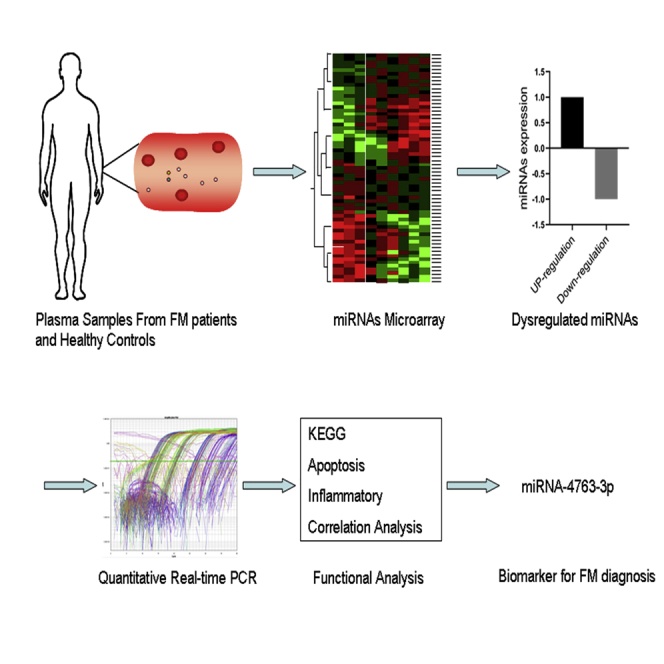
Graphical abstract
Figure 1
Figure 1
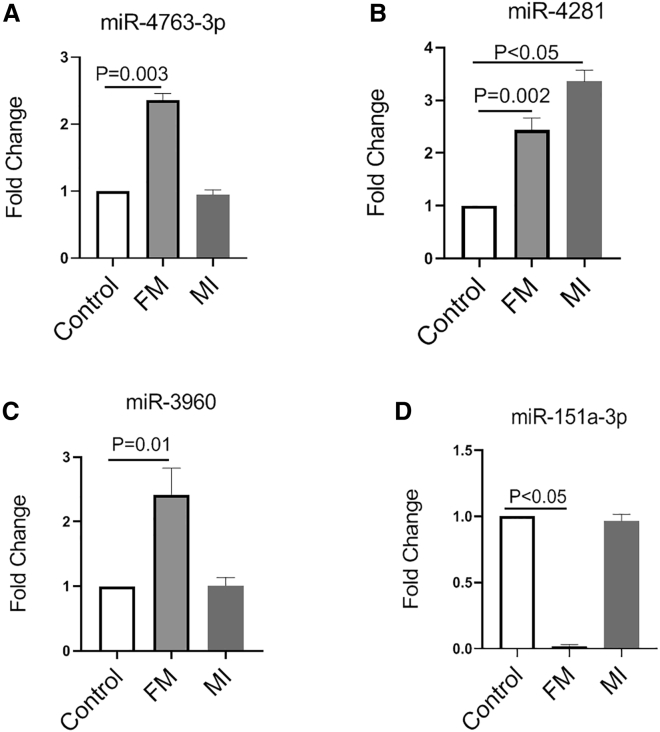
Determination of Circulating miRNA Profiles in FM Patients (A) The fold change of miR-4763-3p from microarray analysis (N = 8). (B) The fold change of miR-4281 from microarray analysis (N = 8). (C) The fold change of miR-3960 from microarray analysis (N = 8). (D) The fold change of miR-151-3p from microarray analysis (N = 8). FM, fulminant myocarditis; MI, myocardial infarction.
Figure 2
Figure 2
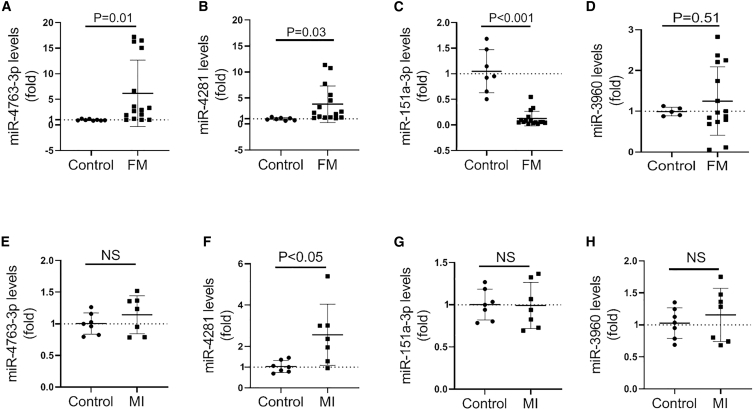
Validation of miRNA Expression by Quantitative Real-Time PCR (A) The expression of miR-4763-3p in plasma from FM patients detected by quantitative real-time PCR (N = 15). (B) The expression of miR-4281 in plasma from FM patients detected by quantitative real-time PCR (N = 15). (C) The expression of miR-151-3p in plasma from FM patients detected by quantitative real-time PCR (N = 15). (D) The expression of miR-3960 in plasma from FM patients detected by quantitative real-time PCR (N = 15). (E) The expression of miR-4763-3p in plasma from MI patients detected by quantitative real-time PCR (N = 7). (F) The expression of miR-4281 in plasma from MI patients detected by quantitative real-time PCR (N = 7). (G) The expression of miR-151-3p in plasma from MI patients detected by quantitative real-time PCR (N = 7). (H) The expression of miR-3960 in plasma from MI patients detected by quantitative real-time PCR (N = 7). FM, fulminant myocarditis; MI, myocardial infarction.
Figure 3
Figure 3
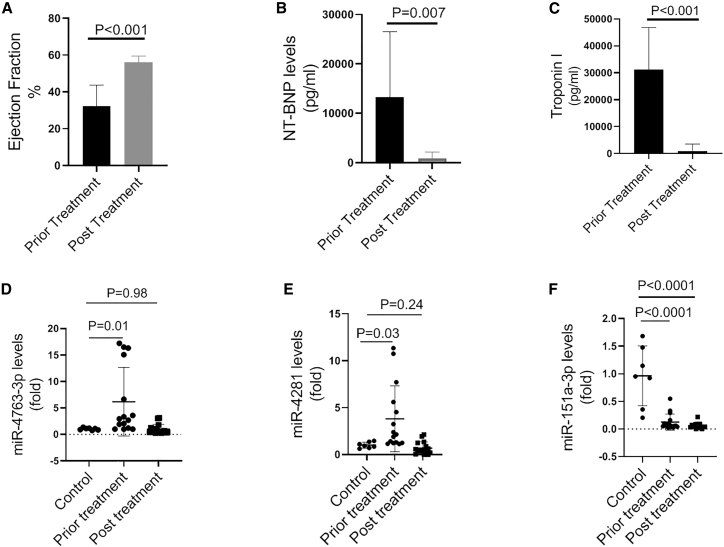
Circulating miRNAs Profile in FM Patients with Follow-Up Treatment (A) Left ventricular ejection fraction in FM patients before and after treatments (N = 15). (B) The concentration of NT-proBNP in FM patients before and after treatments (N = 15). (C) The concentration of cTnI in FM patients before and after treatments (N = 15). (D) The level of circulating miR-4763-3p in control or FM patients before and after treatments detected by quantitative real-time PCR (N = 15). (E) The level of circulating miR-4281 in control or FM patients before and after treatments detected by quantitative real-time PCR (N = 15). (F) The level of circulating miR-151-3p in control or FM patients before and after treatments detected by quantitative real-time PCR (N = 15).
Figure 4
Figure 4
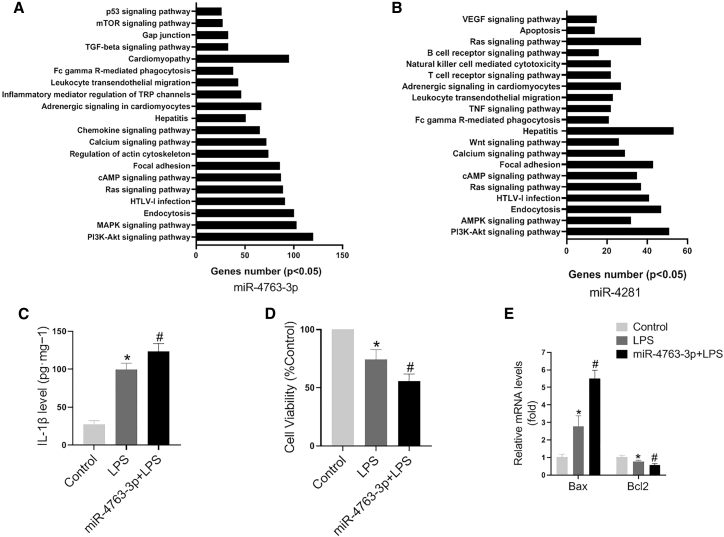
KEGG Pathway Analysis of Potential Biomarker miRNAs (A) The KEGG pathway analysis for miR-4763-3p target genes. (B) The KEGG pathway analysis for miR-4281 target genes. (C) IL-1β levels were detected in AC16 cells with various treatments (N = 5, ∗p < 0.05 versus control, #p < 0.05 versus LPS). (D) Cell viability was detected in AC16 cells with various treatments (N = 5, ∗p < 0.05 versus control, #p < 0.05 versus LPS). (E) Bax and Bcl2 expression levels were detected by quantitative real-time PCR in AC16 cells with various treatments (N = 5, ∗p < 0.05 versus control, #p < 0.05 versus LPS).
Figure 5
Figure 5
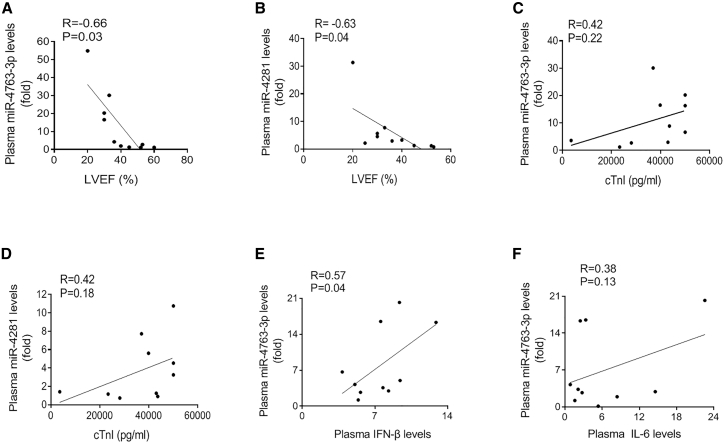
Association between Circulating miRNA Expression and the Severity of FM (A) The correlation between circulating miR-4763-3p level and LVEF (N = 10). (B) The correlation between circulating miR-4281 level and LVEF (N = 10). (C) The correlation between circulating miR-4763-3p level and cTnI concentration (N = 10). (D) The correlation between circulating miR-4281 level and cTnI concentration (N = 10). (E) The correlation between circulating miR-4763-3p level and interferon-β (IFN-β) concentration (N = 10). (F) The correlation between circulating miR-4763-3p level and IL-6 concentration (N = 10).
Figure 6
Figure 6
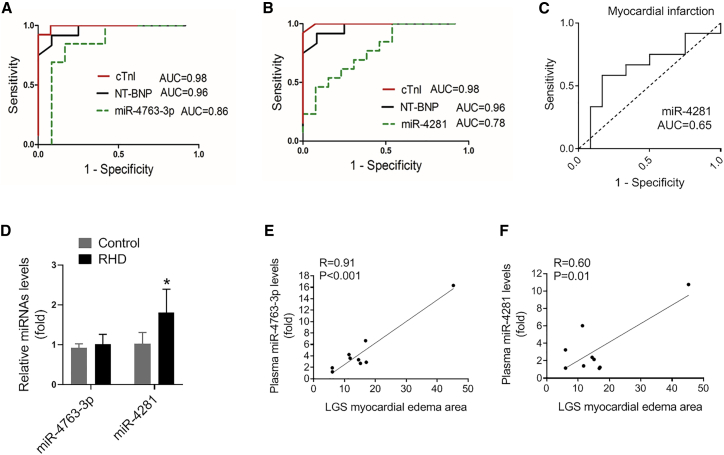
Evaluation of microRNAs in Plasma as Novel Biomarkers for FM (A) The ROC curve for miR-4763-3p in FM patients. (B) The ROC curve for miR-4281 in FM patients. (C) The ROC curve for miR-4281 in MI patients. (D) The expression of miR-4763-3p and miR-4281 was detected by quantitative real-time PCR in the plasma of rheumatic heart disease patients with acute heart failure (∗p < 0.05 versus control). (E) The correlation between circulating miR-4763-3p level and myocardial edema area (N = 9). (F) The correlation between circulating miR-4281 level and myocardial edema area (N = 9).

References

    1. Ammirati E., Veronese G., Cipriani M., Moroni F., Garascia A., Brambatti M., Adler E.D., Frigerio M. Acute and Fulminant Myocarditis: a Pragmatic Clinical Approach to Diagnosis and Treatment. Curr. Cardiol. Rep. 2018;20:114. - PubMed
    1. Wang D., Li S., Jiang J., Yan J., Zhao C., Wang Y., Ma Y., Zeng H., Guo X., Wang H., Section of Precision Medicine Group of Chinese Society of Cardiology. Editorial Board of Chinese Journal of Cardiology. Working Group of Adult Fulminant Myocarditis Chinese society of cardiology expert consensus statement on the diagnosis and treatment of adult fulminant myocarditis. Sci. China Life Sci. 2019;62:187–202. - PMC - PubMed
    1. Gupta S., Markham D.W., Drazner M.H., Mammen P.P. Fulminant myocarditis. Nat. Clin. Pract. Cardiovasc. Med. 2008;5:693–706. - PubMed
    1. Al-Amoodi M., Rao K., Rao S., Brewer J.H., Magalski A., Chhatriwalla A.K. Fulminant myocarditis due to H1N1 influenza. Circ. Heart Fail. 2010;3:e7–e9. - PubMed
    1. Berg D.D., Vaduganathan M., Nohria A., Davids M.S., Alyea E.P., Torre M., Padera R.F., Jr. Immune-related fulminant myocarditis in a patient receiving ipilimumab therapy for relapsed chronic myelomonocytic leukaemia. Eur. J. Heart Fail. 2017;19:682–685. - PubMed