


Implications of Altered Ketone Metabolism and Therapeutic Ketosis in Heart Failure
- PMID: 32479196
- PMCID: PMC7304522
- DOI: 10.1161/CIRCULATIONAHA.119.045033
Implications of Altered Ketone Metabolism and Therapeutic Ketosis in Heart Failure
Abstract
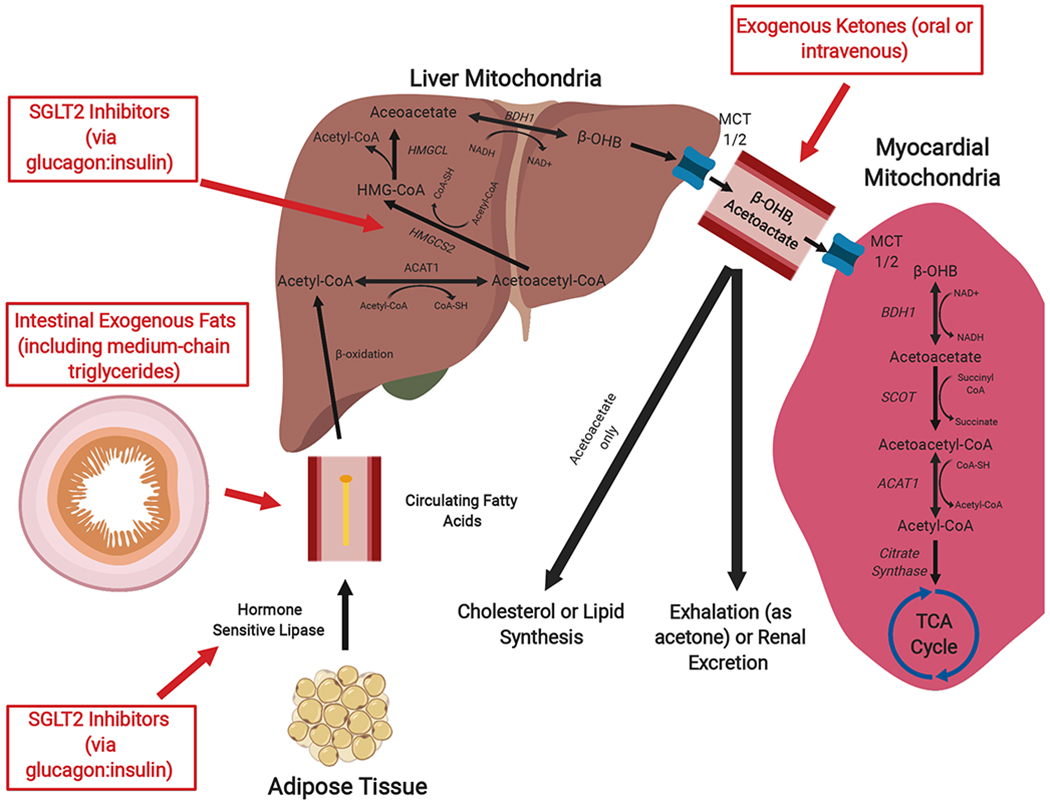
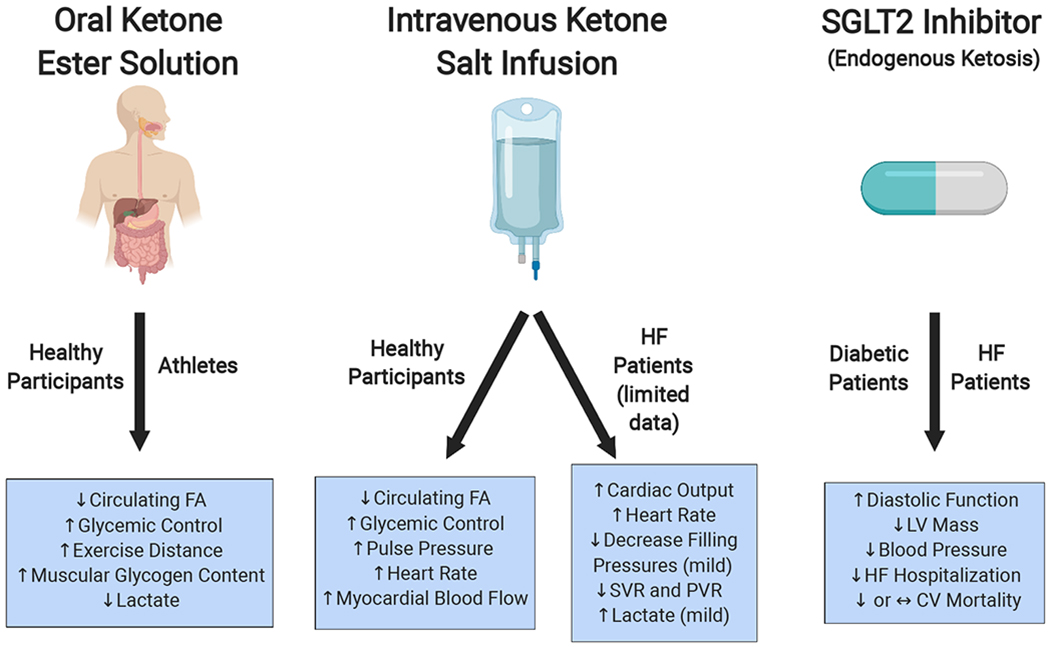
Despite existing therapy, patients with heart failure (HF) experience substantial morbidity and mortality, highlighting the urgent need to identify novel pathophysiological mechanisms and therapies, as well. Traditional models for pharmacological intervention have targeted neurohormonal axes and hemodynamic disturbances in HF. However, several studies have now highlighted the potential for ketone metabolic modulation as a promising treatment paradigm. During the pathophysiological progression of HF, the failing heart reduces fatty acid and glucose oxidation, with associated increases in ketone metabolism. Recent studies indicate that enhanced myocardial ketone use is adaptive in HF, and limited data demonstrate beneficial effects of exogenous ketone therapy in studies of animal models and humans with HF. This review will summarize current evidence supporting a salutary role for ketones in HF including (1) normal myocardial ketone use, (2) alterations in ketone metabolism in the failing heart, (3) effects of therapeutic ketosis in animals and humans with HF, and (4) the potential significance of ketosis associated with sodium-glucose cotransporter 2 inhibitors. Although a number of important questions remain regarding the use of therapeutic ketosis and mechanism of action in HF, current evidence suggests potential benefit, in particular, in HF with reduced ejection fraction, with theoretical rationale for its use in HF with preserved ejection fraction. Although it is early in its study and development, therapeutic ketosis across the spectrum of HF holds significant promise.
Keywords: fatty acids; glucose; heart failure; ketones; metabolism; sodium-glucose transporter 2.
Figures
References
-
- Benjamin EJ, Muntner P, Alonso A, Bittencourt MS, Callaway CW, Carson AP, Chamberlain AM, Chang AR, Cheng S, Das SR, Delling FN, Djousse L, Elkind MSV, Ferguson JF, Fornage M, Jordan LC, Khan SS, Kissela BM, Knutson KL, Kwan TW, Lackland DT, Lewis TT, Lichtman JH, Longenecker CT, Loop MS, Lutsey PL, Martin SS, Matsushita K, Moran AE, Mussolino ME, O’Flaherty M, Pandey A, Perak AM, Rosamond WD, Roth GA, Sampson UKA, Satou GM, Schroeder EB, Shah SH, Spartano NL, Stokes A, Tirschwell DL, Tsao CW, Turakhia MP, VanWagner LB, Wilkins JT, Wong SS, Virani SS, American Heart Association Council on E, Prevention Statistics C, Stroke Statistics S. Heart disease and stroke statistics-2019 update: A report from the american heart association. Circulation. 2019;139:e56–e528. - PubMed
-
- Neubauer S The failing heart--an engine out of fuel. N Engl J Med. 2007;356:1140–1151. - PubMed
-
- Bedi KC Jr., Snyder NW, Brandimarto J, Aziz M, Mesaros C, Worth AJ, Wang LL, Javaheri A, Blair IA, Margulies KB, Rame JE. Evidence for intramyocardial disruption of lipid metabolism and increased myocardial ketone utilization in advanced human heart failure. Circulation. 2016;133:706–716. - PMC - PubMed
-
- De Jong KA, Lopaschuk GD. Complex energy metabolic changes in heart failure with preserved ejection fraction and heart failure with reduced ejection fraction. Can J Cardiol. 2017;33:860–871. - PubMed
Publication types
MeSH terms
Substances
Grants and funding
LinkOut - more resources
Full Text Sources
Other Literature Sources
Medical
Research Materials
Miscellaneous
