


Characterization of native Escherichia coli populations from bovine vagina of healthy heifers and cows with postpartum uterine disease
- PMID: 32479536
- PMCID: PMC7263596
- DOI: 10.1371/journal.pone.0228294
Characterization of native Escherichia coli populations from bovine vagina of healthy heifers and cows with postpartum uterine disease
Abstract
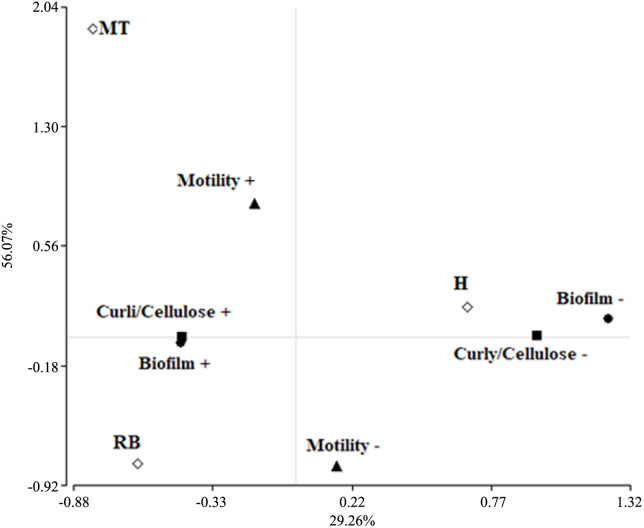
Even though Escherichia coli are common bacteria of the bovine vaginal microbiota, they represent an important pathogen that causes diseases in the reproductive tract and subfertility. However, the actual endometrial virulence profile of E. coli is poorly understood. The present study aims to characterize the phylogenetic structure and virulence potential of native vaginal populations of E. coli from healthy heifers (H), and cows with postpartum uterine diseases (PUD), such as metritis/endometritis (MT) or repeat breeder cows (RB). To this end, the virulence repertoire of 97 E. coli isolates was genotypically and phenotypically assessed. Most of them were assigned to phylogenetic group A (74%), followed by B1 (17%) and D (9%); RB strains were significantly (p < 0.05) more represented by B1. Seven of the 15 evaluated virulence genes (VFG) were detected and the most prevalent were fimH (87%), agn43 (41%) and csgA (35%); while traT (27%), fyuA (11%), hlyA (5%) and kpsMT II (5%) were observed in a lower proportion. Particularly, fyuA was significantly higher (p < 0.05) in MT cows whereas csgA showed the same behavior in PUD animals (p < 0.05). When comparing H and PUD strains, these last ones were associated to positive expression of biofilm, fimbriae curli/cellulose and motility; yet RB strains did not show motility. Vaginal B1 E. coli populations, that possess VFG (fyuA and csgA) as well as the expression of motility, curli fimbriae/cellulose and biofilm, may represent risk factors for endometrial disorders; specifically, those that also, have kpsMT II may have a pathogenic potential for causing the RB syndrome. Future research focusing on the detection of these strains in the vaginal microbiota of cows with postpartum uterine diseases should be done since the control of their presence in vagina could reduce the risk that they access the uterus during the postpartum period.
Conflict of interest statement
The authors have declared that no competing interests exist.
Figures


References
-
- Runciman DJ, Anderson GA, Malmo J. Comparison of two methods of detecting purulent vaginal discharge in postpartum dairy cows and effect of intrauterine cephapirin on reproductive performance. Aust Vet J. 2009;87:369–378. - PubMed
-
- Sheldon IM, Lewis GS, LeBlanc S, Gilbert RO. Defining postpartum uterine disease in cattle. Theriogenology. 2006;65:1516–1530. - PubMed
-
- Bicalho RC, Machado VS, Bicalho ML, Gilbert RO, Teixeira AG, Caixeta LS, et al. Molecular and epidemiological characterization of bovine intrauterine Escherichia coli. J Dairy Sci. 2010;93:5818–5830. - PubMed
-
- Salasel B, Mokhtari A, Taktaz T. Prevalence, risk factors for and impact of subclinical endometritis in repeat breeder dairy cows. Theriogenology. 2010;74:1271e8. - PubMed
Publication types
MeSH terms
LinkOut - more resources
Full Text Sources
Medical
