Review
. 2020 Jul;146(1):35-43.
doi: 10.1016/j.jaci.2020.05.020. Epub 2020 May 29.

SARS-CoV-2 antibody testing-questions to be asked

Affiliations
Review

SARS-CoV-2 antibody testing-questions to be asked

Mustafa K Özçürümez et al. J Allergy Clin Immunol. 2020 Jul.

Abstract

Severe acute respiratory syndrome coronavirus 2 infection and development of coronavirus disease 2019 presents a major health care challenge of global dimensions. Laboratory diagnostics of infected patients, and the assessment of immunity against severe acute respiratory syndrome coronavirus 2, presents a major cornerstone in handling the pandemic. Currently, there is an increase in demand for antibody testing and a large number of tests are already marketed or are in the late stage of development. However, the interpretation of test results depends on many variables and factors, including sensitivity, specificity, potential cross-reactivity and cross-protectivity, the diagnostic value of antibodies of different isotypes, and the use of antibody testing in identification of acutely ill patients or in epidemiological settings. In this article, the recently established COVID-19 Task Force of the German Society for Clinical Chemistry and Laboratory Medicine (DGKL) addresses these issues on the basis of currently available data sets in this rapidly moving field.

Keywords: Antibody response; COVID-19; diagnostic pathway; external quality assurance; immunity; immunoassay; neutralization assay; respiratory tract infections; serologic tests; severe acute respiratory syndrome coronavirus 2.


Figures

Fig 1
Fig 1
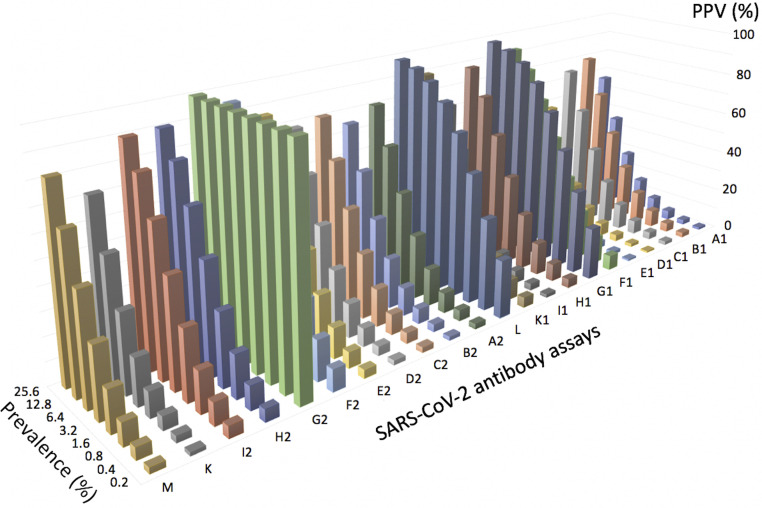
Positive predictive values for 21 commercial SARS-CoV-2 immunoassays and 1 laboratory-developed assay detecting IgM and IgG antibodies (total of 14 test systems) in patient sera and controls. Data were extracted from Whitman et al and plotted against various prevalence settings (0.08%-25.6%). Letters on the horizontal axis refer to the following assays: M: Inhouse; K: Epitope Diagnostics IgG; I2: VivaChek IgG; H2: UCP IgG; G2: Sure IgG; F2: Premier IgG; E2: Innovita IgG; D2: DeepBlue IgG; C2: Decombio IgG; B2: Bioperfectus IgG; A2: Biomedomics IgG; L: Wondito IgG/IgM; K1: Epitope Diagnostics IgM; I1: VivaChek IgM; H1: UCP IgM; G1: Sure IgM; F1: Premier IgM; E1: Innovita IgM; D1: DeepBlue IgM; C1: Decombio IgM; B1: Bioperfectus IgM; A1: BioMedomics IgM.
Fig 2
Fig 2
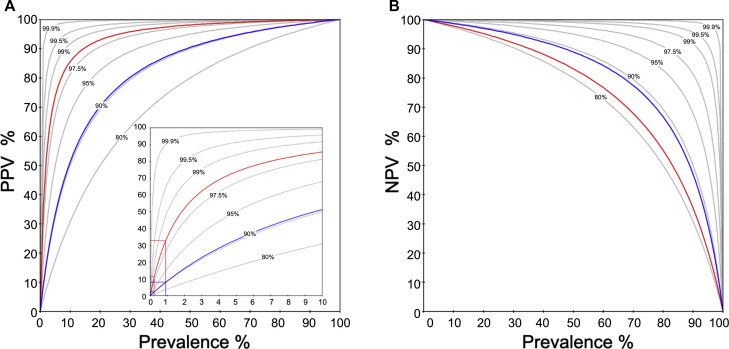
Examples of PPV (A) and NPV (B) (y-axis) as a function of prevalence (x-axis). Gray lines illustrate a theoretically assumed range of test sensitivities/specificities from 80/80% to 99.9/99.9%, as indicated, respectively. Two commercially available SARS-CoV-2 IgG tests are shown with (Fig 2, A) specificities of 90.6% (blue) and 98.5% (red), and (Fig 2, B) sensitivities of 88.7% (blue) and 80.0% (red), respectively. PPV for a population-based prevalence of 0.24% for COVID-19 (Regensburg, Bavaria) and 0.9% are illustrated in the insert of plot (Fig 2, A). As obvious in Fig 2, B, even though assay sensitivity is only 80%, due to its higher specificity the red line is located above the gray line that indicates prevalence-dependent NPV for sensitivities/specificities of 80%, respectively.

References

    1. Meyer B., Drosten C., Müller M.A. Serological assays for emerging coronaviruses: challenges and pitfalls. Virus Res. 2014;194:175–183. - PMC - PubMed
    1. Jin Y., Wang M., Zuo Z., Fan C., Ye F., Cai Z. Diagnostic value and dynamic variance of serum antibody in coronavirus disease 2019. Int J Infect Dis. 2020;94:49–52. - PMC - PubMed
    1. Liu W., Liu L., Kou G., Zheng Y., Ding Y., Ni W. Evaluation of nucleocapsid and spike protein-based ELISAs for detecting antibodies against SARS-CoV-2. J Clin Microbiol. 2020;58 e00461-20. - PMC - PubMed
    1. Okba N.M.A., Müller M.A., Li W., Wang C., GeurtsvanKessel C.H., Corman V.M. Severe acute respiratory syndrome coronavirus 2-specific antibody responses in coronavirus disease 2019 patients. Emerg Infect Dis. 2020;26 - PMC - PubMed
    1. Tan W, Lu Y, Zhang J, Wang J, Dan Y, Tan Z, et al. Viral kinetics and antibody responses in patients with COVID-19 [published online ahead of print March 26, 2020]. Preprint at medRxiv. . - DOI

Substances