


Selective CD8 cell reduction by SARS-CoV-2 is associated with a worse prognosis and systemic inflammation in COVID-19 patients
- PMID: 32479985
- PMCID: PMC7256549
- DOI: 10.1016/j.clim.2020.108486
Selective CD8 cell reduction by SARS-CoV-2 is associated with a worse prognosis and systemic inflammation in COVID-19 patients
Abstract
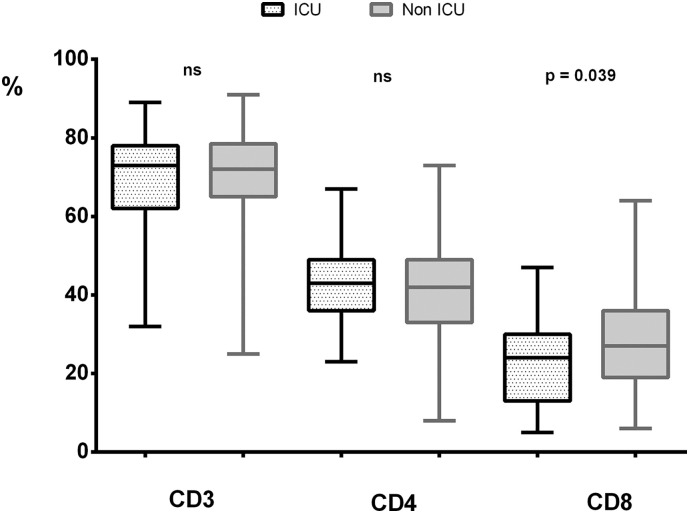
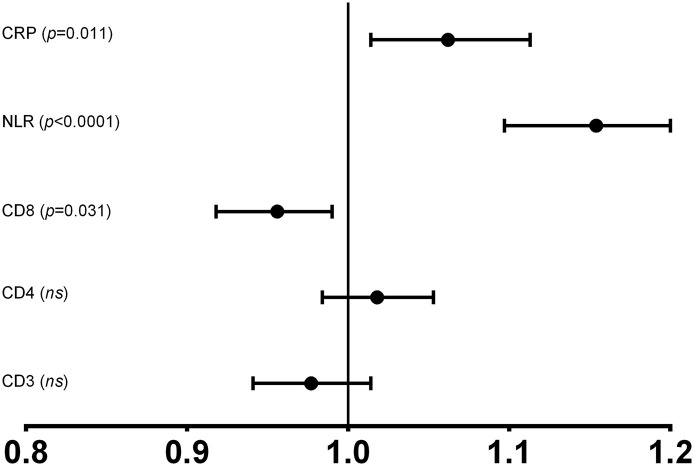
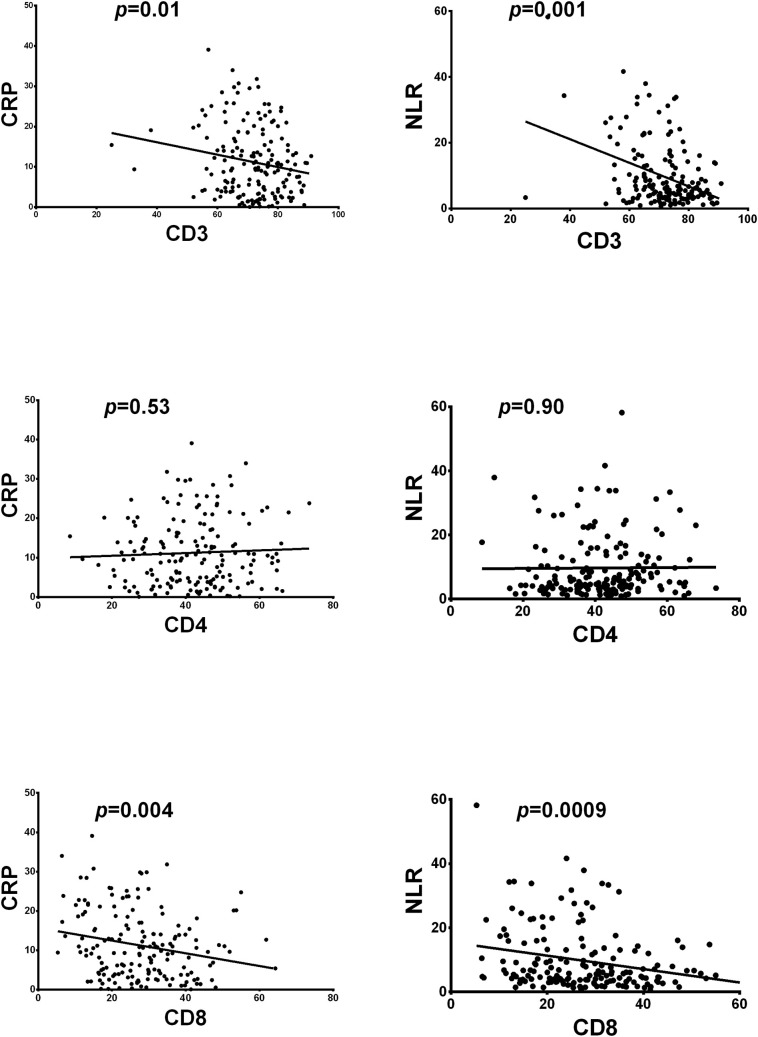
The lymphopenia exhibited in patients with COVID-19 has been associated with a worse prognosis in the development of the disease. To understand the factors associated with a worse evolution of COVID-19, we analyzed comorbidities, indicators of inflammation such as CRP and the ratio of neutrophils/lymphocytes, as well as the count of blood cells with T-lymphocyte subtypes in 172 hospitalized patients with COVID-19 pneumonia. Patients were grouped according to their needs for mechanical ventilation (ICU care) or not. Within the comorbidities studied, obesity was the only associated with greater severity and ICU admission. Both the percentage and the absolute number of neutrophils were higher in patients needing ICU care than non-ICU patients, whereas absolute lymphocyte count, and especially the percentage of lymphocytes, presented a deep decline in critical patients. There was no difference between the two groups of patients for CD4 T-lymphocytes, neither in percentage of lymphocyte nor in absolute number, however for CD8 T-cells the differences were significant for both parameters which were in decline in ICU patients. There was a firm correlation between the highest values of inflammation indicators with the decrease in percentage of CD8 T-lymphocytes. This effect was not seen with CD4 cells. Obesity together with lymphopenia, especially whether preferentially affects to CD8 T- lymphocytes, are factors that can predict a poor prognosis in patients with COVID-19.
Copyright © 2020 Elsevier Inc. All rights reserved.
Conflict of interest statement
Declaration of Competing Interest The authors certify that they have NO affiliations with or involvement in any organization or entity with any financial interest in the subject matter or materials discussed in this manuscript.
Figures
References
-
- Zhou P., Yang X.-L., Wang X.-G., Hu B., Zhang L., Zhang W., Si H.-R., Zhu Y., Li B., Huang C.-L., Chen H.-D., Chen J., Luo Y., Guo H., Jiang R.-D., Liu M.-Q., Chen Y., Shen X.-R., Wang X., Zheng X.-S., Zhao K., Chen Q.-J., Deng F., Liu L.-L., Yan B., Zhan F.-X., Wang Y.-Y., Xiao G.-F., Shi Z.-L. A pneumonia outbreak associated with a new coronavirus of probable bat origin. Nature. 2020;579:270–273. doi: 10.1038/s41586-020-2012-7. - DOI - PMC - PubMed
-
- Hoffmann M., Kleine-Weber H., Schroeder S., Krüger N., Herrler T., Erichsen S., Schiergens T.S., Herrler G., Wu N.-H., Nitsche A., Müller M.A., Drosten C., Pöhlmann S. SARS-CoV-2 cell entry depends on ACE2 and TMPRSS2 and is blocked by a clinically proven protease inhibitor. Cell. 2020;181:271–280.e8. doi: 10.1016/j.cell.2020.02.052. - DOI - PMC - PubMed
-
- Nicin L., Abplanalp W.T., Mellentin H., Kattih B., Tombor L., John D., Schmitto J.D., Heineke J., Emrich F., Arsalan M., Holubec T., Walther T., Zeiher A.M., Dimmeler S. Cell type-specific expression of the putative SARS-CoV-2 receptor ACE2 in human hearts. Eur. Heart J. 2020 doi: 10.1093/eurheartj/ehaa311. (n.d.) - DOI - PMC - PubMed
-
- Aggarwal S., Gollapudi S., Gupta S. Increased TNF-alpha-induced apoptosis in lymphocytes from aged humans: changes in TNF-alpha receptor expression and activation of caspases. J. Immunol. 1999;162:2154–2161. - PubMed
Publication types
MeSH terms
Substances
LinkOut - more resources
Full Text Sources
Medical
Research Materials
Miscellaneous
