Review
. 2020 May 28;9(6):1345.
doi: 10.3390/cells9061345.

Mitochondrial MicroRNAs in Aging and Neurodegenerative Diseases

Affiliations
Review

Mitochondrial MicroRNAs in Aging and Neurodegenerative Diseases

Albin John et al. Cells. .

Abstract

MicroRNAs (miRNAs) are important regulators of several biological processes, such as cell growth, cell proliferation, embryonic development, tissue differentiation, and apoptosis. Currently, over 2000 mammalian miRNAs have been reported to regulate these biological processes. A subset of microRNAs was found to be localized to human mitochondria (mitomiRs). Through years of research, over 400 mitomiRs have been shown to modulate the translational activity of the mitochondrial genome. While miRNAs have been studied for years, the function of mitomiRs and their role in neurodegenerative pathologies is not known. The purpose of our article is to highlight recent findings that relate mitomiRs to neurodegenerative diseases, including Alzheimer's, Parkinson's, and Huntington's. We also discuss the involvement of mitomiRs in regulating the mitochondrial genome in age-related neurodegenerative diseases.

Keywords: Alzheimer’s disease; Huntington’s disease; Parkinson’s disease; aging; microRNAs; mitochondrial function and mitophagy; mitochondrial microRNAs; oxidative stress.


Conflict of interest statement

The authors declare no conflict of interest.

Figures
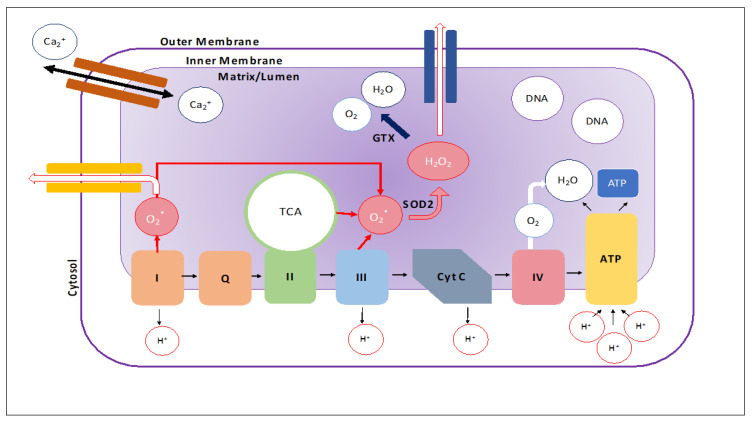
Figure 1
Figure 1
Mitochondrial structure. Schematic of the mitochondrion showing the electron transport chain, flow of ions, and generation reactive oxidative species. These reactive oxidative species can be reduced to hydrogen peroxide via the SOD2 enzyme and further broken down into H2O and O2 by the GPX enzyme. However, the reduction process is not perfect and when under high stress, reactive oxidative species can leak out of the mitochondria. The mitochondria are also important regulators of intracellular calcium concentration.
Figure 2
Figure 2
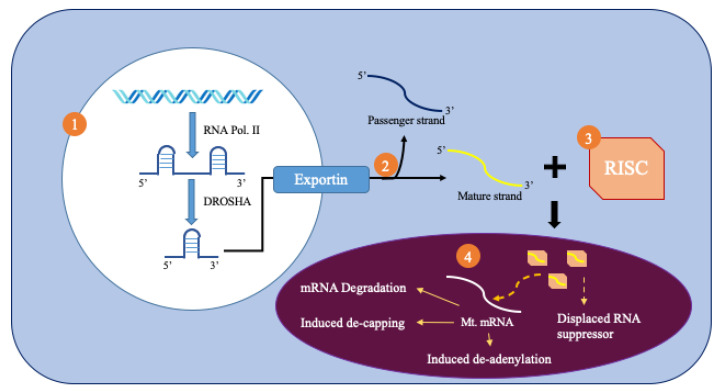
Production and import of mitomiRNA.
Figure 3
Figure 3
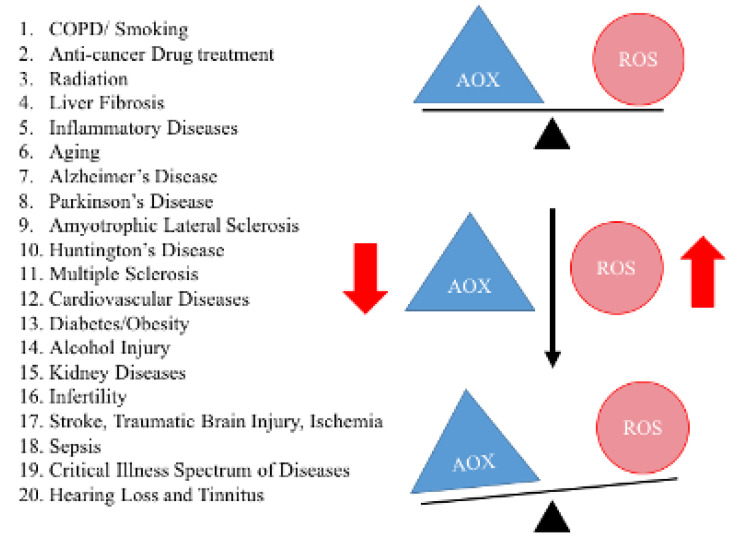
Demonstrates oxidative stress in aging and other age-related diseases. A healthy cell can balance the production of reactive oxidative species and antioxidant enzymes. However, in disease states, such as Alzheimer’s, Parkinson’s, a combination of increased levels of reactive oxidative species production and decreased antioxidant enzymes production have been observed. This imbalance is known as oxidative stress, observed in a large number of human diseases.

References

    1. Reddy P.H., Beal M.F. Amyloid beta, mitochondrial dysfunction and synaptic damage: Implications for cognitive decline in aging and Alzheimer’s disease. Trends Mol. Med. 2008;14:45–53. doi: 10.1016/j.molmed.2007.12.002. - DOI - PMC - PubMed
    1. Wallace D.C. Mitochondrial diseases in man and mouse. Science. 1999;283:1482–1488. doi: 10.1126/science.283.5407.1482. - DOI - PubMed
    1. Wallace D.C. A mitochondrial paradigm of metabolic and degenerative diseases, aging, and cancer: A dawn for evolutionary medicine. Annu. Rev. Genet. 2005;39:359–407. doi: 10.1146/annurev.genet.39.110304.095751. - DOI - PMC - PubMed
    1. Wallace D.C. Why do we still have a maternally inherited mitochondrial DNA? Insights from evolutionary medicine. Annu. Rev. Biochem. 2007;76:781–821. doi: 10.1146/annurev.biochem.76.081205.150955. - DOI - PubMed
    1. Reddy P.H. Mitochondrial medicine for aging and neurodegenerative diseases. Neuromol. Med. 2008;10:291–315. doi: 10.1007/s12017-008-8044-z. - DOI - PMC - PubMed

Publication types