


Quantification of the Animal Tuberculosis Multi-Host Community Offers Insights for Control
- PMID: 32481701
- PMCID: PMC7350387
- DOI: 10.3390/pathogens9060421
Quantification of the Animal Tuberculosis Multi-Host Community Offers Insights for Control
Abstract
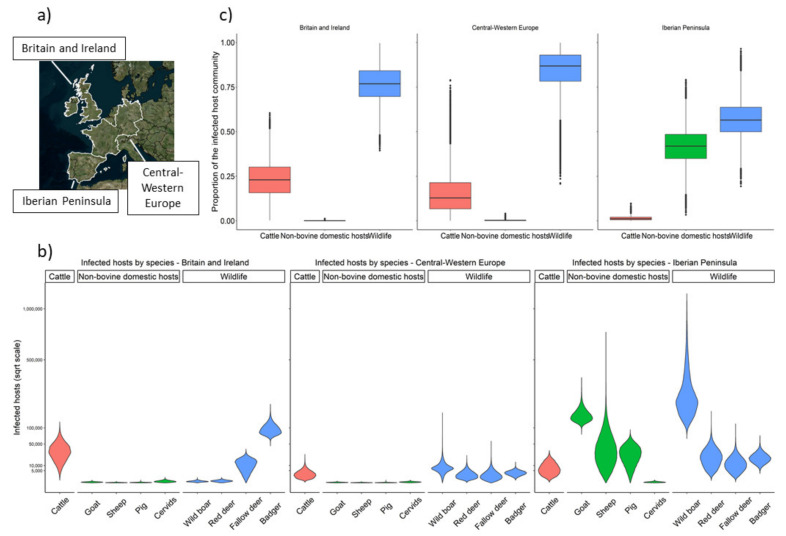
Animal tuberculosis (TB) is a multi-host zoonotic disease whose prevalence in cattle herds in Europe has been increasing, despite a huge investment in eradication. The composition of the host community is a fundamental driver of pathogen transmission, and yet this has not been formally quantified for animal TB in Europe. We quantified multi-host communities of animal TB, using stochastic models to estimate the number of infected domestic and wild hosts in three regions: officially TB-free Central-Western Europe, and two largely TB-endemic regions, the Iberian Peninsula and Britain and Ireland. We show that the estimated number of infected animals in the three regions was 290,059-1,605,612 and the numbers of infected non-bovine domestic and wild hosts always exceeded those of infected cattle, with ratios ranging from 3.3 (1.3-19.6):1 in Britain and Ireland to 84.3 (20.5-864):1 in the Iberian Peninsula. Our results illustrate for the first time the extent to which animal TB systems in some regions of Europe are dominated by non-bovine domestic and wild species. These findings highlight the need to adapt current strategies for effective future control of the disease.
Keywords: disease eradication; livestock; mycobacterium bovis; stochastic models; wild animals.
Conflict of interest statement
The authors declare no conflict of interest.
Figures
References
-
- Gortázar C., Delahay R.J., Mcdonald R.A., Boadella M., Wilson G.J., Gavier-Widen D., Acevedo P. The status of tuberculosis in European wild mammals. Mammal Rev. 2012;42:193–206. doi: 10.1111/j.1365-2907.2011.00191.x. - DOI
-
- Crispell J., Benton C.H., Balaz D., De Maio N., Ahkmetova A., Allen A., Biek R., Presho E.L., Dale J., Hewinson G., et al. Combining genomics and epidemiology to analyse bi-directional transmission of Mycobacterium bovis in a multi-host system. ELife. 2019;8:e45833. doi: 10.7554/eLife.45833. - DOI - PMC - PubMed
-
- Hauer A., De Cruz K., Cochard T., Godreuil S., Karoui C., Henault S., Bulach T., Bañuls A.L., Biet F., Boschiroli M.L. Genetic evolution of Mycobacterium bovis causing tuberculosis in livestock and wildlife in France since 1978. PLoS ONE. 2015;10:e0117103. doi: 10.1371/journal.pone.0117103. - DOI - PMC - PubMed
Grants and funding
LinkOut - more resources
Full Text Sources
