


Stakeholders' Consensus on Strategies for Self- and Other-Regulation of Video Game Play: A Mixed Methods Study
- PMID: 32481721
- PMCID: PMC7313040
- DOI: 10.3390/ijerph17113846
Stakeholders' Consensus on Strategies for Self- and Other-Regulation of Video Game Play: A Mixed Methods Study
Abstract
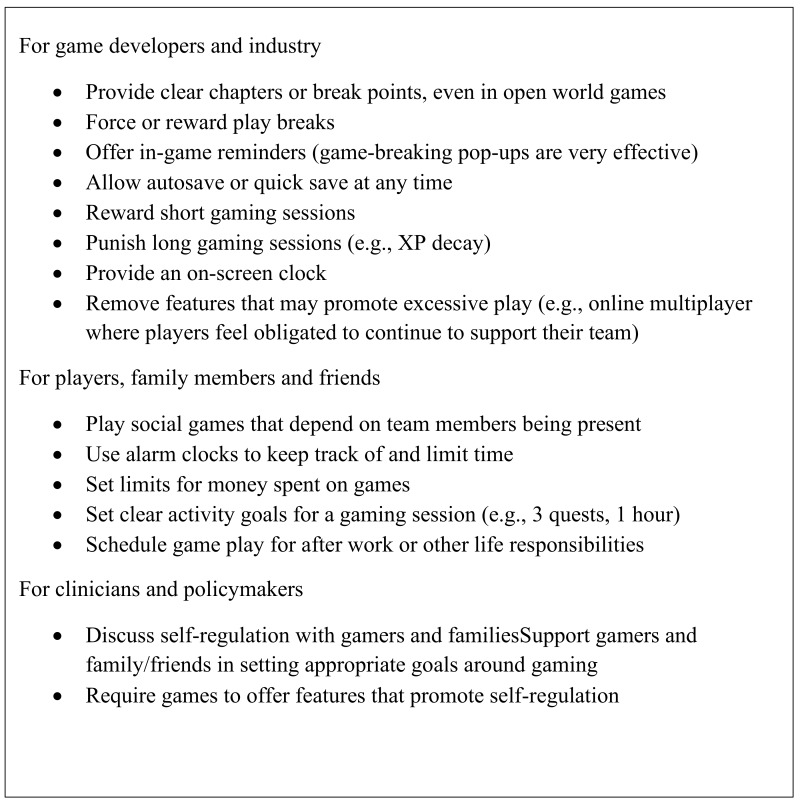
Background: Little is known about strategies or mechanics to improve self-regulation of video game play that could be developed into novel interventions. This study used a participatory approach with the gaming community to uncover insider knowledge about techniques to promote healthy play and prevent gaming disorder. Methods: We used a pragmatic approach to conduct a convergent-design mixed-methods study with participants attending a science fiction and education convention. Six participants answered questions about gaming engagement and self- or game-based regulation of gaming which were then categorized into pre-determined (a priori) themes by the presenters during the presentation. The categorized themes and examples from participant responses were presented back to participants for review and discussion. Seven participants ranked their top choices of themes for each question. The rankings were analyzed using a nonparametric approach to show consensus around specific themes. Results: Participants suggested several novel potential targets for preventive interventions including specific types of social (e.g., play with others in a group) or self-regulation processes (e.g., set timers or alarms). Suggestions for game mechanics that could help included clear break points and short missions, but loot boxes were not mentioned. Conclusions: Our consensus development approach produced many specific suggestions that could be implemented by game developers or tested as public health interventions, such as encouraging breaks through game mechanics, alarms or other limit setting; encouraging group gaming; and discussing and supporting setting appropriate time or activity goals around gaming (e.g., three quests, one hour). As some suggestions here have not been addressed previously as potential interventions, this suggests the importance of including gamers as stakeholders in research on the prevention of gaming disorder and the promotion of healthy gaming. A large-scale, online approach using these methods with multiple stakeholder groups could make effective use of players' in-depth knowledge and help speed discovery and translation of possible preventive interventions into practice and policy.
Keywords: consensus development; gaming disorder; mixed methods research; prevention; stakeholder engagement; video games.
Conflict of interest statement
M.C.C. has spoken to the World Health Organization about this topic at the request of the video game industry but has received no funding, honorarium, fees, meals, accommodations, donations or reimbursement. She is currently seeking funding from industry sources to conduct game research. She has acted as a consultant with a nonprofit organization that provides mental health and suicide prevention support through online video game play. She is the CEO and founder of the Gaming and Wellness Association, Inc., a nonprofit video game research organization. Author M.C. has worked for a video game developer as a game quality tester and heads an IT and research consulting company. Author A.L. declares no conflicts of interest.
Figures
References
-
- American Psychiatric Association . Diagnostic and Statistical Manual of Mental Disorders. 5th ed. American Psychiatric Association; Arlington, VA, USA: 2013.
-
- World Health Organization WHO Gaming Disorder. [(accessed on 28 May 2020)]; Available online: http://www.who.int/features/qa/gaming-disorder/en/
-
- González-Bueso V., Santamaría J.J., Fernández D., Merino L., Montero E., Ribas J. Association between Internet Gaming Disorder or Pathological Video-Game Use and Comorbid Psychopathology: A Comprehensive Review. Int. J. Environ. Res. Public Health. 2018;15:668. doi: 10.3390/ijerph15040668. - DOI - PMC - PubMed
Publication types
MeSH terms
Grants and funding
LinkOut - more resources
Full Text Sources
Research Materials
