Multicenter Study
. 2020 Jul;31(7):1398-1408.
doi: 10.1681/ASN.2020040461. Epub 2020 Jun 1.

Hemodialysis with Cohort Isolation to Prevent Secondary Transmission during a COVID-19 Outbreak in Korea

Affiliations
Multicenter Study

Hemodialysis with Cohort Isolation to Prevent Secondary Transmission during a COVID-19 Outbreak in Korea

Jang-Hee Cho et al. J Am Soc Nephrol. 2020 Jul.

Abstract

Background: Health care-associated infections during previous coronavirus epidemics involving severe acute respiratory syndrome and Middle East respiratory syndrome resulted from human-to-human transmission in hemodialysis (HD) facilities. The effect of a strategy of HD with cohort isolation-separate dialysis sessions for close contacts of patients with confirmed coronavirus disease 2019 (COVID-19)-on the prevention of secondary transmission of severe acute respiratory syndrome coronavirus 2 (SARS-CoV-2) in HD units is unknown.

Methods: Our multicenter cohort study of an HD with cohort isolation strategy enrolled close contacts of patients with confirmed COVID-19, including patients on HD and health care workers in HD units. Close contacts had been identified by epidemiologic investigation and tested negative on an immediate screening test for SARS-CoV-2.

Results: As of March 14, 11 patients on HD and 7 health care workers from 11 HD centers were diagnosed as having COVID-19. The immediate screening test was performed in 306 people, and among them, 302 close contacts with negative test results were enrolled. HD with cohort isolation was performed among all close contacts for a median of 14 days in seven centers. During cohort isolation, nine patients showed symptoms but tested negative for SARS-CoV-2. Two health care workers in the HD units (0.66% of the total group) were diagnosed at the termination test for SARS-CoV-2.

Conclusions: The transmission of COVID-19 can be controlled without closure of HD centers by implementing preemptive activities, including early detection with rapid testing, cohort isolation, collaboration between institutions, and continuous monitoring of infection. Our strategy and experience may provide helpful guidance for circumstances involving the rapid spread of infectious diseases such as COVID-19.

Keywords: COVID-19; cohort isolation; coronavirus; end-stage renal disease; hemodialysis units; quarantine.


Figures

Figure 1.
Figure 1.
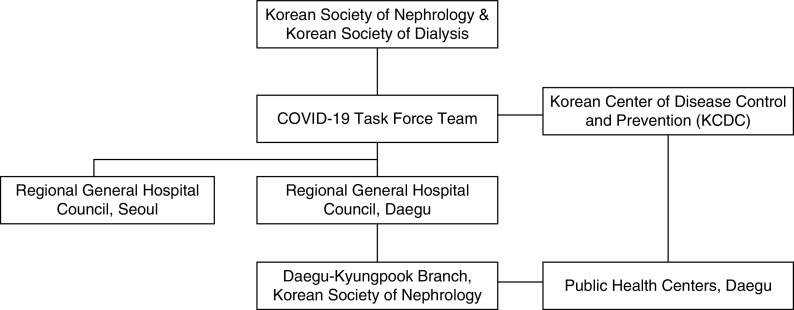
Organizational chart of the joint committee for patients on HD in the COVID-19 outbreak. A joint committee was established with nephrologists and government authorities to take the collaborative activities for HD patients in COVID-19 outbreak when the first HD patient was diagnosed with COVID-19 in Daegu, Korea.
Figure 2.
Figure 2.
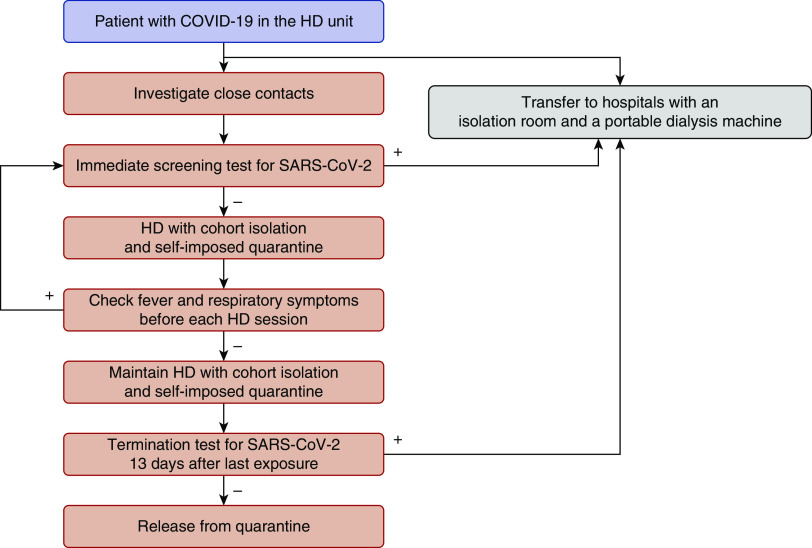
Algorithm of HD with cohort isolation to protect transmission of COVID-19 in an HD facility. Close contacts of the confirmed patients were identified by epidemiologic investigation and underwent immediate screening test for SARS-CoV-2. During cohort isolation, test for SARS-CoV-2 was immediately performed to a close contact who developed any symptoms before dialysis. Termination tests for SARS-CoV-2 were performed to determine the termination of cohort isolation.
Figure 3.
Figure 3.
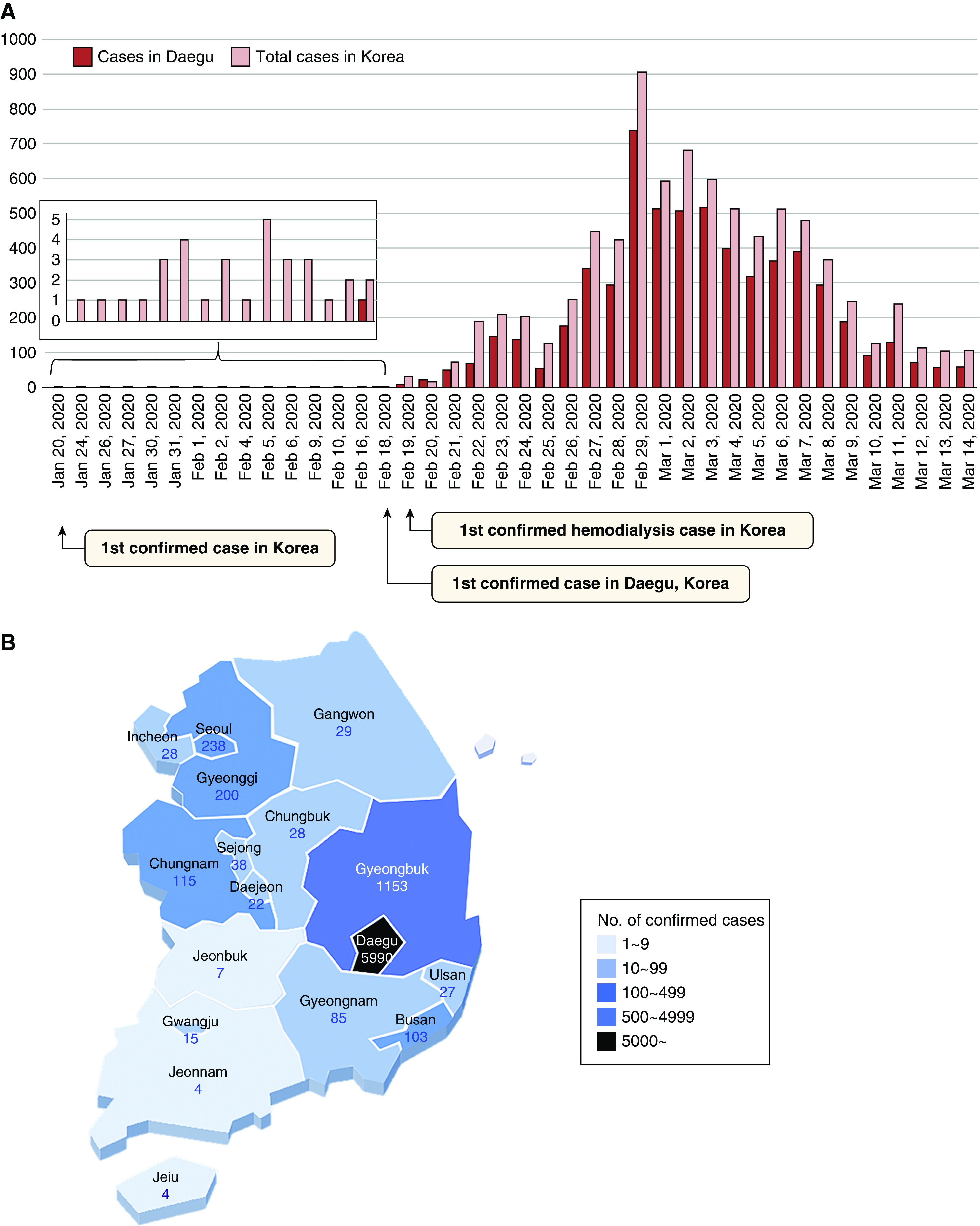
Distribution of laboratory-confirmed cases of COVID-19 in Korea. (A) Daily number of confirmed cases. (B) Regional distribution of confirmed cases.
Figure 4.
Figure 4.
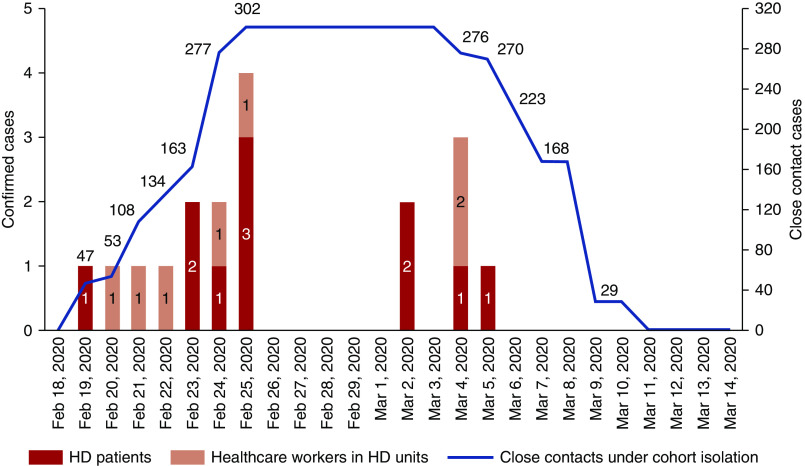
Daily numbers of laboratory-confirmed cases and close contacts under cohort isolation for COVID-19 in Daegu. Confirmed patients on HD are shown with dark red bars. Confirmed health care workers are shown with light red bars. Close contacts under the cohort isolation in HD units are shown with the linear graph.
Figure 5.
Figure 5.
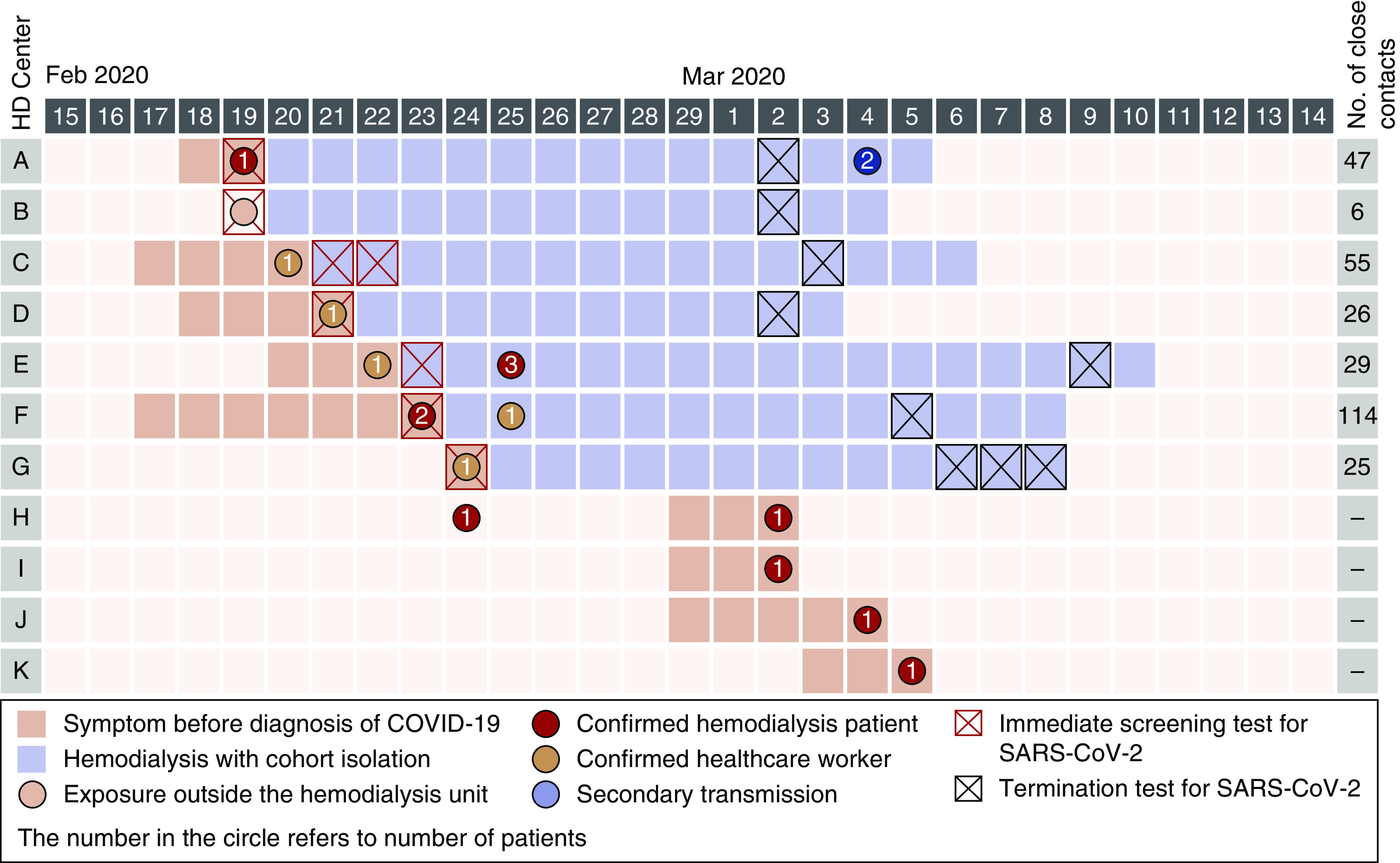
Time course of symptoms, diagnosis of COVID-19, and isolation HD. A total of 207 patients on HD and 95 health care workers were classified as close contacts among 11 HD units during the study period.
Figure 6.
Figure 6.
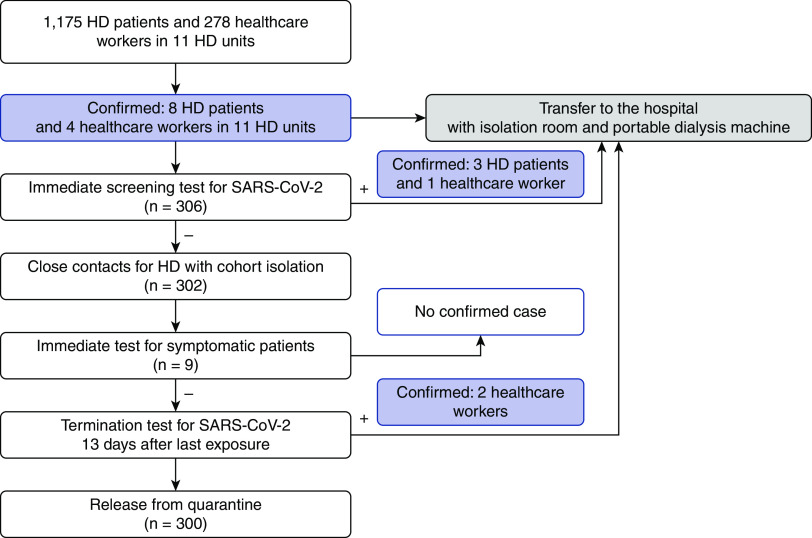
Flowchart of the process of diagnosing COVID-19, HD with cohort isolation, and secondary transmission. Among the 302 close contacts, nine manifested symptoms, but tested negative. Two healthcare workers were diagnosed as COVID-19 at the termination test.

References

    1. Huang C, Wang Y, Li X, Ren L, Zhao J, Hu Y, et al.: Clinical features of patients infected with 2019 novel coronavirus in Wuhan, China. Lancet 395: 497–506, 2020. - PMC - PubMed
    1. Wang D, Hu B, Hu C, Zhu F, Liu X, Zhang J, et al.: Clinical characteristics of 138 hospitalized patients with 2019 novel coronavirus-infected pneumonia in Wuhan, China [published online ahead of print February 7, 2020]. JAMA doi:10.1001/jama.2020.1585 - PMC - PubMed
    1. Guan WJ, Ni ZY, Hu Y, Liang WH, Ou CQ, He JX, et al. China Medical Treatment Expert Group for Covid-19 : Clinical characteristics of coronavirus disease 2019 in China. N Engl J Med 382: 1708–1720, 2020. - PMC - PubMed
    1. Lu R, Zhao X, Li J, Niu P, Yang B, Wu H, et al.: Genomic characterisation and epidemiology of 2019 novel coronavirus: Implications for virus origins and receptor binding. Lancet 395: 565–574, 2020. - PMC - PubMed
    1. Zhu N, Zhang D, Wang W, Li X, Yang B, Song J, et al. China Novel Coronavirus Investigating and Research Team : A novel coronavirus from patients with pneumonia in China, 2019. N Engl J Med 382: 727–733, 2020. - PMC - PubMed

Publication types

MeSH terms