. 2020 May 15;10(14):6082-6094.
doi: 10.7150/thno.44584. eCollection 2020.

Immunohistochemical PSMA expression patterns of primary prostate cancer tissue are associated with the detection rate of biochemical recurrence with 68Ga-PSMA-11-PET

Affiliations

Immunohistochemical PSMA expression patterns of primary prostate cancer tissue are associated with the detection rate of biochemical recurrence with 68Ga-PSMA-11-PET

Daniela A Ferraro et al. Theranostics. .

Abstract

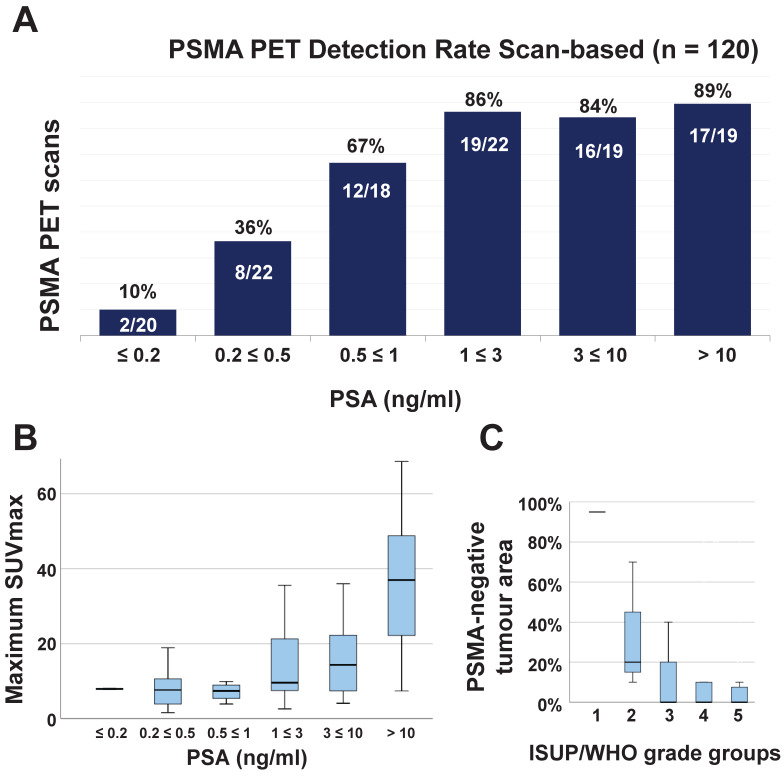
Prostate-specific membrane antigen (PSMA) targeted PET has a high detection rate for biochemical recurrence (BCR) of prostate cancer (PCa). Nevertheless, even at high prostate-specific antigen (PSA) levels (> 3 ng/ml), a relevant number of PSMA-PET scans are negative, mainly due to PSMA-negative PCa. Our objective was to investigate whether PSMA-expression patterns of the primary tumour on immunohistochemistry (IHC) are associated with PSMA-PET detection rate of recurrent PCa. Methods: Retrospective institutional review board approved single-centre analysis of patients who had undergone 68Ga-PSMA-11-PET for BCR after radical prostatectomy (RPE) between 04/2016 and 07/2019, with tumour specimens available for PSMA-IHC. Clinical information (age, PSA-level, ongoing androgen deprivation therapy (ADT), Gleason score) and PSMA-IHC of the primary tumour were collected and their relationship to results from PSMA-PET (positive/negative) was investigated using a multiple logistic regression analysis. Results: 120 PSMA-PET scans in 74 patients were available for this analysis. Overall detection rate was 62% (74/120 scans), with a mean PSA value at scan time of 0.99 ng/ml (IQR 0.32-4.27). Of the clinical factors, only PSA-level and ADT were associated with PSMA-PET positivity. The percentage of PSMA-negative tumour area on IHC (PSMA%neg) had a significant association to PSMA-PET negativity (OR = 2.88, p < 0.001), while membranous PSMA-expression showed no association (p = 0.73). The positive predictive value of PSMA%neg ≥ 50% for a negative PSMA-PET was 85% (13/11) and for a PSMA%neg of 80% or more, 100% (9/9). Conclusions: PSMA-negative tumour area on IHC exhibited the strongest association with negative PSMA-PET scans, beside PSA-level and ADT. Even at very high PSA levels, PSMA-PET scans were negative in most of the patients with PSMA%neg ≥ 50%.

Keywords: PSMA PET; PSMA staining; PSMA-negative prostate cancer; immunohistochemistry; restaging.


Conflict of interest statement

Competing Interests: IAB has received research grants and speaker honorarium from GE Healthcare, research grants from Swiss Life and speaker honorarium from Bayer Health Care and Astellas Pharma AG. MM received speaker fees from GE Healthcare. TH holds an advisory function for MSD and Bayer. Authors DAF, JHR, UJM, BK, JM, LH, DE, and NJR declare no conflict of interest. The Department of Nuclear Medicine holds an institutional Research Contract with GE Healthcare. The authors thank the Sick legat and the Iten-Kohaut foundation for their financial support.

Figures

Figure 1
Figure 1
Patient inclusion flowchart and patient characteristics. *including salvage lymph node dissection and other treatment combinations. ADT = androgen-deprivation therapy; IHC = immunohistochemistry; RPE = radical prostatectomy; SBRT = stereotactic body radiation therapy; sRT = salvage radiotherapy
Figure 2
Figure 2
(A) Bar chart of 68Ga-PSMA-11-PET detection rate in relation to the PSA level at scan time. (B) Boxplot of the correlation between patient PSA level at scan time and maximum SUVmax of 68Ga-PSMA-11-PET for the 74 positive scans (r = 0.518, p < 0.001, CI: 0.260, 0.594). (C) Boxplot of the inverse correlation between PSMA-negative tumour area on immunohistochemistry (PSMA%neg) and maximum ISUP/WHO grade groups of the primary tumour (r = -0.243, p < 0.007, CI: -0.066, -0.420) for all 74 patients included in the study. SUVmax = maximum standardized uptake value
Figure 3
Figure 3
Overview of the primary tumour of the 5 patients with PSMA%neg > 50%. (A) shows GS 4+4 = 8, poorly defined, fused glands, wide negativity for PSMA, only single cell expression of Synaptophysin (arrowhead) and moderate Androgenreceptor (AR) expression (Pat. 14). (B) shows GS 4+4 = 8, focal cribriform morphology in H&E and predominantly fused glands with secretions, focal expression of PSMA and single cell expression of Synaptophysin and moderate AR experssion (Pat. 59). (C) shows GS 4+5 = 9, poorly defined to solid glands with cytoplsamic vacuoles, vast negativity in the PSMA staining, single cells reactive for synaptophysin and moderate AR expression (Pat. 19). (D) shows GS 3+3 = 6, isolated glands can be appreciated being widely negative for PSMA, with no Synaptophysin expression and weak AR reactivity (Pat. 31). (E) shows GS 4+5 = 9, poorly defined glands and focal cribriform growth is visiable with vast negativity for PSMA, single cell Synaptophysin expression and strong AR reactivity (Pat. 62). Scale bar 100 mu.
Figure 4
Figure 4
Hematoxylin and eosin staining (H&E) and immunohistochemical (IHC) PSMA staining of primary tumour (PT) and metastatic lymph node (LN) from two patients who had LN showing a homogeneous pattern of PSMA-expression and PSMA%neg in concordance to the PT. (A) Shows a PT with GS 4+4 = 8 and 0% PSMA%neg and LN metastasis with GS 4+5 = 9 and 0% PSMA%neg (Pat.45). (B) Shows a primary tumour with GS 4+4 = 8 and 80% PSMA%neg and LN metastasis with GS 4+5 = 9 and 90% PSMA%neg (Pat.45). Bars represent 5mm with tumour outlined in blue, with exception of the bottom row which shows a magnification of PSMA-IHC images (bar 250 µm).
Figure 5
Figure 5
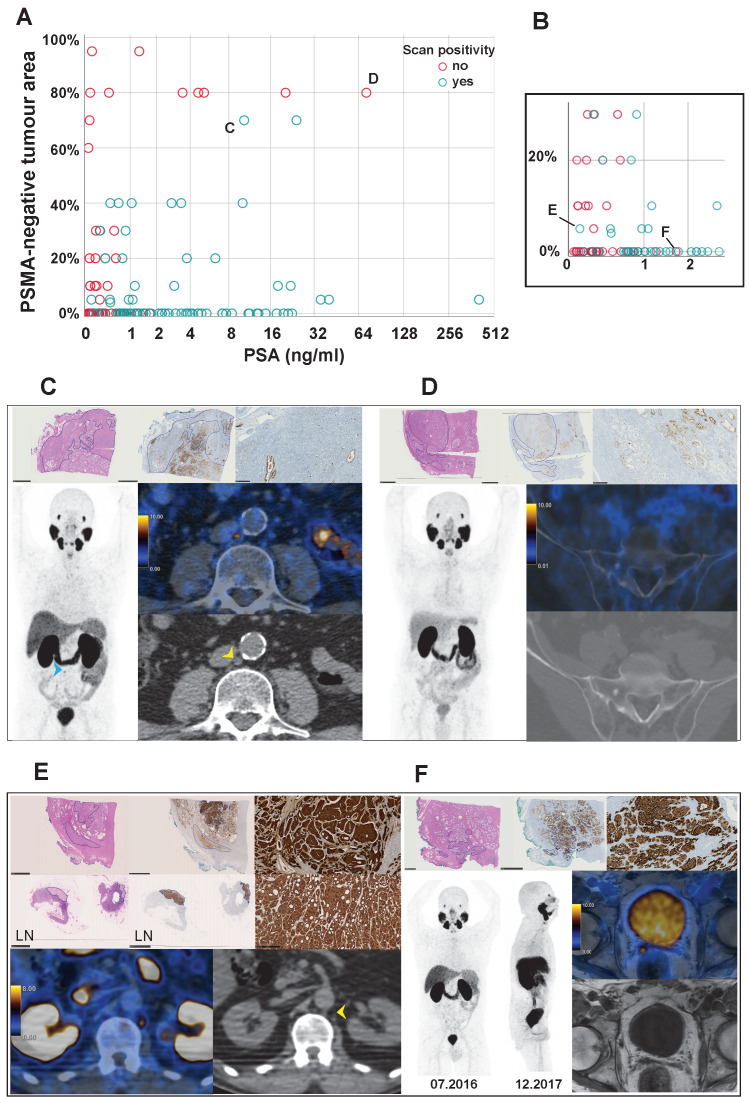
(A) Distribution of 68Ga-PSMA-11-PET scans according to primary tumour PSMA-negative tumour area (PSMA%neg) on immunohistochemistry (IHC) and patient prostate-specific antigen (PSA) level at scan time. PSMA%neg is presented on linear scale and PSA level on logarithmic scale. Patients with a PSMA%neg of 80% or more always had negative 68Ga-PSMA-11-PET scans, regardless of PSA levels. Patients with a PSMA-negative tumour area < 80% and a PSA level ≥ 2 ng/ml always had positive 68Ga-PSMA-11-PET scans. (B) Detail from figure A magnifying on scans from patients with low PSMA%neg and low PSA values. (C-F) H&E (top left) and PSMA-IHC (top middle and magnification on top right) of the primary tumour and lymph nodes (only in figure E, middle row), as well as 68Ga-PSMA-11-PET images (maximum intensity projection (MIP), fused PET/CT or PET/MR and CT or MR) of the patients who had scans marked with the respective letters in figures A or B. MIP images are in the same intensity as the fused PET images. In the histopathology images, bars represent 5mm with tumour outlined in blue and 250 µm in the magnification of the PSMA-IHC: (C) Primary tumour (pT3b, GS 4+4 = 8) of a 57 y.o. patient with 70% PSMA%neg. 68Ga-PSMA-11-PET performed for biochemical recurrence at a PSA level of 10.4 ng/ml shows only two retroperitoneal lymph nodes with 7mm (arrowhead, SUVmax 7.4) and 5mm (not shown). The patient received radiotherapy (RT), with a partial drop of PSA and an immediate further rise, allowing the hypothesis that 68Ga-PSMA-11-PET underestimated disease. (D) Primary tumour (pT2c, GS 4+4 = 8) of a 68 y.o. patient with 80% PSMA%neg. The patient had two negative 68Ga-PSMA-11-PET scans for biochemical recurrence under PSA levels of 4.65 ng/ml and 20.36 ng/ml, respectively, and refused treatment. A third 68Ga-PSMA-11-PET scan was performed under a PSA level of 72 ng/ml and showed a new sclerotic lesion in the sacrum (arrowhead), suspicious for metastasis in the clinical context despite missing PSMA-expression, and confirmed by MR (supplementary Figure S3) which showed also multiple lesions in the vertebral spine and iliac bones. (E) Primary tumour (pT3a, GS 4+3 = 7) and a metastatic lymph node (LN) of a 64 y.o patient with 5% and 0% PSMA%neg, respectively. 68Ga-PSMA-11-PET performed for biochemical recurrence under a PSA level of 0.11 ng/ml with two small retroperitoneal nodes (SUVmax 7.8, pointed by the arrowhead, and 6.2, not shown). The patient underwent RT for the paraortal lymphatic chain achieving an undetectable PSA until last follow up. (F) Primary tumour (pT3b, GS 4+4 = 8) of a 64 y.o. patient with 0% PSMA%neg. 68Ga-PSMA-11-PET was negative despite a PSA of 1.69 ng/ml (only MIP shown). Patient underwent PSA follow-up and a second scan was performed when PSA level achieved 4.63 ng/ml, showing local recurrence in the seminal vesicles bed (blue arrowhead, SUVmax 7.3).

References

    1. Wright GL Jr, Haley C, Beckett ML, Schellhammer PF. Expression of prostate-specific membrane antigen in normal, benign, and malignant prostate tissues. Urol Oncol. 1995;1:18–28. - PubMed
    1. Bostwick DG, Pacelli A, Blute M, Roche P, Murphy GP. Prostate specific membrane antigen expression in prostatic intraepithelial neoplasia and adenocarcinoma - A study of 184 cases. Cancer. 1998;82:2256–61. - PubMed
    1. Silver DA, Pellicer I, Fair WR, Heston WD, Cordon-Cardo C. Prostate-specific membrane antigen expression in normal and malignant human tissues. Clin Cancer Res. 1997;3:81–5. - PubMed
    1. Sweat SD, Pacelli A, Murphy GP, Bostwick DG. Prostate-specific membrane antigen expression is greatest in prostate adenocarcinoma and lymph node metastases. Urology. 1998;52:637–40. - PubMed
    1. Hupe MC, Philippi C, Roth D, Kumpers C, Ribbat-Idel J, Becker F, Expression of Prostate-Specific Membrane Antigen (PSMA) on Biopsies Is an Independent Risk Stratifier of Prostate Cancer Patients at Time of Initial Diagnosis. Frontiers in Oncology. 2018. 8. - PMC - PubMed

Publication types

MeSH terms