Association Between Thrombolytic Door-to-Needle Time and 1-Year Mortality and Readmission in Patients With Acute Ischemic Stroke
- PMID: 32484532
- PMCID: PMC7267850
- DOI: 10.1001/jama.2020.5697
Association Between Thrombolytic Door-to-Needle Time and 1-Year Mortality and Readmission in Patients With Acute Ischemic Stroke
Abstract
Importance: Earlier administration of intravenous tissue plasminogen activator (tPA) in acute ischemic stroke is associated with reduced mortality by the time of hospital discharge and better functional outcomes at 3 months. However, it remains unclear whether shorter door-to-needle times translate into better long-term outcomes.
Objective: To examine whether shorter door-to-needle times with intravenous tPA for acute ischemic stroke are associated with improved long-term outcomes.
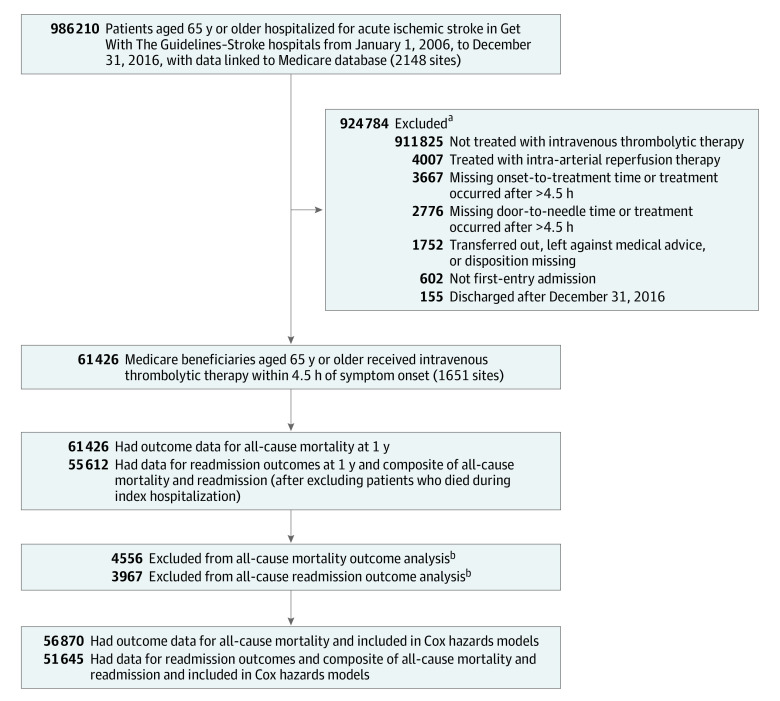
Design, setting, and participants: This retrospective cohort study included Medicare beneficiaries aged 65 years or older who were treated for acute ischemic stroke with intravenous tPA within 4.5 hours from the time they were last known to be well at Get With The Guidelines-Stroke participating hospitals between January 1, 2006, and December 31, 2016, with 1-year follow-up through December 31, 2017.
Exposures: Door-to-needle times for intravenous tPA.
Main outcomes and measures: The primary outcomes were 1-year all-cause mortality, all-cause readmission, and the composite of all-cause mortality or readmission.
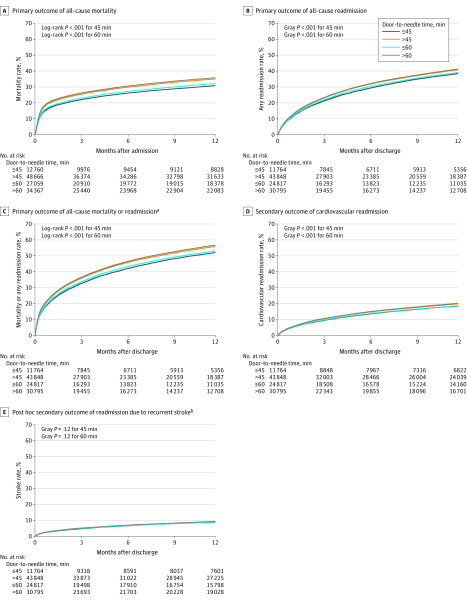
Results: Among the 61 426 patients treated with tPA within 4.5 hours, the median age was 80 years and 43.5% were male. The median door-to-needle time was 65 minutes (interquartile range, 49-88 minutes). The 48 666 patients (79.2%) who were treated with tPA and had door-to-needle times of longer than 45 minutes, compared with those treated within 45 minutes, had significantly higher all-cause mortality (35.0% vs 30.8%, respectively; adjusted HR, 1.13 [95% CI, 1.09-1.18]), higher all-cause readmission (40.8% vs 38.4%; adjusted HR, 1.08 [95% CI, 1.05-1.12]), and higher all-cause mortality or readmission (56.0% vs 52.1%; adjusted HR, 1.09 [95% CI, 1.06-1.12]). The 34 367 patients (55.9%) who were treated with tPA and had door-to-needle times of longer than 60 minutes, compared with those treated within 60 minutes, had significantly higher all-cause mortality (35.8% vs 32.1%, respectively; adjusted hazard ratio [HR], 1.11 [95% CI, 1.07-1.14]), higher all-cause readmission (41.3% vs 39.1%; adjusted HR, 1.07 [95% CI, 1.04-1.10]), and higher all-cause mortality or readmission (56.8% vs 53.1%; adjusted HR, 1.08 [95% CI, 1.05-1.10]). Every 15-minute increase in door-to-needle times was significantly associated with higher all-cause mortality (adjusted HR, 1.04 [95% CI, 1.02-1.05]) within 90 minutes after hospital arrival, but not after 90 minutes (adjusted HR, 1.01 [95% CI, 0.99-1.03]), higher all-cause readmission (adjusted HR, 1.02; 95% CI, 1.01-1.03), and higher all-cause mortality or readmission (adjusted HR, 1.02 [95% CI, 1.01-1.03]).
Conclusions and relevance: Among patients aged 65 years or older with acute ischemic stroke who were treated with tissue plasminogen activator, shorter door-to-needle times were associated with lower all-cause mortality and lower all-cause readmission at 1 year. These findings support efforts to shorten time to thrombolytic therapy.
Conflict of interest statement
Figures
Comment in
-
Long-term Outcomes After Thrombolytic Therapy for Acute Ischemic Stroke.JAMA. 2020 Jun 2;323(21):2184-2185. doi: 10.1001/jama.2020.5269. JAMA. 2020. PMID: 32484521 No abstract available.
-
Door-to-Needle Time and Long-term Outcomes in Patients With Stroke.JAMA. 2020 Oct 13;324(14):1467. doi: 10.1001/jama.2020.15185. JAMA. 2020. PMID: 33048148 No abstract available.
References
-
- Emberson J, Lees KR, Lyden P, et al. ; Stroke Thrombolysis Trialists’ Collaborative Group . Effect of treatment delay, age, and stroke severity on the effects of intravenous thrombolysis with alteplase for acute ischaemic stroke: a meta-analysis of individual patient data from randomised trials. Lancet. 2014;384(9958):1929-1935. doi: 10.1016/S0140-6736(14)60584-5 - DOI - PMC - PubMed
-
- Kwiatkowski TG, Libman RB, Frankel M, et al. ; National Institute of Neurological Disorders and Stroke Recombinant Tissue Plasminogen Activator Stroke Study Group . Effects of tissue plasminogen activator for acute ischemic stroke at one year. N Engl J Med. 1999;340(23):1781-1787. doi: 10.1056/NEJM199906103402302 - DOI - PubMed
-
- Lansberg MG, Schrooten M, Bluhmki E, Thijs VN, Saver JL. Treatment time-specific number needed to treat estimates for tissue plasminogen activator therapy in acute stroke based on shifts over the entire range of the modified Rankin Scale. Stroke. 2009;40(6):2079-2084. doi: 10.1161/STROKEAHA.108.540708 - DOI - PMC - PubMed
Publication types
MeSH terms
Substances
LinkOut - more resources
Full Text Sources
Medical