


Evaluation of the EUROIMMUN Anti-SARS-CoV-2 ELISA Assay for detection of IgA and IgG antibodies
- PMID: 32485620
- PMCID: PMC7255182
- DOI: 10.1016/j.jcv.2020.104468
Evaluation of the EUROIMMUN Anti-SARS-CoV-2 ELISA Assay for detection of IgA and IgG antibodies
Abstract
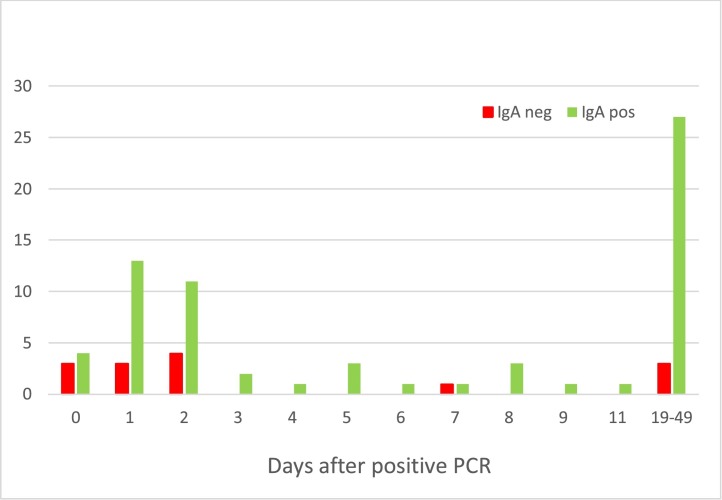
As the Coronavirus 2019 (COVID-19) pandemic evolves, the development of immunoassays to help determine exposure and potentially predict immunity has become a pressing priority. In this report we present the performance of the EUROIMMUN enzyme-linked immunosorbent assay (ELISA) for semi-quantitative detection of IgA and IgG antibodies in serum and plasma samples using recombinant S1 domain of the SARS-CoV-2 spike protein as antigen. Specimens from patients, with and without COVID-19 infection, were tested at the University of Chicago Clinical Microbiology and Immunology Laboratory. Of 86 samples from SARS-CoV-2 PCR-negative patients, including 28 samples positive for common human coronavirus strains, 76 tested negative and 10 tested positive for IgA (88.4% agreement, 95% CI: 79.9-93.6) while 84 tested negative and 2 tested positive for IgG (97.7% agreement, 95% CI: 91.9-99.6). Of 82 samples from SARS-CoV-2 PCR-positive patients, 14 tested negative and 68 tested positive for IgA (82.9% agreement, 95% CI: 73.4-89.5) while 27 tested negative and 55 tested positive for IgG (67.1% agreement, 95% CI: 56.3-76.3). Of samples collected ≥4 days after positive PCR, 38 of 42 (90.5% agreement, 95% CI: 77.9-96.2) were positive for IgA, and 42 of 42 (100% agreement, 95% CI: 91.6-100) were positive for IgG, respectively. The EUROIMMUN Anti-SARS-CoV-2 ELISA Assay demonstrated good sensitivity for detection of IgA and excellent sensitivity for detection of IgG antibodies from samples collected ≥4 days, after COVID-19 diagnosis by PCR. This assay demonstrated good specificity for IgA and excellent specificity for IgG and demonstrated only borderline cross reaction in 2 of the 28 samples from patients with common human coronaviruses infection, types NL63 and OC43.
Keywords: COVID-19; SARS-CoV-2; Serology.
Copyright © 2020 Elsevier B.V. All rights reserved.
Conflict of interest statement
Declaration of competing interest All authors declared no conflict of interest. Study was internally funded.
Figures

References
-
- Lu R., Zhao X., Li J., Niu P., Yang B., Wu H., Wang W., Song H., Huang B., Zhu N., Bi Y., Ma X., Zhan F., Wang L., Hu T., Zhou H., Hu Z., Zhou W., Zhao L., Chen J., Meng Y., Wang J., Lin Y., Yuan J., Xie Z., Ma J., Liu W.J., Wang D., Xu W., Holmes E.C., Gao G.F., Wu G., Chen W., Shi W., Tan W. Genomic characterisation and epidemiology of 2019 novel coronavirus: implications for virus origins and receptor binding. Lancet. 2020;395:565–574. doi: 10.1016/S0140-6736(20)30251-8. - DOI - PMC - PubMed
-
- Huang A.T., Garcia-Carreras B., Hitchings MDT Yang B., Katzelnick L., Rattigan S.M., Borgert B., Moreno C., Solomon B.D., Rodriguez-Barraquer I., Lessler J., Salje H., Burke D.S., Wesolowski A., Cummings DAT . 2020. A Systematic Review of Antibody Mediated Immunity to Coronaviruses: Antibody Kinetics, Correlates Of Protection, And Association of Antibody Responses with Severity of Disease. medRxiv 04.14.20065771. - DOI - PMC - PubMed
-
- Lassaunière R., Frische A., Harboe Z.B., Nielsen A.C.Y., Fomsgaard A., Krogfelt K.A., Jørgensen C.S. 2020. Evaluation of Nine Commercial SARS-CoV-2 Immunoassays. medRxiv 04.09.20056325. - DOI
-
- Okba N.M.A., Müller M.A., Li W., Wang C., GeurtsvanKessel C.H., Corman V.M., Lamer M.M., Sikkema R.S., de Bruin E., Chandler F.D., Yazdanpanah Y., Le Hingrat Q., Descamps D., Houhou-Fidouh N., Reusken C.B.E.M., Bosch B.J., Drosten C., Koopmans M.P.G., Haagmans B.L. Severe acute respiratory syndrome coronavirus 2 − specific antibody responses in coronavirus disease 2019 patients. Emerg. Infect. Dis. 2020;26(7) doi: 10.3201/eid2607.200841. - DOI - PMC - PubMed
Publication types
MeSH terms
Substances
LinkOut - more resources
Full Text Sources
Other Literature Sources
Medical
Miscellaneous
