


Potential of Cry10Aa and Cyt2Ba, Two Minority δ-endotoxins Produced by Bacillus thuringiensis ser. israelensis, for the Control of Aedes aegypti Larvae
- PMID: 32485828
- PMCID: PMC7354544
- DOI: 10.3390/toxins12060355
Potential of Cry10Aa and Cyt2Ba, Two Minority δ-endotoxins Produced by Bacillus thuringiensis ser. israelensis, for the Control of Aedes aegypti Larvae
Abstract
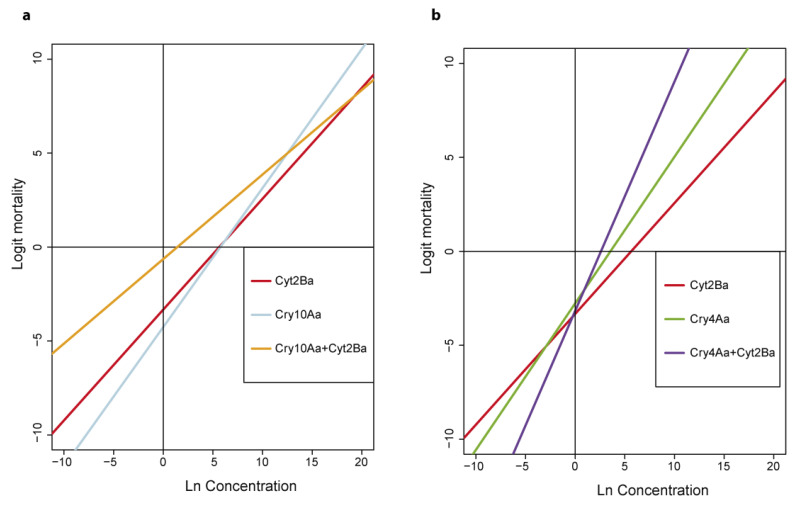
Bacillus thuringiensis ser. israelensis (Bti) has been widely used as microbial larvicide for the control of many species of mosquitoes and blackflies. The larvicidal activity of Bti resides in Cry and Cyt δ-endotoxins present in the parasporal crystal of this pathogen. The insecticidal activity of the crystal is higher than the activities of the individual toxins, which is likely due to synergistic interactions among the crystal component proteins, particularly those involving Cyt1Aa. In the present study, Cry10Aa and Cyt2Ba were cloned from the commercial larvicide VectoBac-12AS® and expressed in the acrystalliferous Bt strain BMB171 under the cyt1Aa strong promoter of the pSTAB vector. The LC50 values for Aedes aegypti second instar larvae estimated at 24 hpi for these two recombinant proteins (Cry10Aa and Cyt2Ba) were 299.62 and 279.37 ng/mL, respectively. Remarkable synergistic mosquitocidal activity was observed between Cry10Aa and Cyt2Ba (synergistic potentiation of 68.6-fold) when spore + crystal preparations, comprising a mixture of both recombinant strains in equal relative concentrations, were ingested by A. aegypti larvae. This synergistic activity is among the most powerful described so far with Bt toxins and is comparable to that reported for Cyt1A when interacting with Cry4Aa, Cry4Ba or Cry11Aa. Synergistic mosquitocidal activity was also observed between the recombinant proteins Cyt2Ba and Cry4Aa, but in this case, the synergistic potentiation was 4.6-fold. In conclusion, although Cry10Aa and Cyt2Ba are rarely detectable or appear as minor components in the crystals of Bti strains, they represent toxicity factors with a high potential for the control of mosquito populations.
Keywords: Aedes aegypti; Bacillus thuringiensis; Bti; minor proteins; mosquito control; synergy.
Conflict of interest statement
The authors declare no conflict of interest. The funders had no role in the design of the study; in the collection, analyses, or interpretation of data; in the writing of the manuscript, or in the decision to publish the results.
Figures
References
-
- Goldberg L.J., Margalith J. A bacterial spore demonstrating rapid larvicidal activity against Anopheles sergentii, Uranotaenia unguiculata, Culex univitattus, Aedes aegypti and Culex pipiens. Mosq. News. 1977;1:355–362.
-
- Federici B.A., Park H., Bideshi D.K. Overview of the basic biology of Bacillus thuringiensis with emphasis on genetic engineering of bacterial larvicides for mosquito control. Open Toxinol. J. 2010;3:154–171. doi: 10.2174/1875414701003010083. - DOI
-
- Margalith Y., Ben-Dov E. Biological control by Bacillus thuringiensis subsp. israelensis. In: Recheigl J.E., Recheigl N.A., editors. Insect Pest Management: Techniques for Environmental Protection. CRC Press; Boca Raton, FL, USA: 2000.
-
- Lacey L.A. Bacillus thuringiensis serovariety israelensis and Bacillus sphaericus for mosquito control. J. Am. Mosq. Control Assoc. 2007;23:133–163. - PubMed
Publication types
MeSH terms
Substances
Grants and funding
LinkOut - more resources
Full Text Sources
