. 2020 May 29;21(11):3867.
doi: 10.3390/ijms21113867.

Recovery of BDNF and CB1R in the Prefrontal Cortex Underlying Improvement of Working Memory in Prenatal DEHP-Exposed Male Rats after Aerobic Exercise

Affiliations

Recovery of BDNF and CB1R in the Prefrontal Cortex Underlying Improvement of Working Memory in Prenatal DEHP-Exposed Male Rats after Aerobic Exercise

Dean-Chuan Wang et al. Int J Mol Sci. .

Abstract

Early-life exposure to di-(2-ethylhexyl)-phthalate (DEHP) has been suggested to relate to hyperactivity, lack of attention, and working memory deficits in school-age children. Brain-derived neurotrophic factor (BDNF) and endocannabinoids are induced by aerobic exercises to provide beneficial effects on brain functions. This study investigated the mechanisms underlying working memory impairment and the protective role of exercise in prenatal DEHP-exposed male rats. Sprague Dawley dams were fed with vehicle or DEHP during gestation. The male offspring were trained to exercise on a treadmill for 5 weeks, which was followed by an assessment of their working memory with a T-maze delayed non-match-to-sample task. The expressions of BDNF, dopamine D1 receptor (D1R), cannabinoid receptor 1 (CB1R), and fatty acid amide hydrolase (FAAH) in the prefrontal cortex were detected by Western blot. The results showed that DEHP-exposed rats exhibited working memory impairments without significant alterations in locomotor activities. The reduced expressions of prefrontal BDNF and CB1R were obtained in the DEHP-exposed rats, while D1R and FAAH were barely affected. Importantly, aerobic exercise during childhood-adolescence prevented the impairment of working memory in the DEHP-exposed rats by recovering the BDNF and CB1R expressions in the prefrontal cortex. These findings suggest that exercise may provide beneficial effects in ameliorating the impairment of working memory in the prenatal DEHP-exposed male rats at late adolescence.

Keywords: aerobic exercise; brain-derived neurotrophic factor; di-(2-ethylhexyl)-phthalate; endocannabinoids; working memory.


Conflict of interest statement

The authors declare that there are no conflicts of interest.

Figures
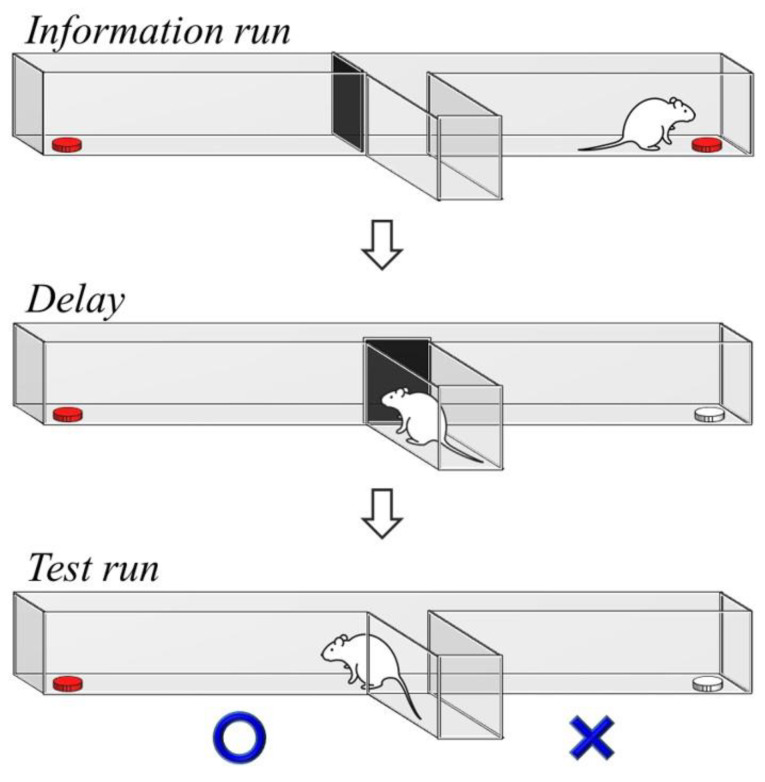
Figure 1
Figure 1
The demonstration of the delayed non-match-to-sample task. A delayed period between the information run and test run is required for the prefrontal activity to perform working memory processing. The correct and wrong choices are indicated in the test run. The white food tray represents a previously visited location in the information run.
Figure 2
Figure 2
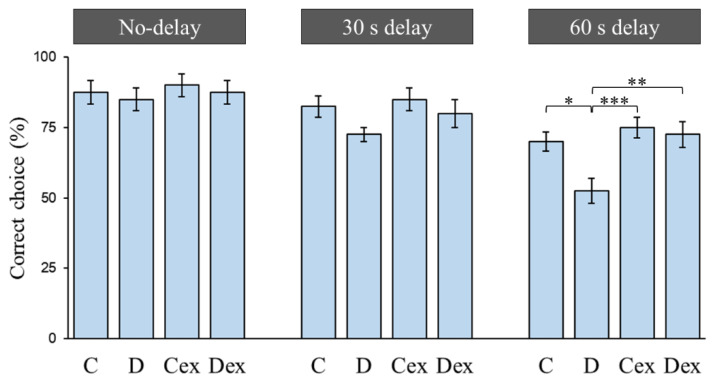
Choice accuracy in the delayed non-match-to-sample task. Animals were trained to perform the rewarded alternation in trials with no-delay, 30 s delay, and 60 s delay conditions. No significant differences were found in the no-delay and 30 s delay conditions. In the 60 s delay condition, the choice accuracy was significantly decreased in the D group. Compared with the D group, exercise improved the choice accuracy in the Dex group. C: control; D: di-(2-ethylhexyl)-phthalate (DEHP) exposure; Cex: exercised control; Dex: exercised DEHP exposure. Data are presented in mean ± SEM (n = 10 in each group). *: p < 0.05, **: p < 0.01, ***: p < 0.005.
Figure 3
Figure 3
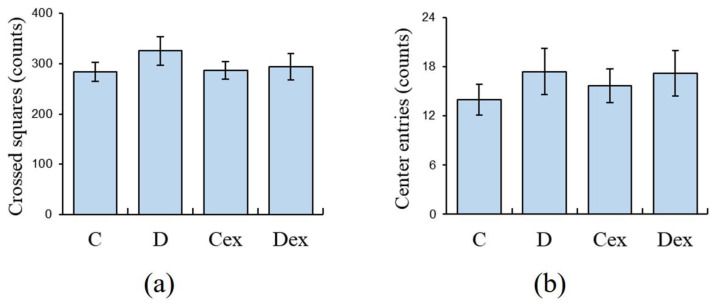
Spontaneous locomotor activities in the open field test. Animals were allowed to explore in an open field for 10 min. There were no significant differences among groups in (a) number of crossed squares or (b) center entries. C: control; D: DEHP exposure; Cex: exercised control; Dex: exercised DEHP exposure. Data are presented in mean ± SEM (n = 10 in each group).
Figure 4
Figure 4
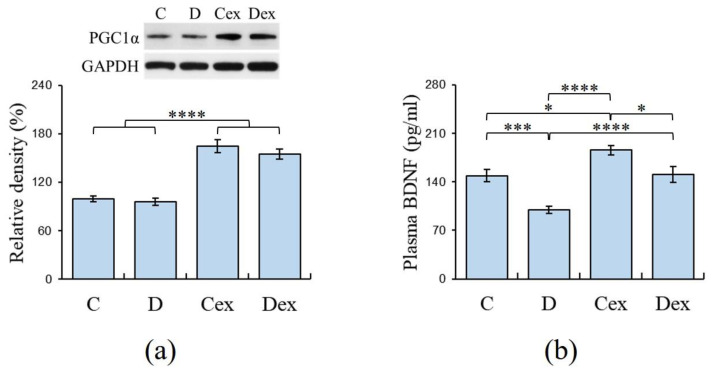
Muscle peroxisome proliferator-activated receptor gamma coactivator 1-α (PGC-1α) and plasma brain-derived neurotrophic factor (BDNF) levels analyzed by Western blot and ELISA, respectively. (a) Increased PGC-1α expressions were observed in the Cex and Dex groups compared to the C and D groups. (b) Plasma BDNF levels were significantly decreased in the D group, whereas exercise normalized these reductions in the Dex group. C: control; D: DEHP exposure; Cex: exercised control; Dex: exercised DEHP exposure. Data are presented in mean ± SEM (n = 10 in each group). *: p < 0.05, ***: p < 0.005, ****: p < 0.001.
Figure 5
Figure 5
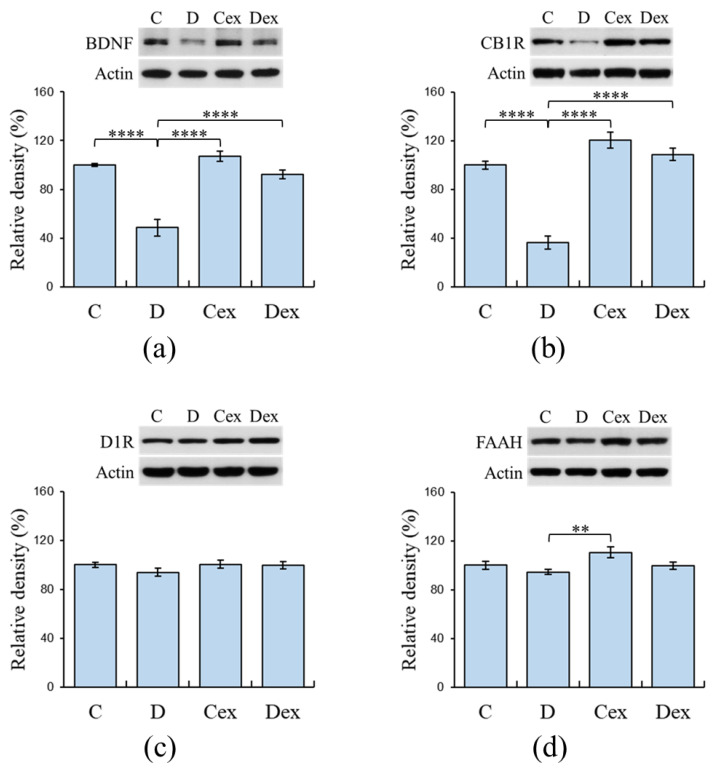
Expressions of prefrontal BDNF, dopamine D1 receptor (D1R), cannabinoid receptor 1 (CB1R), and fatty acid amide hydrolase (FAAH) analyzed by Western blot. (a) Decreased expressions of prefrontal BDNF were observed in the D group, whereas exercise restored this impairment in the Dex group. (b) Decreased expressions of prefrontal CB1R were observed in the D group, whereas exercise restored this impairment in the Dex group. (c) No significant differences were found among groups in their expressions of prefrontal D1R. (d) No significant differences were found among groups in the expressions of prefrontal FAAH. C: control; D: DEHP exposure; Cex: exercised control; Dex: exercised DEHP exposure. Data are presented in mean ± SEM (n = 10 in each group). **: p < 0.01, ****: p < 0.001.

References

    1. Johns L.E., Cooper G.S., Galizia A., Meeker J.D. Exposure assessment issues in epidemiology studies of phthalates. Environ. Int. 2015;85:27–39. doi: 10.1016/j.envint.2015.08.005. - DOI - PMC - PubMed
    1. Lee D.W., Kim M.S., Lim Y.H., Lee N., Hong Y.C. Prenatal and postnatal exposure to di-(2-Ethylhexyl) phthalate and neurodevelopmental outcomes: A systematic review and meta-analysis. Environ. Res. 2018;167:558–566. doi: 10.1016/j.envres.2018.08.023. - DOI - PubMed
    1. Dai Y., Yang Y., Xu X., Hu Y. Effects of uterine and lactational exposure to di-(2-ethylhexyl) phthalate on spatial memory and NMDA receptor of hippocampus in mice. Horm. Behav. 2015;71:41–48. doi: 10.1016/j.yhbeh.2015.03.008. - DOI - PubMed
    1. Quinnies K.M., Harris E.P., Snyder R.W., Sumner S.S., Rissman E.F. Direct and transgenerational effects of low doses of perinatal di-(2-ethylhexyl) phthalate (DEHP) on social behaviors in mice. PLoS ONE. 2017;12:e0171977. doi: 10.1371/journal.pone.0171977. - DOI - PMC - PubMed
    1. Wang D.C., Chen T.J., Lin M.L., Jhong Y.C., Chen S.C. Exercise prevents the increased anxiety-like behavior in lactational di-(2-ethylhexyl) phthalate-exposed female rats in late adolescence by improving the regulation of hypothalamus-pituitary-adrenal axis. Horm. Behav. 2014;66:674–684. doi: 10.1016/j.yhbeh.2014.09.010. - DOI - PubMed

MeSH terms

LinkOut - more resources