. 2020 May 31;20(11):3121.
doi: 10.3390/s20113121.

Development of a Portable, Ultra-Rapid and Ultra-Sensitive Cell-Based Biosensor for the Direct Detection of the SARS-CoV-2 S1 Spike Protein Antigen

Affiliations

Development of a Portable, Ultra-Rapid and Ultra-Sensitive Cell-Based Biosensor for the Direct Detection of the SARS-CoV-2 S1 Spike Protein Antigen

Sophie Mavrikou et al. Sensors (Basel). .

Abstract

One of the key challenges of the recent COVID-19 pandemic is the ability to accurately estimate the number of infected individuals, particularly asymptomatic and/or early-stage patients. We herewith report the proof-of-concept development of a biosensor able to detect the SARS-CoV-2 S1 spike protein expressed on the surface of the virus. The biosensor is based on membrane-engineered mammalian cells bearing the human chimeric spike S1 antibody. We demonstrate that the attachment of the protein to the membrane-bound antibodies resulted in a selective and considerable change in the cellular bioelectric properties measured by means of a Bioelectric Recognition Assay. The novel biosensor provided results in an ultra-rapid manner (3 min), with a detection limit of 1 fg/mL and a semi-linear range of response between 10 fg and 1 μg/mL. In addition, no cross-reactivity was observed against the SARS-CoV-2 nucleocapsid protein. Furthermore, the biosensor was configured as a ready-to-use platform, including a portable read-out device operated via smartphone/tablet. In this way, we demonstrate that the novel biosensor can be potentially applied for the mass screening of SARS-CoV-2 surface antigens without prior sample processing, therefore offering a possible solution for the timely monitoring and eventual control of the global coronavirus pandemic.

Keywords: Bioelectric Recognition Assay (BERA); Point-of-Care (POC); S1 spike protein; membrane engineering; serological assay; severe acute respiratory syndrome-coronavirus 2 (SARS-CoV-2).


Conflict of interest statement

The authors declare no conflict of interest.

Figures
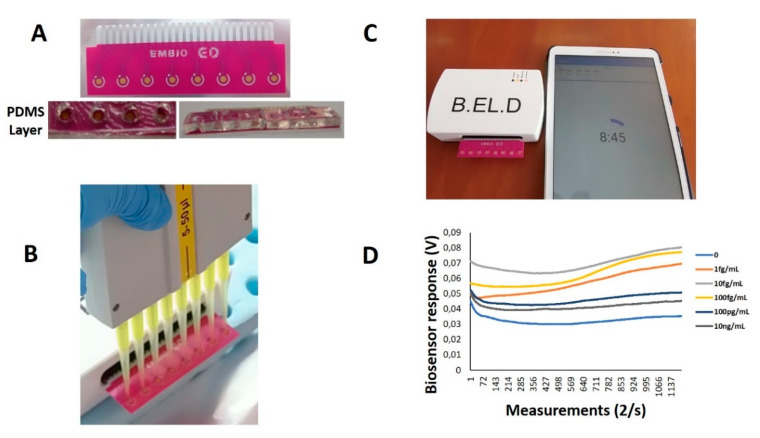
Figure 1
Figure 1
Experimental set-up of the Vero/anti-S1 cell-based biosensor’s assembly. An eight-channel gold screen-printed electrode assembly was prepared with the PDMS layer attached for the well formation (A). The potentiometer device is connected to a tablet device for the recording of the measurements immediately after the sample application (B,C). The electric signal is visualized through a voltage vs. time graph (D).
Figure 2
Figure 2
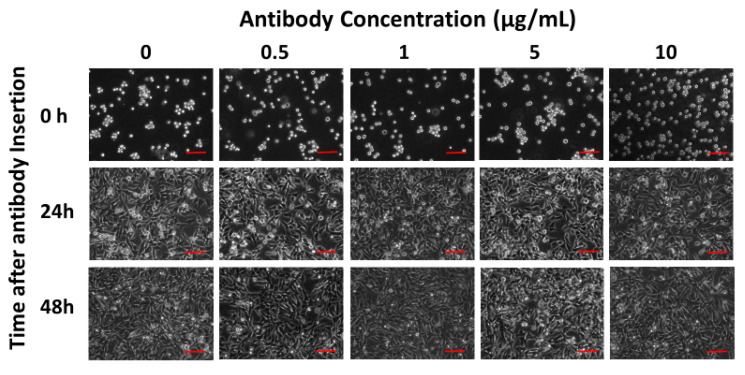
Morphological changes in the Vero cells 0, 24 and 48 h after electroinsertion of 0, 0.5, 1, 5 and 10 μg/mL of SARS-CoV-2 Spike S1 antibody. Scale bars = 50 μm.
Figure 3
Figure 3
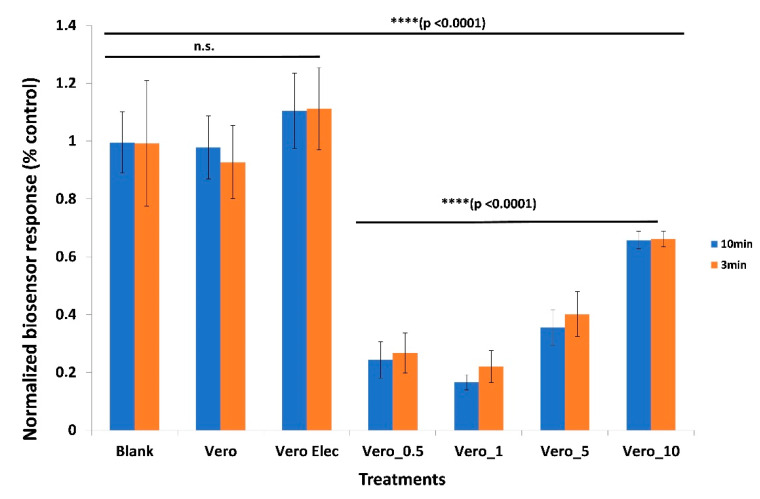
Distinct response of Vero/anti-S1 cells membrane-engineered with human chimeric antibodies (Vero_) against the SARS-CoV-2 spike S1 protein compared with the response of non-electroporated Vero cells (Vero) or electroporated but not antibody-engineered cells (Vero Elec). Cells were membrane-engineered with different antibody concentrations (Vero_0.5:0.5 μg/mL; Vero_1:1 μg/mL; Vero_5:5 μg/mL; Vero_10:10 μg/mL). Blank: response of the S1 protein solution added to cell-free electrodes. Results are presented after three (red columns) or ten minutes (blue columns) of sample–cell interaction. ****: statistically significant different results (p < 0.0001); n.s.: non-statistically significant different results. Results are expressed as normalized biosensor responses (% blank = control) (n = 24).
Figure 4
Figure 4
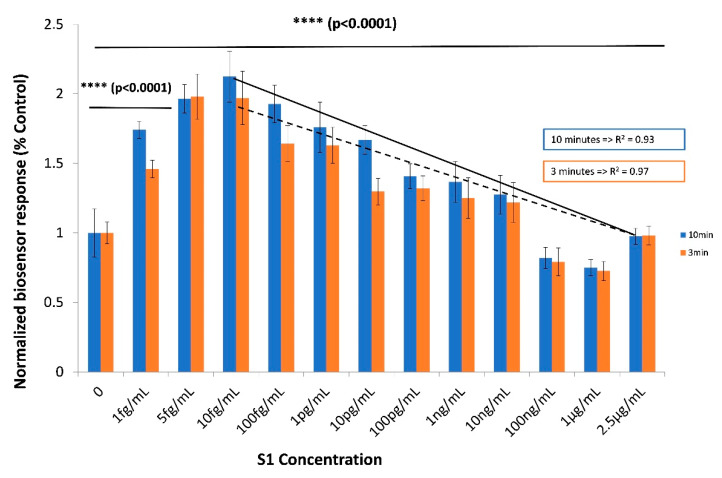
Concentration-dependent biosensor responses against the SARS-CoV-2 spike S1 protein. Vero/anti-S1 cells membrane-engineered with 0.5 μg/mL of human chimeric antibodies were used as the biorecognition element. Results are presented after three (red columns) or ten minutes (blue columns) of sample–cell interaction. ****: statistically significant different results (p < 0.0001). Results are expressed as normalized biosensor responses (% control) (n = 24).
Figure 5
Figure 5
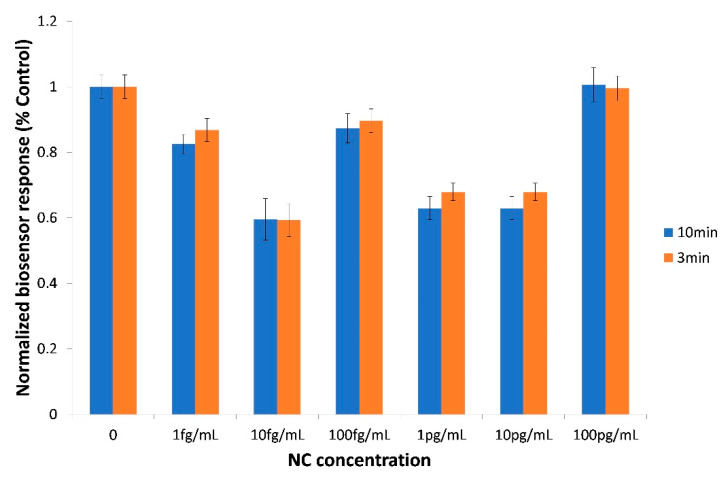
Biosensor cross-response against the SARS-CoV-2 nucleocapsid (NC) protein in the 1fg/mL–100 pg/mL concentration range. Vero/anti-S1 cells membrane-engineered with 0.5 μg/mL of human chimeric antibodies were used as the biorecognition element. Results are presented after three (red columns) or ten minutes (blue columns) of sample–cell interaction. Results are expressed as normalized biosensor responses (% control) (n = 24).

References

    1. Li H., Liu S.M., Yu X.H., Tang S.L., Tang C.K. Coronavirus disease 2019 (COVID-19): Current status and future perspectives. Int. J. Antimicrob. Agents. 2020;29:105951. doi: 10.1016/j.ijantimicag.2020.105951. - DOI - PMC - PubMed
    1. Sheridan C. Fast, portable tests come online to curb coronavirus pandemic. Nat. Biotech. 2020 doi: 10.1038/d41587-020-00010-2. - DOI - PubMed
    1. Broughton J.P., Deng X., Yu G., Fasching C.L., Singh J., Streithorst J., Granados A., Gonzalez A.S., Zorn K., Gopez A., et al. Rapid Detection of 2019 Novel Coronavirus SARS-CoV-2 Using a CRISPR-based DETECTR Lateral Flow Assay. medRxiv. 2020 doi: 10.1101/2020.03.06.20032334. - DOI
    1. Qiu M., Shi Y., Guo Z., Chen Z., He R., Chen R., Zhou D., Dai E., Wang X., Si B., et al. Antibody responses to individual proteins of SARS coronavirus and their neutralization activities. Microbes Infect. 2005;5–6:882–889. doi: 10.1016/j.micinf.2005.02.006. - DOI - PMC - PubMed
    1. Tortorici M.A., Veesler D. Structural insights into coronavirus entry. Adv. Virus Res. 2019;105:93–116. doi: 10.1016/bs.aivir.2019.08.002. - DOI - PMC - PubMed

MeSH terms

LinkOut - more resources